

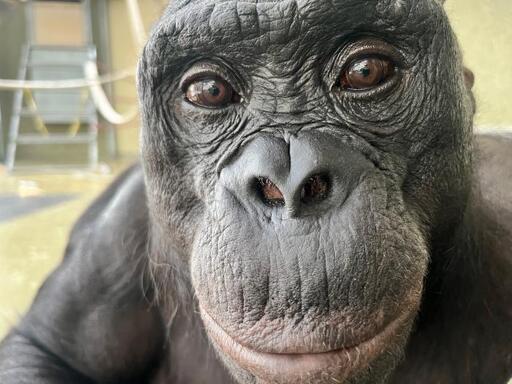
Imagine you’re at a tea party with a bonobo. What kind of tea are you serving? Are there cakes? What is the bonobo wearing? Is the ability to imagine things unique to humans? According to new evidence from Johns Hopkins University, it is not. A study published in the journal Science in February found that a bonobo named Kanzi could identify and track pretend objects across a series of controlled experiments. This is the first time imagination has been demonstrated in a nonhuman animal under scientific conditions. The findings suggest that the cognitive machinery underlying imagination may date back 6 to 9 million years to the common ancestor shared by humans and other great apes. “It really is game-changing that their mental lives go beyond the here and now,” said co-author Christopher Krupenye, an assistant professor in the Department of Psychological and Brain Sciences at Johns Hopkins, in a press release. “Imagination has long been seen as a critical element of what it is to be human but the idea that it may not be exclusive to our species is really transformative.” Kanzi, a 43-year-old bonobo living in captivity at Ape Initiative taught scientists about the bonobo mind. Photo courtesy of Ape Initiative. Kanzi, a 43-year-old bonobo who lived at Ape Initiative, a nonprofit research center in Des Moines, Iowa, had been raised in a captivity and trained to communicate using more than 300 lexigrams (symbols linked to words). He could also respond to spoken English prompts. In the first…This article was originally published on Mongabay
From Conservation news via This RSS Feed.