

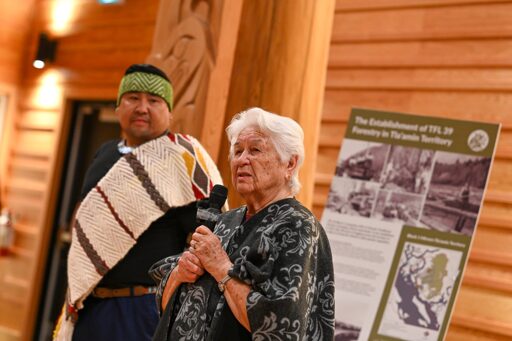

ɬaʔəmen (Tla’amin) Elder Elsie Paul prays during a ceremony to mark her nation’s purchase of Western Forest Products’ tree-farm licence on Feb. 19 . Photo courtesy Tla’amin Nation
Tla’amin Nation is set to take back control over a large piece of its territory, after signing a deal to take over a company’s licence to log more than 1,540 square kilometres of forest in their homelands.
The nation agreed to buy the tree-farm license for the massive parcel — about 13 times larger than the City of Vancouver — from Western Forest Products for $80 million on Feb. 19.
The license for the Stillwater Forest Operation covers a vast majority of forest in the qathet (Powell River) area, where Tla’amin is located.
The lands themselves are not being returned to Tla’amin; tree-farm licenses are granted by the “B.C.” government to allow companies to harvest on “Crown” lands, typically over 25-year terms.
But Tla’amin Hegus (Chief) John Hackett said the ability to steward his people’s land is a major step forward.
“This acquisition brings another 43 per cent of Tla’amin territory back under our stewardship and control,” Hackett said in a statement.
“We look forward to reconnecting with this vast part of our territory and managing the lands according to Tla’amin teachings and values and for the benefit of future generations.”

A Tla’amin Nation-owned Thichum Forest Products feller-buncher sorts logs at a cutblock. Photo by Abby Francis
The Tla’amin-owned Qwoqwnes Forestry Holdings signed the deal last month.
The firm says it plans to manage the land under Thichum Forest Products, another company it owns.
“We’re approaching it as an economic opportunity, but also very much like a stewardship opportunity,” said Dillon Johnson, Tla’amin Management Services’ chief financial officer.
He said there’s a “quadruple bottom line” behind the nation’s ambitions — which encompasses economic, environmental, social, and cultural aspects.
“We’re a forestry company, but we’re doing it differently,” Johnson said, “in that we’re not just harvesting … with that sole focus on the profit.
“It’s balancing with demonstrating to the community that we’re here to help too.”

A ɬaʔəmen (Tla’amin) Elder shakes hands with Dillon Johnson, Tla’amin Management Services’ chief financial officer, at the tree-farm licence agreement event on Feb. 19. Photo courtesy Tla’amin Nation
‘Super meaningful to the community’
The social aspect of the “quadruple bottom line” means the management of the forests will prioritize “meaningful employment” for Tla’amin citizens, said Adam Culos, Thichum Forest Products’ general manager.
For example, in mid-December the nation bought a log sorting operation, he said, creating three full-time jobs.
Additionally, as part of the agreement Western Forest Products will provide Tla’amin enough lumber to build 50 two-bedroom homes on the nation, as well as a log big enough to build a canoe.
“The tenure is primarily second-growth and it’s been challenging locating and harvesting a cedar canoe log,” Culos said.
“But it’s super meaningful to the community.”
The First Nation-owned company also tries to use all parts of the trees it harvests, he explained.
For example, their cedar bark is given to community members for cultural activities such as cedar weaving, as well as wood for paddle-carving.

A Thichum Forest Products truck dumps logs at the nation’s sorting operation. Photo by Abby Francis
The nation plans to develop its own processing plant for raw logs, lumber and wood waste to create secondary products.
Thichum Forest Products follows Tla’amin’s 300-year Forest Resource Plan.
That long-term document prioritizes protecting sensitive ecosystems, archaeological and ceremonial sites, and culturally important trees such as taχamay (western redcedar).
The plan is rooted in taʔow, or teachings, of the ɬaʔəmen (Tla’amin) people.
“Stewardship takes patience and long-term thinking,” Hackett said in a statement.
“Through our 300-year Tla’amin Forest Resource Plan, we will guide these lands using our taʔow, making decisions not just for today, but for the generations who will follow us.”

A Western Forest Products map shows the forest area included in the tree-farm licence it recently sold to Tla’amin Nation. Image courtesy Western Forest Products
‘We’re betting on ourselves’
Another important part of the transaction is to reinvest forestry earnings into the local community, Johnson said.
“We’re betting on ourselves on this one,” he said. “We can’t wait around; we’re a modern treaty nation, a self-governing nation.
“Our long term self-sufficiency, security and stability relies on our ability to generate … and lead our own economy, and this is a big step in that direction.”
Although the nation has a lot of work to do in the coming months, Johnson believes acquiring the tree-farm license is a big step forward in “building a strong leadership role in forestry.”
And he said the project is guided by the idea that if you want to build wealth, you need to invest in your own strengths — and to keep that wealth, diversify.
“That’s what we’re doing here,” he said.
“We want to build wealth, build some prosperity … But if you want to maintain wealth, diversify — and so that’s the next step.”
Johnson acknowledged the territories included in the deal are shared with other communities, most notably shíshálh Nation.
“We look forward to working with them,” he said, “and with our sister nations.”

Western Forest Products president Steven Hofer (left) and Tla’amin Nation Hegus (Chief) John Hackett sign an agreement for the First Nation to buy the company’s tree-farm licence on Feb. 19. Photo courtesy Tla’amin Nation
‘Buy the whole thing’
The deal with Western Forest Products has been in negotiations for some time, according to Johnson.
He said, for multiple generations, ɬaʔəmen people would “just see the logging trucks go by” as trees were harvested from their territory “and we had absolutely no say or way to participate.”
Johnson said the nation started out by partnering with forestry companies in their homeland. At first, they negotiated to have Tla’amin become a minority partner.
“As we went down that path … we kind of started to look at it a little differently,” he said.
Eventually a bolder idea emerged, he recalled: to “buy the whole thing.”
Over the course of two years, Johnson said the First Nation and the company went “back and forth” hammering out the agreement.
That included what he recalled were “many long nights” with lawyers to comb out the details.
Steven Hofer, Western Forest Products’ president and CEO, said the company aims to forge “relationships that align our business needs with the stewardship and economic development aspirations of Indigenous communities,” according to a statement.
“We look forward to working with Tla’amin Nation and Qwoqwnes,” Hofer said, “as we proceed with this new phase of our relationship.”

ɬaʔəmen (Tla’amin) drummers open a ceremony on Feb. 19 to mark their nation’s purchase of Western Forest Products’ tree-farm licence. Photo courtesy Tla’amin Nation
‘A generational opportunity’
Although the agreement is now signed, Culos said the final transaction will take about four to six months.
First the signatories must create procedures, and work through the transfer process with the province.
“In the long term, we have the forest resource plan that looks at forestry from a 300-year perspective, from a ɬaʔəmen perspective,” he explained.
“So we start integrating those values into like stewardship plans on how we manage the forest in a big picture.”
For Culos, regaining tenure to the forests brings excitement for the future.
“It’s definitely a long-term vision, and we will do it the right way,” he said.
“It means everything for the nation: it’s a generational opportunity, it supports long-term success, and we’re doing it through investment in their businesses … That sustains the future of the community.”
Johnson shares his excitement for the deal’s impact on future generations.
And thanks to the long-term vision behind the move, he imagines Tla’amin Nation’s future leaders in 25 years having “more options” available.
“I see the potential of this for my kids and my future grandkids and all my nieces and cousins who are younger than me,” he shared. “This is really for them.
“I think our ancestors would be proud this work happened and this step is being made to reclaim the territory.”
The post Tla’amin set to reclaim forest stewardship with $80M logging licence deal: ‘A generational opportunity’ appeared first on Indiginews.
From Indiginews via This RSS Feed.