

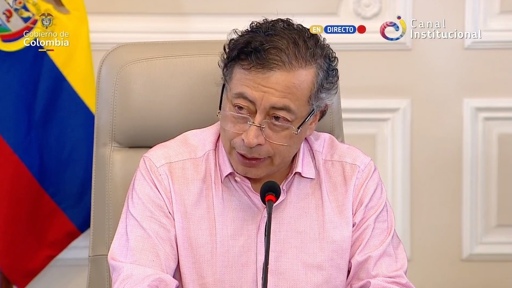
On March 17, in a statement to the media, Colombian President Gustavo Petro denounced that there have been bombings on the Colombian-Ecuadorian border coming from Ecuador: “A bomb dropped from an airplane has been found on the border with Ecuador, confirming my suspicion – though further investigation is still needed – that we are being bombed from Ecuador and that it is not the work of irregular armed groups.”
In addition, Petro said there have been several explosions and that there is a recording that should be made public. “I spoke with Trump and with the president of Ecuador … because we don’t want to go to war … We have no reason to be bombed. National sovereignty must be respected. The investigation is ongoing. We have to make the necessary decisions.”
The reaction from Ecuador was immediate. President Daniel Noboa wrote on X: “Today, with the support of the international community, we continue this fight, bombing the hideouts used by these groups – most of whom are Colombian and whom your own government allowed to infiltrate our country due to lax border security. President Petro, your statements are false; we are acting on our territory, not yours.”
Furthermore, Noboa said: “We will not back down. Meanwhile, in Colombia, they are giving space to the family of Fito [leader of a criminal gang], who crossed into the country in the middle of a national curfew, coincidentally at the same time as former candidate Luisa González. We will continue to clean up and lift up Ecuador.”
The trade and security conflict
There is currently a trade dispute between Ecuador and Colombia, two neighboring countries. Several weeks ago, Ecuador announced a 50% increase in tariffs on products from Colombia. A week ago, Colombia responded in kind, raising tariffs on Ecuadorian products by 50%.
This impasse has caused serious problems for border communities that depend on trade between the two countries. Noboa argues that the decision was in response to Colombia’s failure to actively secure its borders, through which a massive amount of cocaine enters the country, that is then transported through Ecuador, and exits via its ports to the United States and Europe – the world’s leading cocaine consumers.
Furthermore, Noboa asserts that there is a trade imbalance that has historically favored Colombia over Ecuadorian businesses. There have already been several requests to lift the measure from merchants in both countries. On the Colombian side, transporters, merchants, and workers have blocked the Rumichaca Bridge – the main border crossing between Ecuador and Colombia – for several days.
A dispute over responsibility
Several analysts have stated that following the Peace Accords signed in 2016 between the Colombian government and the Revolutionary Armed Forces of Colombia (FARC), a large part of southern Colombia began to be used by cocaine trafficking groups to transport their unfiltered product through Ecuador and use its ports to export the illegal substance. This is believed to have been one of the causes of the increase in disputes among criminal gangs in Ecuador – allied with international cartels – over control of trade routes, which has triggered the most severe security crisis in Ecuador’s history.
Petro, on the other hand, has said that the reason the cocaine export business has shifted to Ecuador – despite Colombia being the world’s leading cocaine producer – is that Colombian forces have improved and better secured their ports, while Ecuador has failed to do so. Noboa, for his part, is demanding that Colombia increase its presence along its southern border to prevent cocaine from entering through that route and to curb the other major illicit trade: illegal mining.
Several weeks ago, Quito announced that it would launch armed operations – with the support of US military and police forces – to dismantle drug trafficking and illegal mining gangs. To this end, it has imposed a curfew in several provinces across the country where drug trafficking groups are most powerful.
At the same time, the Ecuadorian Army has launched a series of airstrikes in various parts of the country, including in the northern provinces bordering Colombia, targeting drug trafficking and illegal mining groups that, according to the Ecuadorian government, move freely between the two countries to carry out their criminal activities. In the south of the country, according to the government, at least 129 illegal mining camps have been destroyed in Podocarpus National Park in the province of Zamora Chinchipe, which borders Peru, the world’s second-largest cocaine producer.
A historic conflict of varying intensity
Ecuador and Colombia were once part of the same country, known as Gran Colombia, which also included present-day Venezuela and Panama. Gran Colombia, formed under the leadership of Simón Bolívar during the War of Independence from Spain in the early 19th century, was divided into three countries due to differences among elites.
After that, border disputes were not always resolved amicably. Although Ecuador and Colombia did not engage in a prolonged armed conflict, as Ecuador did with Peru, wars did occur. The first took place in 1832, a few years after Ecuador’s separation from Gran Colombia, over control of the territories of Pasto, Popayán, and Buenaventura. The conflict was resolved in 1859 following the signing of the Treaty of Bogotá, which demarcated the borders.
There was also a war between 1862 and 1863, during the Colombian Civil War between Conservatives and Liberals, in which Ecuador’s then-president, the Conservative Gabriel García Moreno, faced off against Colombian troops in the north of the country. After several battles, the Colombian Liberal army defeated the Ecuadorian forces. A peace treaty was signed a few weeks later.
During the 20th century, both countries lived in relative harmony, though not without some political disagreements. Many Ecuadorian and Colombian politicians sought refuge in the neighboring country when they were being persecuted by their own government, which sometimes led to diplomatic disputes.
However, during the late 20th and early 21st centuries, the so-called Plan Colombia began to take shape. The project, sponsored by Washington, sought to destroy Colombian guerrilla forces and secure control over Colombian territory. After several attempts, many right-wing Colombian politicians were unable to convince successive Ecuadorian governments to participate in the armed conflict.
However, the conflict reached Ecuador when, on March 1, 2008, the Colombian government of the far-right Álvaro Uribe bombed Ecuadorian territory without permission from Ecuadorian authorities. The attack killed 20 Colombians – including several FARC leaders – and four Mexican students who were spending the night in an unauthorized camp.
The bombing led to the severing of diplomatic relations between the two countries and a vehement protest by the Ecuadorian government, then led by the progressive Rafael Correa. The severing of diplomatic relations lasted until 2010.
To this history of friendship and acute, deep-seated differences, we must now add the current dispute between Colombia and Ecuador. Gustavo Petro has raised concerns over the alleged bombings (without directly attributing them to the Ecuadorian military) while Daniel Noboa has categorically denied any firing into neighboring territory.
However, in general terms, Colombia and Ecuador have maintained peaceful and cordial relations for most of their history, so a conflict of this kind is not expected to escalate into an armed conflict, although the 21st-century world offers few geopolitical certainties.
The post Tensions escalate between Colombia and Ecuador appeared first on Peoples Dispatch.
From Peoples Dispatch via This RSS Feed.