


Richard Arlin WalkerSpecial to ICT
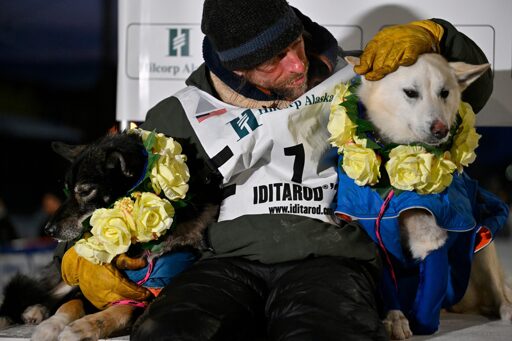
Veteran musher Jessie Holmes of Brushkana, Alaska, won his second consecutive Iditarod Trail Sled Dog Race on Tuesday, March 17, crossing the finish line in Nome at 9:32:51 p.m. local time.
Holmes and his dog team finished the 975-mile race from Anchorage in southcentral Alaska to the rural town on the Bering Sea in nine days, seven hours, 32 minutes and 51 seconds. Travis Beals, who finished sixth in 2025 and 2024, was in position to finish second. Highly accomplished veterans Jeff Deeter, Paige Drobny and Wade Marrs were expected to round out the top 5.

Alaska musher Jessie Holmes arrives first to the finish lane, claiming his second straight Iditarod Trail Sled Dog Race championship, in Nome, Alaska, Tuesday March 17, 2026. Credit: Marc Lester/Anchorage Daily News via AP
Past champion Peter Kaiser, Yup’ik, was in line to finish 10th. It would be his 10th top-10 finish in his Iditarod career. Two months earlier, he won his 10th Kuskokwim 300, widely considered to be the most challenging mid-distance race.
Past champion Ryan Redington, Iñupiaq, was hoping to finish in 11th. Jesse Terry, Anishinaabe, was in 17th and vying for Rookie of the Year. Kevin Hansen, Iñupiaq, was in 21st. Jody Potts-Joseph, Han Gwich’in, dropped out early March 17 in Unalakleet (mile 714), citing the best interest of her dogs.
Holmes’ team maintained an average moving speed of 7.8 mph and had led the race since Finger Lake. Drobny, a multiple top-10 Iditarod finisher who placed third last year, got close but could never catch him.
Holmes rested his dogs for four hours in Finger Lake (mile 123) before the climb to Rainy Pass. He said he gave his dog team 20-minute snack breaks between checkpoints – he said snacking was “putting gas in the tank” – in addition to prolonged rests and feedings at checkpoints and a race-required 24-hour and 8-hour break.
“I feel confident because I’ve been investing in the dog team the whole way and not worrying about what other people do,” he told Iditarod Insider, the race’s online news site, as he snacked his team, wiped frost from their faces and gave each a “good boy” before heading to White Mountain (mile 898).
“It allows me the freedom to do the right thing by the dogs,” he said. “That always manages to put us in a good position.”
Holmes claimed the most special awards of the race: First to McGrath, the one-third mark; first to Cripple, the halfway mark; first to the Yukon; first to Kaltag, the three-quarter mark; first to reach the Bering Sea coast; and first to reach White Mountain, where all mushers and dogs must take an eight-hour rest before continuing on to Safety and then Nome.
Holmes was presented a check for $80,000 for his first-place finish.
For his other firsts, Holmes received a total of $4,500 cash; $5,500 worth of gold nuggets; beaver fur musher’s mitts with beadwork by Loretta Maillelle, Athabascan; a beaver fur hat by Rosalie Egrass, Athabascan; 25 pounds of fresh salmon filets; a carved salmon plaque with a wood-burned mushing scene, by Yup’ik artist Apay’uq Moore; and a carved loon by Iñupiaq artist Mark Tetpon. He was served a gourmet meal at the checkpoint in Ruby for being the first to the Yukon and invited an Iditarod volunteer to dine with him.
Holmes is the 10th musher to win more than one Iditarod. At the finish line, he said he was walking in the footsteps of past repeat champions like Susan Butcher and Lance Mackey. He gave his dog team all the credit.
“The dogs deserve all the recognition and all the glory,” he said. “It’s a blessing to be here with the most amazing dog team. The heart and soul they put into this – that’s what gets me emotional.”
The race was marred by a tragedy: Charley, a four-year-old dog on veteran musher Mille Porsild’s team, died in Elim the morning of March 17. Porsild dropped out of the race. Her dog was flown from the checkpoint for a necropsy to determine cause of death.
It was a challenging race.
Mushers and teams crossed paths with an angry bison. The bison charged Potts-Joseph’s team and turned away after she spoke to it in the Han Gwich’in language – saying words to the effect of “We’re not a threat to you. Have mercy on us and leave us alone.”
IDITAROD 2026: Musher calms angry bison with grandmother’s words in the Han Gwich’in language
Thirty-seven mushers and teams started the race on March 8. Three were Expedition mushers, a new noncompetitive class.
Mushers and teams ascended Rainy Pass, the highest point in the Iditarod; descended Dalzell Gorge; and then traversed Farewell Burn, a treacherous 35-mile stretch known for little snow, frozen tussocks and exposed ground. Mushers Sydnie Bahl and Brenda Mackey sustained damage to their sleds traversing the Burn.
From there, mushers and teams navigated the interior to the Kuskokwim and the Takotna rivers, went north to Ruby and the Yukon River, and then headed west to the icy Bering Sea coast and Nome.
Mushers and teams endured extremely cold weather. Wind chill temperatures as low as minus-50 degrees were reported in low lying areas.
“Mushers say they can’t remember a race when it’s been this cold,” Iditarod Trail Committee writer Terrie Hanke reported on the Iditarod website’s news feed. “It hasn’t been just a little below zero but it’s been significantly below the zero mark.”
By March 17, four mushers had scratched, or dropped out.
The Iditarod Trail Sled Dog Race was founded in 1973 to keep alive the heritage of the Alaska sled dog. Dogs have been an important part of Alaska Native life for millennia, and their endurance was brought to the world’s attention in 1925 when a relay of sled dog teams delivered a life-saving diphtheria serum across Alaska to Nome. The dog sled was a primary mode of transportation in the Alaska interior until the 1950s, when Alaskans were introduced to the snowmachine.

Indigenous musher Jody Potts-Joseph and her dog team placed second in the 2025 Percy DeWolfe Memorial Mail Race, a 185-mile in Dawson City, Yukon, Canada. Potts-Joseph is Han Gwich’in from Eagle Village, Alaska.
Credit: Photo courtesy of Jody Potts-Joseph
Alaska Native mushers were dominant in the early Iditarods — Native mushers won the 1974, 1975 and 1976 races — but Alaska Natives have largely been underrepresented in the annual event. Six Alaska Natives have won the Iditarod in its 54-year history, and six Alaska Native women have competed, with Potts-Joseph the latest.
Potts-Joseph, a standout in the Yukon Quest and Kobuk 440, was at the back of the pack much of the race. Had she finished, she would have received the Red Lantern Award, a symbol of dedication and perseverance presented to the last musher to cross the finish line. Only three Alaska Natives have received it.
The post IDITAROD 2026: Jessie Holmes wins second consecutive Iditarod title appeared first on ICT.
From ICT via This RSS Feed.