


The value of UK “single individual” licences for arms exports in 2024 (the latest full-year figures) increased by 86% to reach a record £9.2bn. Saudi Arabia, Ukraine, Qatar, and the US are the top recipients. These are the findings in a new report from Campaign Against Arms Trade (CAAT).
Campaigners have criticised the close relationship between the UK and US arms industries which the report shows. The US, which bombed seven countries in the twelve months leading up to the beginning of the US-Israeli war on Iran, remains a major recipient of UK arms.
Ever-declining transparency around UK arms exports
The staggering £9.2bn figure still does not cover exports under unlimited “open” licences. CAAT estimates these account for roughly half of all UK arms exports. And for some countries and regions, including the US and West Asia, a substantial majority of exports go through open licences, thus more than doubling the figure.
Moreover, government department UK Defence & Security Exports has not published a separate set of data. This prevents a more complete picture of exports. Concerningly as well, the detail available on export licences declined due to a transition in the government’s online licence application system.
These two issues demonstrate serious deterioration in the transparency of UK arms exports, even as the level of exports appears to rise.
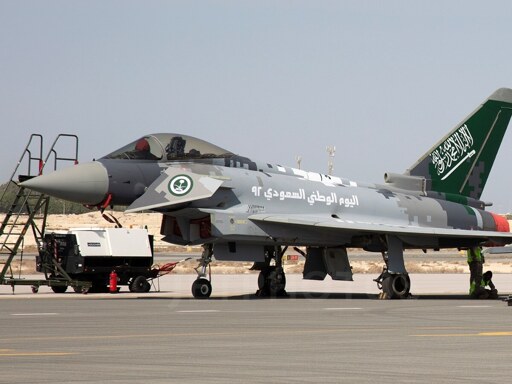
The report discusses how the UK government, along with major arms companies such as BAE Systems, aggressively pursued major new arms export deals. In particular, it targeted sales of the Eurofighter Typhoon combat aircraft to Qatar, Saudi Arabia, and Turkey.
Turkey is engaged in ongoing armed conflict with Kurdish groups in Turkey, Syria, and Iraq. And Saudi Arabia recently used its existing fleet of Eurofighters to cause devastation in Yemen. Turkey signed an £8bn deal with the UK government to buy 20 Eurofighter aircraft in October 2025.
UK arms exports fuelling two genocides
The most important policy question on arms sales facing the newly-elected Labour government in 2024 concerned arms sales to Israel in the face of the ongoing Gaza genocide. Most importantly, there were concerns over the supply of components for the F-35 combat jets. Israel now possesses 48 of these aircraft, 15% of which is made in the UK. Israel has been using its F-35s in so-called “beast mode” to bomb Gaza.
Activists have denounced the government’s moral failings, for suspending only a small number of arms export licences to Israel. And they highlight an exception to the UK’s own arms export criteria which allows the continuing supply of F-35 components to Israel via the US.
The report also draws attention to government failures around the genocidal conflict in Sudan. Both the ruling Sudan Armed Forces regime and the rebel Rapid Support Forces (RSF) have committed atrocities. The RSF stands accused of genocide and the use of starvation as a weapon of war.
The RSF depends heavily on arms supplies from the United Arab Emirates. The UAE is a significant UK arms customer, with £825m worth of arms export licences issued between 2020-24. The UK government took no action to halt arms sales to the UAE. And this was even after receiving evidence from the UN that UK-supplied military equipment to the UAE had been found in the hands of the RSF. In fact, arms export licences to the UAE surged in late 2024.
Report author Dr Sam Perlo-Freeman, CAAT’s research co-ordinator, said:
Taken together, the cases of Israel, Turkey, and the UAE show that the new government has no more interest than the last in centering human rights and international law in its arms trade policies, rather putting the interests of the arms industry front and centre in an unrestrained sales drive.
The decision to jettison the arms export criteria to allow continued F-35 component supplies to Israel, in particular, reveals an export control system that is broken beyond repair.
Further details in the report
As well as discussing these issues, the report:
- Presents detailed data and analysis of export licence data in 2024, showing key trends, major recipients, and an analysis of the declining transparency of the data.
- Analyses the different sources of information on UK arms supplies to Ukraine, including from the House of Commons Library, the government’s Annual Report on Strategic Export Controls, and the Stockholm International Peace Research Institute (SIPRI).
- Presents and discusses SIPRI data on UK exports of “major conventional weapons” which, in contrast to the export licence data, shows UK exports remaining at historically low levels, with few recent deliveries of major platforms such as aircraft and warships. This partly reflects the fact that a large part of UK arms exports involves components, subsystems, and services, not covered by the SIPRI data. However, recent major contracts such as Eurofighter sales to Turkey and warship sales to Norway suggest this measure may also see an increase in the coming years.
Featured image via the Canary
By The Canary
From Canary via This RSS Feed.