

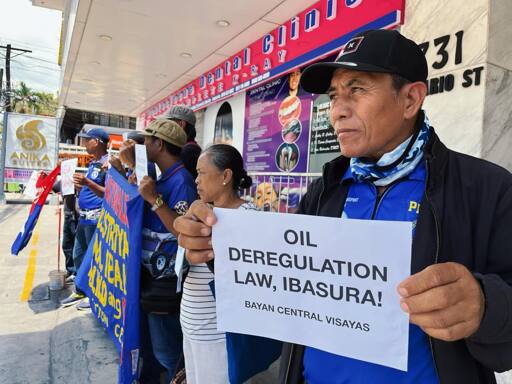
Jeepney drivers and Filipino consumers do not have to be at the mercy of oil companies. The oil industry does not have to be deregulated. Oil prices can be controlled. The government does not have to be useless.
While jeepney drivers, motorists, and commuters in the Philippines bear the full burden of speculative, volatile global oil prices due to oil deregulation, consumers in our ASEAN neighbors are well protected by their governments from the devastating impacts of the ongoing oil shock.
Across the region, pump price trends suggest a stark contrast: while Filipinos are left to absorb soaring costs as diesel edges past P100 per liter, consumers in Indonesia, Malaysia, and Thailand continue to benefit from state regulatory mechanisms and subsidy schemes that their governments maintain amid the escalating conflict in Iran and West Asia.
This week, oil companies implemented another round of mega oil price hikes as global prices continued to soar. The latest round of increases has already raised the price of diesel by P39 per liter to P49 per liter, and the price of gasoline by P22 per liter to P31 per liter since the US and Israel launched their unprovoked war against Iran on February 28.
Comparing domestic pump prices before the US-Israel attack on Iran with today’s prices, the common price of diesel in the National Capital Region (NCR) has already skyrocketed by 80 percent, and gasoline (RON95) by 46 percent.
In contrast, the Indonesian government has fixed the pump price of the state-subsidized Biosolar (diesel mixed with biofuel and sold by the state-owned Pertamina oil company) at IDR6,800 (roughly P24) per liter nationwide before and after the Iran crisis. The non-subsidized Dexlite diesel increased by about seven percent from IDR 13,250 (P47) per liter to IDR 14,200 (P50) per liter. In Malaysia, subsidized diesel in its Sabah and Sarawak states remained at MYR 2.15 (P33) since the Iran crisis. However, its non-subsidized diesel sold in Peninsular Malaysia (which includes the capital Kuala Lumpur) increased by almost 29 percent, from MYR 3.04 (P46) per liter to MYR 3.92 (P60) per liter. In Thailand, the government previously capped diesel at THB 30 (P55) per liter, then approved a new price of THB 33 (P61) per liter starting March 18, an increase of 10 percent.

Meanwhile, the Indonesian government’s Pertamina company is selling its Pertalite gasoline (RON90) at IDR 10,000 (P35) per liter today, about 17 percent lower than its retail price of IDR 12,050 (P42) per liter before the Iran crisis. In Malaysia, the government has kept the price of state-subsidized RON95 gasoline at its pre-Iran crisis level of MYR 1.99 (~P30) per liter to date. However, its non-subsidized RON97 gasoline jumped by 22 percent, from MYR 3.15 (P48) per liter to MYR 3.85 (P59) per liter. The domestic pump price of Gasohol 95 (gasoline blended with biofuel) in Thailand has decreased by 12-15%, from THB 36 (P66) per liter before the Iran crisis to around THB 31-32 (P57-59) per liter today, with Gasohol 95 subsidized through the government’s Oil Fuel Fund to cushion the impact of global price spikes.
Note also how expensive our diesel and gasoline products are compared to those of our ASEAN neighbors. The estimated common price today of diesel in NCR is around P99 per liter compared to Indonesia’s P24 per liter (subsidized diesel) and P50 (non-subsidized diesel); Malaysia’s P33 per liter (subsidized) and P60 per liter (non-subsidized); and Thailand’s P61 per liter. For gasoline (RON95), the estimated common pump price in NCR is around P82 per liter. In Malaysia, subsidized RON95 retails at P30 per liter, and in Thailand, at P57-59 per liter. Aside from the lack of price regulation and state subsidies, petroleum products in the Philippines are more expensive due to onerous taxes. Our value-added tax (VAT) rate of 12 percent on oil products is the highest in ASEAN.
But the bigger culprit is deregulation – a policy imposed on the Philippines by the International Monetary Fund (IMF) through conditional loans – that took away all the necessary policy tools that the government could use today to protect the people and the economy from the global oil shock. Compared with Indonesia, Malaysia, and Thailand, Philippine fuel prices are the most exposed to global price spikes due to deregulation. A set of metrics developed by GlobalPetrolPrices.com on fuel market pricing policies shows that the Philippines has the highest price flexibility (how often the fuel price changes), oil price correlation (how closely the fuel price follows the world oil price), and pass-through (how much a change in global oil price affects fuel prices).

All of these clearly show that regulating oil prices is a policy option always available to the government if it chooses to do so. Pump prices do not have to be “free for all”, contrary to the claim of Energy Secretary Sharon Garin. Jeepney drivers and Filipino consumers do not have to be at the mercy of oil companies and their “generosity” to stagger the mega oil price hikes. The oil industry, given its strategic role in national development and in ensuring a decent standard of living for our people, does not have to be deregulated. Oil prices can be controlled. The government does not have to be useless.
The post ‘Sana oil’| As Filipinos suffer mega oil price hikes, prices barely moved in our ASEAN neighbors appeared first on Bulatlat.
From Bulatlat via This RSS Feed.