

“There is no such thing as ‘apolitical’ reporting. It is always focused on the interest of the people.”
CAGAYAN DE ORO — The campus press community expressed dismay over the situation faced by a Mindanao-based student publication.
Last week, various campus publications and youth organizations expressed solidarity with Primum, student publication of the Davao-based University of Mindanao (UM), after its Facebook page got reportedly deactivated on March 10.
The deactivation allegedly stemmed from Primum’s publication of a literary piece titled Ang Alegorya ng Mananakbo which recounted former president Rodrigo Duterte’s remarks that the presidency is “not a woman’s job” following the announcement of his daughter, Vice President Sara Duterte, to run in the next presidential election.
The school administration allegedly demanded the takedown of this piece.
Primum’s Facebook page, however, was restored on March 14. The following day, it opened applications for writers after the previous editorial board’s “voluntary, individual resignation.”
The Davao chapter of the College Editors Guild of the Philippines (CEGP), an alliance of tertiary student publications, said what happened to Primum reflects a pattern of censorship and administrative interference directed at silencing independent student press.
“If a student publication can be taken over, stripped of its editors, and placed under administrative control, then what remains of a free campus press?” CEGP Davao asked.
Not isolated
What happened to Primum adds to the growing number of attacks and censorship on several campus publications, particularly after releasing political content, including pieces critical of the Dutertes.
Atenews and Crusaders, student publications of Ateneo de Davao University and Xavier University-Ateneo de Cagayan, respectively, were among those that expressed solidarity with Primum.
These Ateneo campus publications were also harassed and red-tagged last year after expressing support for Duterte’s arrest due to alleged crimes against humanity.
The statement was posted by other Ateneo tertiary student publications. But only the two Ateneo student papers based in Mindanao were bombarded with criticisms.
Read:#TheRealDuterteLegacy | Campus press suffers attacks amid COVID-19 pandemic
Aside from Duterte-related content, some student publications were attacked following the conduct of their school-based polls during the 2025 midterm elections whose results did not fit the preference of many. An example was Liceo U Student Press, student publication of Liceo de Cagayan University in Cagayan de Oro where the result of its poll was taken down from its Facebook page. Red-tagging also happened as most of the preferred senatorial candidates were from progressive groups.
The same negative remarks were received by the Crusaders after releasing the results of their midterm elections survey, with almost the same list of preferred senatorial bets. The result, however, was not taken down.
The gubernatorial poll conducted by the Spark, student publication of Camarines Sur Polytechnic Colleges, was also branded as a “fake survey” by then Camarines Sur 2nd District Rep. Luis Raymond Villafuerte. The poll result showed that he was behind his opponent in the voting.
Student publications of two Cagayan State University campuses were also allegedly directed by the school administration to take down their anti-corruption news reports following their Martial Law commemoration coverage last year, allegedly saying that these were “unauthorized.”
Vilification
CEGP Davao Chairperson Catherine Discorson said that the increasing attacks against critical campus publications could be attributed to the “state-sponsored black propaganda,” notably the labeling of independent student press as “communists.”
Read:Students denounce campus militarization
She viewed the existence of the National Task Force to End Local Communist Armed Conflict (NTF-ELCAC) and the Anti-Terror Law as contributory to the relentless attacks.
“As a result, the security and well-being of campus journalists are more at risk,” Discorson said in Filipino, in response to a question raised by Bulatlat. “The state fears the rise of critical students.”
The CEGP documented 206 cases of alleged campus press freedom violations from July 2023 to June 2024. This is apart from the over 1,000 cases from 2010 to 2021. Censorship topped the list, according to the group.
Read:Campus press condemns attempt by police anti-cybercrime to censor UP publication
Other alleged violations included administrative intervention, withholding or looting of funds, non-mandatory collection of publication fees, expulsion or suspension, harassment, libel, red-tagging, and state surveillance.
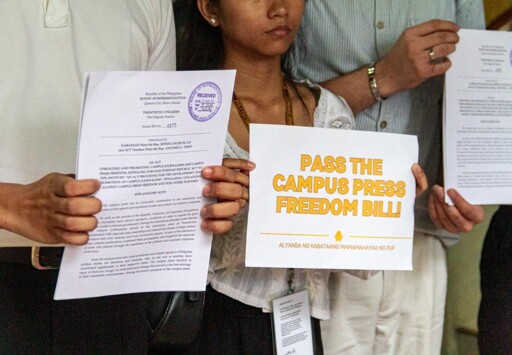
In August 2025, the Makabayan bloc filed House Bill No. 4172 (Campus Press Freedom Act) which seeks to replace the Campus Journalism Act of 1991.
It aims to authorize concerned government agencies to investigate campus press freedom violations and impose administrative sanctions on the violators.
Discorson said that the stance of campus journalists should not only be tied to the experience of the students within their institutions. It should also include their communities where they belong.
“There is no such thing as ‘apolitical’ reporting. It is always focused on the interest of the people,” she said in Filipino. (DAA)
The post Political content led to attacks vs campus press appeared first on Bulatlat.
From Bulatlat via This RSS Feed.
You must log in or # to comment.