

By Cris Fernan Bayaga
Bulatlat.com
CEBU CITY – During mobilizations, the public often sees raised fists and thunderous chants. But beyond the banners are faces like any other, students who attend classes, meet deadlines, and return to their homes at night.
Ordinary in their routines, they become extraordinary only in their refusal to stay silent.
These are young people who stand beside the oppressed and unheard, carrying protest placards with the same hands that hold pens and exam papers.
Yet to the state, they quickly become names to watch. To strangers online, they are reduced to labels.
But beyond the megaphones and the watchful gaze of authorities are students who still return to their families, friends, and academic responsibilities.

Students from various universities across the National Capital Region stage a mobilization for International Students’ Day on November 17, 2025 (Photo courtesy of The Catalyst)
Three of them jokingly call themselves the “Triple B.”
Joaquin Buenaflor serves as chairperson of the University Student Council at the University of the Philippines Diliman. From the Polytechnic University of the Philippines are Tiffany Brillante, national convenor of Youth Rage Against Corruption (YRAC), and student journalist Jacob Baluyot, associate editor of The Catalyst and national chairperson of Alyansa ng Kabataang Mamamahayag ng PUP (AKM-PUP).
The nickname began as a passing vocal stim and stayed when they realized all their surnames begin with the same letter.
Behind the joke are three student leaders who met across schools, organizations, and protest lines, bound by a shared refusal to look away.
The state, however, also kept a close watch.
One by one, subpoenas arrived bearing similar accusations. For authorities, their participation in the student movement was reason enough to place them under scrutiny.

Baluyot (left) and Buenaflor (right) hold placards denouncing state attacks against them during a mobilization in front of the Department of Justice on February 4 (Photo courtesy of Iad Abbu/The Cursor)
Their days move between classes, publication work, organization meetings, and the streets where they join others demanding accountability.
But their paths to activism did not begin in the picket lines.
Childhood days
Baluyot and Buenaflor proudly call themselves “mga batang Tondo.”
They grew up in one of Manila’s most densely populated districts, where narrow alleys double as playgrounds and neighbors know each other by name.
Afternoons were spent in streets where children played beneath tangled electric wires, and sari-sari stores served as gathering points for the community.
In places like Tondo, struggles are rarely hidden. Stories travel quickly. People learn early that survival often depends on one another.
For Baluyot and Buenaflor, growing up there meant understanding how closely lives are intertwined.
Brillante, meanwhile, spent her childhood in Caloocan, where much of her focus revolved around education.
Even at three years old, she had already set high expectations for herself academically, determined to excel in school.
Despite growing up in different communities, the three share a similar story as products of the public education system.
Doing well in school was not simply a personal achievement. It was a shared hope that education might open opportunities beyond what previous generations had known.
But they also witnessed early how unequal that system could be.
Underfunded classrooms, limited resources, and exhausted teachers were part of their everyday reality. Struggle, they said, was almost written into the curriculum of public education.
When they speak today about corruption and injustice, those convictions trace back to these early experiences.
To the crowded neighborhoods, to childhood classrooms, and to communities where people spoke openly about the realities they faced.
Young creatives
Long before they stood in protest lines, the three students were already finding ways to express themselves.
Buenaflor describes himself as a self-taught expert in writing jingle lyrics and choreographing dance routines during high school. Younger students often approached him for help preparing performances.
“My understanding of leadership started out with helping others. It honed my skills and confidence that I can mobilize a community as long as the process is collaborative and people see a leader who is willing to learn with them,” he said.
Creative writing and directing became his way of making sense of the world around him.
Baluyot, meanwhile, found his first passion in dance, particularly traditional and folk dance, which became his main focus during secondary school. He competed in interschool events and performed in formal programs.
But storytelling had already begun earlier.
As a child, he listened closely to conversations among older relatives and turned them into poems and songs. Later, photography became another outlet.
During photowalks around the city, he found himself drawn to everyday scenes, moments between strangers that many people overlooked.

A photo of PUP janitress Cristina Sonico taken by Baluyot as she pauses from cleaning one of the university’s floors (Photo courtesy of Jacob Baluyot)
Even at a young age, Baluyot developed a habit of observing closely.
He tuned in to radio commentaries and watched documentaries by prominent journalists, fascinated by the power of narrative.
This passion eventually led him to journalism and theater, spaces where storytelling could intersect with social realities.
Brillante also discovered storytelling early in life.
She spent both her elementary and high school years as a campus journalist, drawn particularly to opinion writing and radio broadcasting.
“I used to be an opinion writer. It was there that I found the courage to speak on issues that mattered to me through creative writing. It was also how I realized that words can be powerful enough to spark change,” she said.
In these beginnings, they learned that expression is also a way of reaching for others, that a performance can hold struggle, a word can gather people, and a story can make distant realities feel possible.
These allowed them to imagine a different world with others.
The Whys
For Brillante, her political awakening came during the Duterte administration’s handling of the COVID-19 pandemic.
The case of activist Reina Mae Nasino became a turning point.
Nasino, arrested on charges activists say were fabricated, spent her pregnancy inside the Manila City Jail. Amid the pandemic, she was forced to give birth while in detention.
Nasino’s four-month-old daughter was separated from her, and eventually died from complications linked to poor health conditions.

Nasino visits daughter at Manila North Cemetery a day after her release from detention, two years since her daughter passed due to complications. (Photo courtesy of Altermidya)
For Brillante, the case exposed the cruelty of a justice system that often fails those already marginalized.
It also strengthened her conviction that women must continue asserting their voices in political spaces.
Baluyot’s path to activism was shaped by a system that continues to harm families, including his own.
In 2022, his mother was hospitalized at the UP Philippine General Hospital. There, he witnessed the reality faced by many families seeking care in the country’s public health system.

Members of the All U.P. Workers Union – UP Manila/PGH call for a resolutions during 37th founding anniversary on September 23, 2024 (Photo courtesy of Yaghi Parilla/The Manila Collegian)
Relatives of patients slept along corridors and benches, waiting hours, or even days, for consultations, results, or a vacant hospital bed.
Taking care of his mother, he said, often felt like pleading for basic dignity.
When she passed away, the experience left him with a realization that survival becomes fragile when healthcare is treated as a privilege rather than a right.
For Baluyot, the loss was not only personal. It became political.
Buenaflor’s turning point came upon witnessing the neglect towards the education sector.
When the pandemic forced universities into remote learning, he saw how deeply unequal access to education had become.
While some students adjusted to online classes, others struggled with unstable internet connections, shared devices, or homes that were not conducive to studying.
His experience volunteering as a community teacher under Agui-Aral, a program of UP Diliman’s College of Social Sciences and Philosophy (CSSP), made those gaps even more visible.

Buenaflor in striped white polo teaches children in Pook Aguinaldo as part of the Agui-Aral campaign of Rise for Education – CSSP during the pandemic (Photo courtesy of SALiGAN sa CSSP)
Teaching elementary students in Pook Aguinaldo, he encountered children who had already reached higher grade levels but still struggled with basic reading and writing.
For him, these realities made it impossible to separate education from broader social issues.
Activism, they realized, was not simply an abstract political stance. It was a response to conditions they had seen firsthand.
Student leadership
Taking up space became second nature for them. What began as personal experiences with injustice translated into commitment to organizing within their universities and communities.
For the three of them, leadership grew out of the urgency to respond to conditions they could no longer turn a blind eye to and to calls they could no longer ignore.
Baluyot believes journalism plays a crucial role in preserving truth, particularly in times when attempts are made to distort it.
Hence, an attack towards one means that the stories of communities at the margins risk going untold, and the spaces for accountability begin to shrink.
He said, is why defending journalism is inseparable from defending democracy itself.
“To write is already to choose,” he said, emphasizing that journalism can never be completely neutral.
For him, the choice has always been clear, that is to side with the masses.
Brillante said her experience as an opinion writer taught her that ideas can evolve into concrete action.
Joining mass organizations allowed her to move beyond simply writing about issues to actively organizing around them.

Brillante addresses the trumped-up charges filed against student leaders and the continuing budget cuts in PUP during a united press conference on October 8, 2025 (Photo courtesy of The Catalyst)
Buenaflor situates their activism within the longer history of youth movements in the Philippines.
He pointed to the First Quarter Storm, when students played a decisive role in challenging the dictatorship of Ferdinand Marcos Sr.
Ironically, he noted, the same family the youth once fought to remove from power now governs the country again.
“The youth have always played a decisive role in moments when the country stood at a crossroads,” he said.
For Buenaflor, that return to power only underscores why youth activism remains necessary.
History, he said, is not simply a record of past events, it is an ongoing struggle.
He said the challenge for a new generation of student leaders is to confront a political climate where the gains of past movements are at risk of being forgotten.
Anti-Corruption Protest
Three years after Marcos Jr. assumed the presidency, the country again found itself confronting questions of accountability.
Records show that nearly 9,855 flood-control projects were funded nationwide, amounting to more than P500 billion intended to protect communities from flooding.
Government reports claimed that over 5,500 of these projects were completed by 2022.
But when heavy rains arrived, many of those promises seemed to dissolve.
Floodwaters submerged communities across the country, including areas where flood-control systems were supposedly in place.
Investigations revealed that some projects were incomplete, poorly constructed, or ineffective.
Scrutiny soon extended to contractors allegedly linked to government officials and lawmakers accused of inserting questionable projects into the national budget.
For progressive groups, the pattern was difficult to ignore, billions were spent, yet communities continued to drown.
Each storm has since become a cruel reminder that what was promised as protection has turned into hollow concrete.

Lynlie Manghihilot, a resident of Cotcot, Liloan, Cebu, looks over her flooded home after Typhoon Tino hit their community on November 4, 2025 (Photo courtesy of Lynda Katherine Mecaros)
The cement being poured were not for safeguarding communities, but to fatten the pockets of those who approved them.
But months later, despite mounting public outrage and calls for investigation, no official directly implicated in the controversy has been placed behind bars.
The absence of accountability pushed many Filipinos to the streets.
On September 21, thousands marched toward Mendiola demanding accountability in what many had begun calling the flood-control scandal.

Protesters gather along Mendiola Street during the “Bahain ang Luneta to Mendiola” protest mobilization on September 21, 2025 (Photo courtesy of Cris Fernan Bayaga/Lanog)
The protest coincided with the 53rd anniversary of the declaration of Martial Law, a date historically marked by mobilizations against dictatorship and corruption.
Among those present were the three student activists later referred to by supporters as the Triple B.
Buenaflor and Brillante stood among the protesters at the frontlines of the march, while Baluyot documented the mobilization as a student journalist.
For the three students, what began as a day of protest against corruption would soon turn into something far heavier, a confrontation with the very institutions they were critical of.
Filed subpoenas
The knock did not come all at once.
For the three students, it arrived on different days, but in similar forms.
An anxious message from a friend, unfamiliar men waiting outside the house, a document stamped with the authority of the state.
For them, the protest did not end when the placards were lowered.
It followed them home.
The first subpoena arrived on October 7, addressed to Jacob Baluyot, a student journalist, in relation to his coverage of the “Baha sa Luneta Rally” that marched toward Mendiola.
At the time, he was sitting in a photography class when a childhood friend sent him an urgent message: several state forces were outside his house, asking for him.
It was in that moment, Baluyot said, that the weight of the situation began to sink in.
For him, the visit was more than a surprise. It was a realization that his rights as a journalist were being curtailed.
He immediately coordinated with a paralegal team from PUP and lawyers from the National Union of Peoples’ Lawyers (NUPL) to respond to the subpoena.

Baluyot holds a scanned copy of the subpoena issued by the Department of Justice accusing him of sedition and inciting to sedition outside the department on January 15 (Photo courtesy of The Catalyst)
But the document itself raised doubts.
The subpoena cited his alleged involvement in the “Trillion Peso March,” a mobilization entirely different from the protest he had covered.
Baluyot insists he was present at the “Baha sa Luneta Rally,” not the march mentioned in the complaint.
The discrepancy, he said, only deepened his suspicion that the case was part of a broader state-sponsored attack against activists and campus journalists.
The subpoena required him to appear at the PNP-CIDG headquarters in Camp BGen Rafael T. Crame, Quezon City, on October 10.
Baluyot refused to appear in person, arguing that being summoned for interrogation inside police headquarters rather than in court was a form of intimidation and a violation of his rights as a journalist.
Instead, he submitted a written response on October 10, denying allegations that he was among the leaders who organized the march, an event he said he did not even cover.
Months later, the case escalated.
On January 23, the Department of Justice (DOJ) issued another subpoena accusing him of inciting to sedition, part of a broader complaint filed against protesters who participated in the September 21 mobilization.
But during the first scheduled hearing, the lawyer representing the CIDG failed to appear, citing other commitments.
For Baluyot, the absence spoke volumes.
He said the incident only reinforced how hollow and baseless the accusations against him were.
Weeks after Baluyot received his first subpoena, Brillante found herself facing the same ordeal.

Brillante speaks in front of the DOJ to denounce the inciting to sedition charges filed against her during a mobilization on February 4 (Photo courtesy of Fruji Sabello, Jr./The Manila Collegian)
She received a subpoena identical in format, citing the same allegations tied to the September 21 protest.
The document initially came as a shock. But for Brillante, the moment also opened a difficult but necessary conversation with her family about her activism.
She said it became an opportunity to explain why she had joined the protest in the first place.
“It was a chance to explain to my parents that I was not doing it only for myself or even just for our family. I was doing it for many Filipinos who must be heard during times when public trust is betrayed,” she said.
Just days later, another subpoena surfaced.
On October 24, 2025, Buenaflor became the third student to be targeted.

Buenaflor leads a protest action in Philcoa denouncing the subpoena filed by the PNP-CIDG two days earlier, on October 24, 2025 (Photo courtesy of Philippine Collegian)
State forces arrived at their home in a police mobile vehicle, approaching his family to deliver a subpoena accusing him of being one of the leaders of the march.
Buenaflor recalled how the officers made a remark that felt less like official procedure and more like mockery.
They joked that since he was an honor student, the state might as well “give him an award.”
His uncle refused to receive the document, but the officers insisted that Buenaflor must appear on October 27 or face consequences.
Like Baluyot, he refused to appear at police headquarters, believing the summons was another attempt at intimidation.
The accusations struck even closer to home.
Buenaflor is the son of a policeman, yet even his father disagreed with the charges filed against him.
While his family understood that the state has the power to pursue such cases, they remained convinced of his innocence.
They knew him not as a criminal, but as a student standing up for his community.
In Tondo, where Buenaflor grew up, the reaction was far from condemnation, instead, neighbors rallied behind him.
“I consider our whole barangay as my extended family. When they heard about the subpoena, they disagreed with the accusations and said they would support me, because they know I am fighting for their rights as well,” he said.
Their names were included in a single complaint filed against more than 100 individuals, all accused of Inciting to Sedition in connection with the September 21 anti-corruption protest.
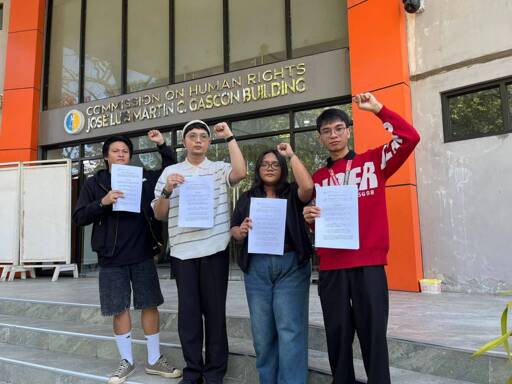
Refusing to be intimidated, the three students brought the issue before the Commission on Human Rights (CHR) on February 23, filing a joint complaint calling for an independent investigation of CIDG’s use of subpoenas as trumped-up charges against them.

The “Triple B,” together with musician Vitrum, file a joint complaint before the CHR against what state-sponsored sedition charges against them on February 23 (Photo courtesy of The Catalyst)
The complaint followed the submission of their counter-affidavit to the Department of Justice on February 4, where they formally contested the allegations.
The subpoenas were meant to intimidate, to turn protest into fear and participation into hesitation.
Yet for them, the experience revealed something else, how deeply their actions had disturbed those in power.
The subpoenas may have placed their names in the files of the state.
But on the streets where they marched, those names have come to represent something harder to suppress, the refusal of the youth to look away while the country submerges in dishonesty.
Pushing On
Challenges meant to intimidate often hope to push people into silence.
But for many who choose to speak out, adversity becomes a turning point that sharpens conviction rather than erasing it.
For the three students who now face state-sponsored attacks, the experience has only strengthened their resolve.
Brillante and Buenaflor both share the dream of becoming lawyers, an aspiration shaped not only by their academic pursuits but also by the realities they continue to endure.
For them, being subpoenaed and accused by the state did not weaken their belief in justice.

Subpoenaed activists together with musician Vitrum and their legal counsel from NUPL, submit their counter-affidavit before the Department of Justice on February 4 (Photo courtesy of The Catalyst)
Instead, it deepened their understanding of the legal system, and the need for advocates willing to stand beside ordinary Filipinos when institutions fail them.
Brillante said the experience reinforced how crucial it is for people to have defenders when the systems meant to protect them are used otherwise.
For her, the youth must learn to dream beyond themselves, and to challenge the expectations that attempt to limit their participation in the movement.
As a woman, she said, speaking up in spaces long dominated by authority is itself an act of resistance.
Young women are often expected to remain silent or cautious, she noted. But for Brillante, continuing to assert her voice despite legal threats is part of breaking those expectations.
Buenaflor’s dream of becoming a lawyer has also taken on deeper meaning.
For him, the law should not remain distant from the communities it claims to protect.
Instead, it must be brought closer to workers, urban poor communities, and students who continue to speak out despite intimidation.
His vision resonates with the UP Diliman University Student Council’s campaign, “Atin ang Bukas” or The Future is Ours, a call for the youth to recognize their role in shaping the country’s direction.
For Buenaflor, it is more than a campaign slogan.
It is a reminder that the future cannot simply be inherited. It must be fought for.
Baluyot, meanwhile, hopes to continue pursuing journalism—determined to document the stories authorities would rather remain unseen.
He said fear, for him, is an invitation to become fiercer and sharper.
He hopes campus journalists will not view his experience through a defeatist lens, but instead as a reminder of the importance of holding the line when it matters most.
For Baluyot, the principle remains simple.
“To write not for the people is nothing,” he said, citing The Catalyst’s dictum.
He said journalism is never neutral because it’s always a choice, and his is to side with the masses.
For these three students, education should not end with personal achievements.

Progressive groups and students together with members of Kilusang Bayan Kontra Kurakot (KBBK), hold a press conference on January 19 ahead of the 40th anniversary of the EDSA People Power Uprising (Photo courtesy of Philippine Collegian)
Diplomas, they believe, should become tools that serve the people.
Inside the picket lines are not only protesters, but young people with ambitions and futures ahead of them.
They are students who understand that their aspirations cannot exist in isolation from the realities of the country they live in.
In the spaces between lectures and protest actions, they continue to choose the same path.
Believing that education must serve the people, and that the future they fight for today is the one they will live in tomorrow. (JDS, RVO)
The post In between the picket lines appeared first on Bulatlat.
From Bulatlat via This RSS Feed.