

President Daniel Noboa’s right-wing government continues to advance its neoliberal political and economic agenda. In recent weeks, Labor Minister Harold Burbano announced that Ministerial Agreement MDT.2026-059 had been approved, allowing for an increase in the workday through agreements that make labor conditions more flexible in Ecuador.
For several decades, following significant struggles by the Ecuadorian labor movement, the maximum workday was set at 8 hours. However, employers have tirelessly sought to undermine that union victory. Thus, the government of Noboa – who belongs to the country’s wealthiest family – has decreed that workdays of up to 10 hours may be implemented.
The government defends the decision by arguing that the market has undergone radical changes and that the measure does not increase the weekly workload (which, according to Minister Burbano, will remain at 40 hours per week), but only the daily workload, and that this can be distributed more flexibly. “This is not a proposal from the far right or the far left, but a pragmatic solution to people’s needs,” Burbano said in a radio interview.
However, some critics of the government argue that the measure paves the way for future increases in the workweek to be implemented without major complications. Furthermore, they have pointed out that the measure makes it easier for employers to avoid paying overtime, which accounts for up to 30% of workers’ income.
Protests against labor flexibilization
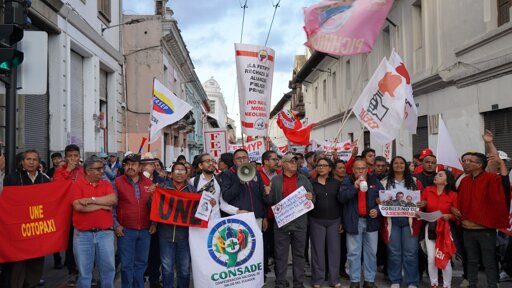
The measure, which, according to the country’s major unions, was not discussed or agreed upon with workers, has caused widespread discontent among labor organizations. Thus, on March 13, a massive march took place in Quito, the capital of Ecuador, demanding the repeal of the ministerial agreement, which, according to union leaders, makes workers’ jobs more precarious and directly undermines their rights.
There were also worker protests in Guayaquil, the country’s most populous city, where demonstrators marched down Nueve de Octubre Avenue to voice their opposition to the Noboa administration. Protests against the executive branch also took place in the Amazon region, with demonstrators demanding the delivery of necessary medicines and medical supplies – an issue that has drawn heavy criticism of the government for its failure to address the critical public health crisis.
Among the organizations that called for the demonstrations were the United Workers’ Front (FUT), the National Union of Educators (UNE), and the Popular Front (FP), among others. Thousands of demonstrators – including workers, students, environmentalists, and others – marched through the streets of downtown Quito chanting slogans such as “Down with labor reform” and “Out with Noboa, out.”
In fact, the demonstration brought together not only workers demanding the repeal of the ministerial agreement, but also various groups and social movements opposed to a series of controversial measures that the Noboa administration has been implementing, such as the Mining and Energy Law, which would allow for the extraction of stone materials in the Galápagos Islands (an ecological reserve) and greater protection for mining companies at the expense of local communities’ interests; as well as hundreds of citizens protesting against a law that requires municipalities to invest 70% of their funds in public works, which would destroy a large number of social, educational, and health projects carried out by municipalities and would lead to mass layoffs.
Read more: Ecuador’s new mining and energy law puts the Galápagos Islands at risk
Regarding the increase in the workweek, FUT President Edwin Bedoya said that Noboa’s decision seeks to benefit employers at the expense of workers’ rights. He also emphasized that “one of the objectives is to lower labor costs for the business sector in order to comply with the International Monetary Fund’s requirements.”
For his part, the country’s top teachers’ union leader, Andrés Quishpe, said that the Noboa administration has shown it has no interest in following the will of the people, after the majority of Ecuadorians rejected at the polls the attempts by Noboa and his economic group to make labor laws more flexible. Thus, Quishpe emphasized that “There is no other way out but to confront Noboa in the streets.”
Labor organizations announced that they will continue to take to the streets to defend the rights they have won.
Repression against workers
Once the demonstration reached Plaza de Santo Domingo in Quito, a heavily armed police contingent fired tear gas and stun grenades at protesters who refused to disperse. The protesters responded by throwing stones and tearing down the barricades that law enforcement had set up on several streets to restrict their movement.
The forcefulness with which the police acted was denounced by several media outlets covering the protest. Among them, Elena Rodríguez of TeleSur posted a video on her X account showing how the mounted police ran over one citizen and beat another: “A man was rammed by police motorcycles; it does not look like an accident, but rather a deliberate action. At the same time, another citizen was being beaten with batons by officers. Under what protocol do they act this way against protesters?”
Following Noboa’s electoral defeat in November 2025 – which blocked his path to the long-awaited Constituent Assembly intended to repeal the 2008 Constitution (which protects civil liberties, upholds sovereignty, and defends the importance of the state in public life) – Noboa has focused on reforming municipal, environmental, mining, energy, and labor laws, among others, through a Parliament that he controls and which, for now, has remained loyal to the president’s agenda.
Read more: The United States announces the start of military operations in Ecuador
Drop in approval ratings
However, the decisions imposed – with little or no dialogue – amid other circumstances such as the public health crisis, the worst security crisis in Ecuador’s history, and the imprisonment of opposition leaders like Guayaquil Mayor Aquiles Álvarez, among others, seem to be creating a sense of unease that is growing little by little as time goes on.
In October 2025, according to some polls, nearly 60% of the population approved of President Noboa’s performance. By February 2026, that approval rating had plummeted to 38%, which, according to the polling firm CIEES, reflects a feeling among Ecuadorians that the government has made too many mistakes and that people cannot identify a notable achievement of Noboa’s right-wing administration. Furthermore, the CIEES study indicates that a widespread sense of pessimism exists among the population, with a prevalence rate of around 72%, one of the highest levels in recent years in the South American country.
The post Ecuadorian workers fight back against 10-hour workday appeared first on Peoples Dispatch.
From Peoples Dispatch via This RSS Feed.