


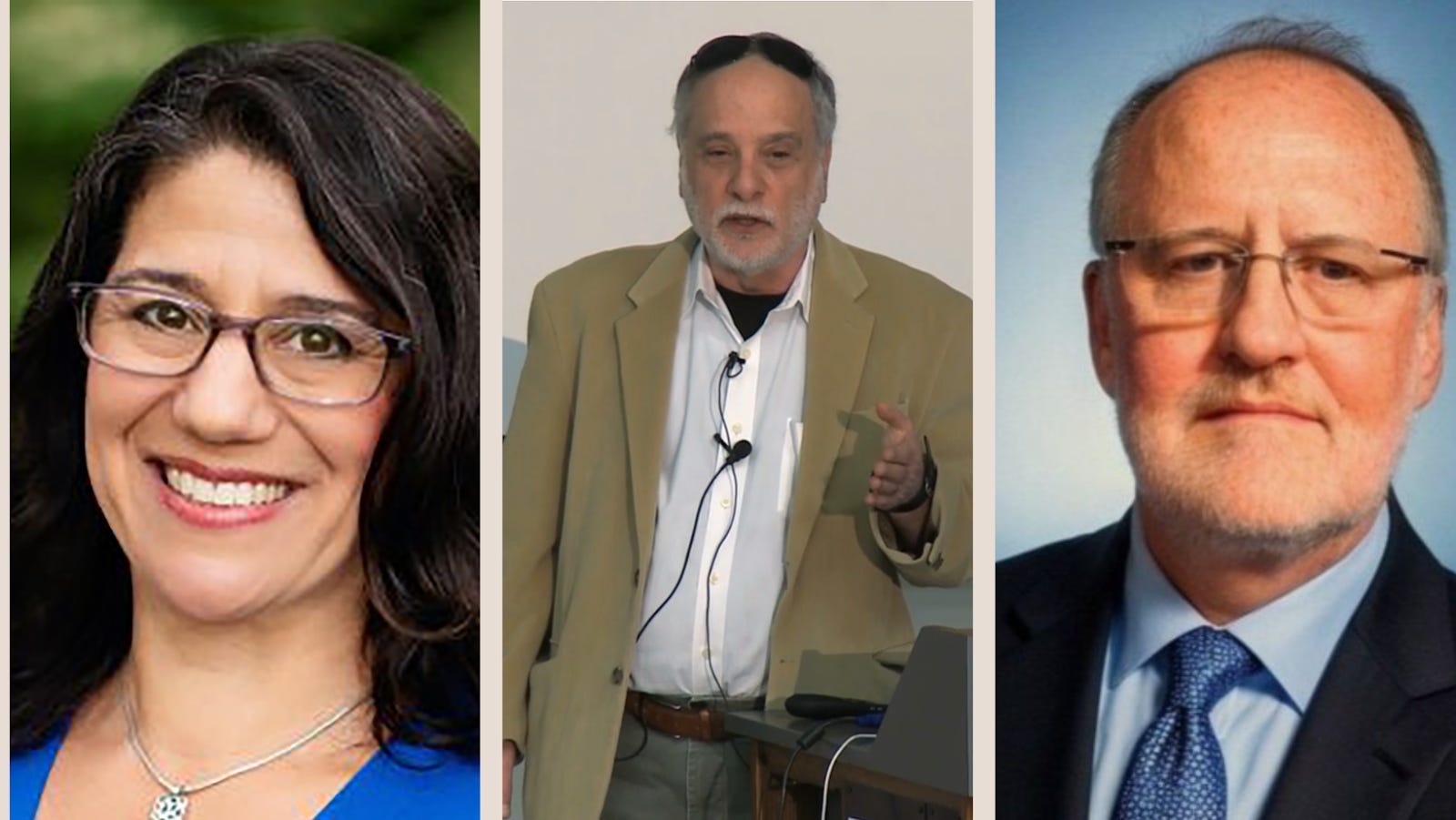
Left: Dr. Lisa Littman, Center: Dr. Kenneth Zucker, Right: J. Michael Bailey
Erin In The Morning is a reader-supported publication. To receive new posts and support my work, consider becoming a free or paid subscriber.
Dr. Lisa Littman self-identified as “pro-LGBT” during her speech at a conference for Genspect—an anti-LGBT hate group, according to the Southern Poverty Law Center. She was the very first presenter on the two-day itinerary for the event held in Albuquerque, New Mexico, in September of last year. Genspect’s founder called Littman “the greatest hero of the movement”—the movement, it seems, against transgender youth.
The topic of Littman’s presentation was AYAGDOS—the Adolescent and Young Adult Gender Dysphoria Outcomes Study. You or your trans child may have stumbled upon ads for the initiative on Reddit, Facebook, Google, X, or Instagram. They’re recruiting people with gender dysphoria between the ages of 13 and 25 who “think” they “might be trans” to participate in a study from Northwestern University, as the ads plastered with the university logo prominently announce.
At first, they targeted demographics more sympathetic to the cause, like users of r/detrans on Reddit. Now they’re expanding to more politically diverse audiences, Littman told the Genspect convention.
But trans community leaders have issued a strong warning against participating. Critics cite the researchers’ long and tumultuous histories with trans research subjects, which are rife with retractions and reported misconduct, as well as ties to organizations designated as hate groups by the Southern Poverty Law Center.
Genspect is just one of those groups, although they ardently reject the hate group label. “The people drawn to Genspect aren’t extremists,” founder Stella O’Malley said of the nearly 300 Albuquerque conference attendees, 40% of whom self-identified as TERFs (anti-trans radical feminists). “We come from all sides, all backgrounds, all belief systems.”
Meanwhile, researchers leading AYAGDOS—Littman, Dr. Kenneth Zucker, and Dr. J. Michael Bailey—have promoted pseudoscientific and pejorative ideas about trans people (such as that trans women are the product of a sexual fetish); relied on controversial methodologies that skew study outcomes; and reportedly used unwitting trans women as “original research” subjects, to name just a few scandals that have plagued one or more of the trio.
Bailey, a principal investigator and tenured Northwestern professor, also allegedly had sex with one such subject and used nonconsensually testimonies from others who had sought out his care as a clinician in his book. Bailey denied allegations of misconduct. He, Littman, and Northwestern spokespersons did not reply to requests for comment.
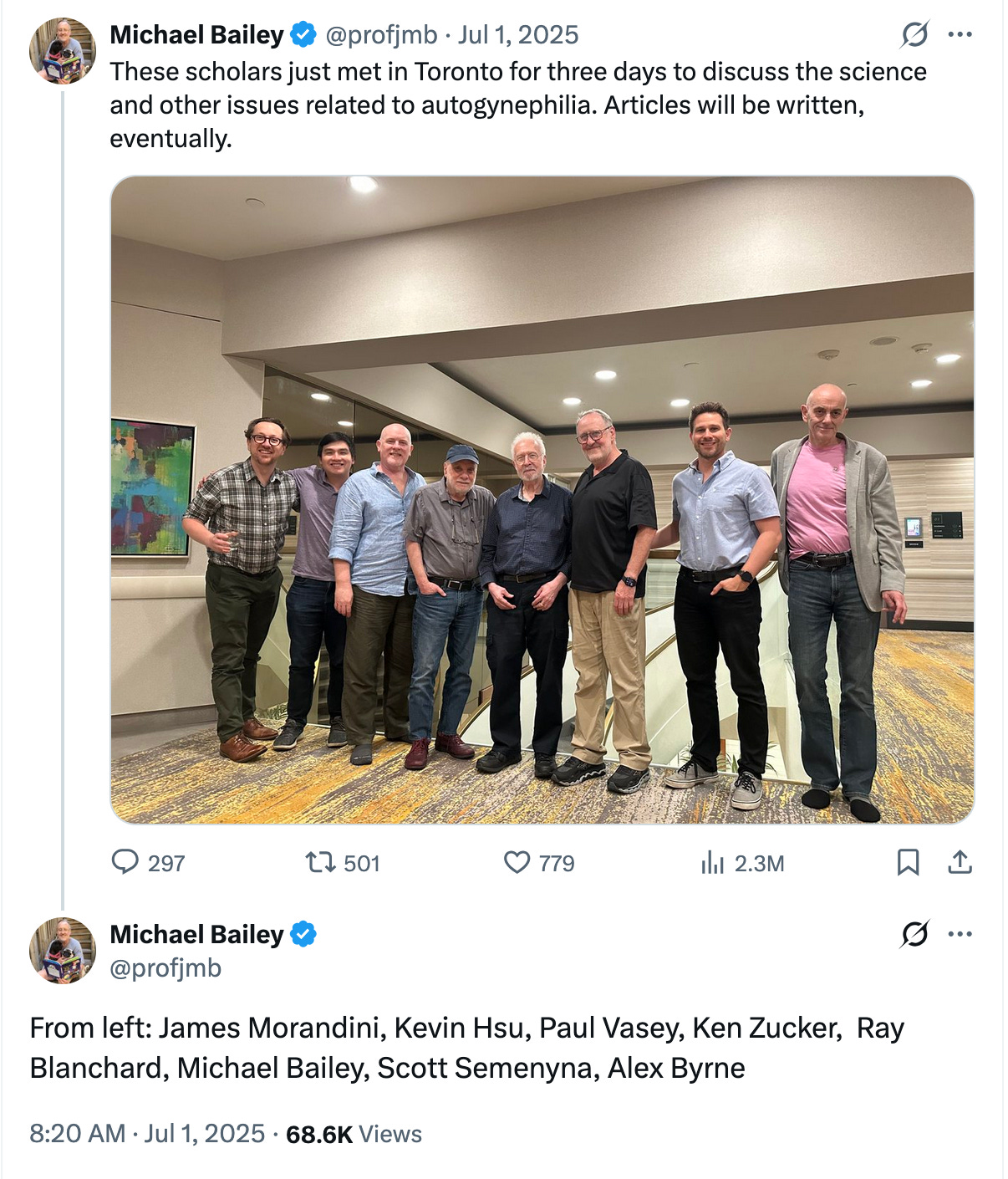
Caption: An X post showing AYAGDOS investigators Dr. J. Michael Bailey and Dr. Kenneth Zucker alongside other academics promoting the “autogynephilia” movement, which seeks to pathologize trans women’s gender identity as a fetish. Post via @ProfJMB on X.
Although the AYAGDOS ads are newly making the rounds, the beginnings of the study emerged in 2018, when Littman published a now-notorious paper on “Rapid Onset Gender Dysphoria,” also known as ROGD. The paper plucked the term from the backwaters of anti-trans internet forums, launching it into the mainstream. The new name gave credence to classic moral panics about the “social contagion” of queerness with a modern, scientific-sounding spin.
Mere weeks after the ROGD paper went live, the journal had to republish it with corrections to the title, abstract, introduction, discussion, and conclusion sections. But the damage was already done.
ROGD is “a pseudoscientific phrase made popular by Dr. Lisa Littman and others that is used to legitimize the claims of anti-LGBTQ+ activists and parents who rejected their trans kids,” as per the Southern Poverty Law Center. Over 60 psychological organizations condemned the concept, saying in a joint statement that “the proliferation of misinformation regarding ROGD is also infiltrating policy decisions.”
At the time that letter was penned, there were 100 bills under consideration across the country that sought to limit the rights of transgender young people, many of which “were predicated on the unsupported claims advanced by ROGD,” the letter said. That was in 2021—the number has only increased.
But for Dr. Kenneth Zucker, a psychologist who now works in private practice, Littman’s paper on ROGD was an inspiration. He told Erin in the Morning that, after reading it, he pitched the concept of AYAGDOS to Bailey at Northwestern. Littman was brought onto the project later.
As for Bailey, in 2023, his own survey on “ROGD” was retracted from Springer Nature for failing to obtain ethics approval from an Institutional Review Board (IRB), purportedly ignoring data that challenged ROGD, and violating principles of informed consent.
This time around, Zucker told Erin in the Morning, researchers behind AYAGDOS are going through Northwestern’s IRB and are at least attempting to incorporate the input of actual trans people living with gender dysphoria. (None of the lead researchers themselves are transgender.)
“One of the criticisms of Littman was that Littman only collected information from parents, and, obviously, in developmental, clinical psychology and psychiatry, using multiple ‘informants’ as they’re called, is a pretty standard practice,” Zucker said. “A better study, looking at different facets of gender dysphoria, would involve collecting information from both parents and youth.”
Zucker, too, is no stranger to controversy—his studies back in the 1990s on the “attractiveness” of gender variant children have been the source of great ostracization, as was his handling of youth at Toronto’s Centre for Addiction and Mental Health, where he was a pediatric gender specialist for years. There, he deployed what some have compared to conversion therapy on trans and gender nonconforming youth—including instructing parents to confiscate “feminine” objects like dolls and dresses from children assigned male at birth. (He vehemently denies his work was conversion therapy.)
Zucker remains adamant that AYAGDOS is motivated by the pursuit of free inquiry, reducing suffering, and sound science, not ideological values about gender. He said the Southern Poverty Law Center’s hate group classification of organizations like Genspect was “politically and intellectually unwarranted,” and that the Southern Poverty Law Center is “stupid” and “wrong.”
“Our goal as clinicians is that we want people to get to a certain point that they’re comfortable with, and they don’t regret where they’ve landed,” he said, emphasizing that he thinks many of these youth could regret undergoing medical transition later on down the line.
Erin in the Morning asked how he might address the opposite: the overwhelming majority of trans youth who are so encumbered by a lack of familial support, by institutional barriers, and by anti-trans laws that prohibit gender-affirming medicine, that they can’t access or lose access to care. Young people who grow up and undergo the drawn-out process of puberty for a gender at fundamental odds with who they are. Who, as adults, have to seek out extensive medical interventions, including surgeries, to undo the physical changes they were forced through as minors, because they were denied access to gender-affirming care.
“Sure,” Zucker said. “All of those things are important.”
Erin In The Morning is a reader-supported publication. To receive new posts and support my work, consider becoming a subscriber.
From Erin In The Morning via This RSS Feed.