


Amelia Schafer
ICT
Today’s Illinois primary has the potential to reshape politics, and the democratic party as a whole, for decades to come, with five open congressional seats and one open senate seat.
Among the dozens of candidates is one Indigenous person, Anthony Tamez, Sicangu Lakota, Oji-Cree and Black who is running as a democrat against incumbent Mike Quigley for Illinois fifth congressional district seat.
Illinois is home to upwards of 280,000 Indigenous people according to the Chicago American Indian Community Collaborative. This number includes Alaska Natives American Indian, Pacific Islanders and citizens of South American tribal communities. With just over 2 percent of the Illinois population, Indigenous people and their votes could play a key role in these elections.
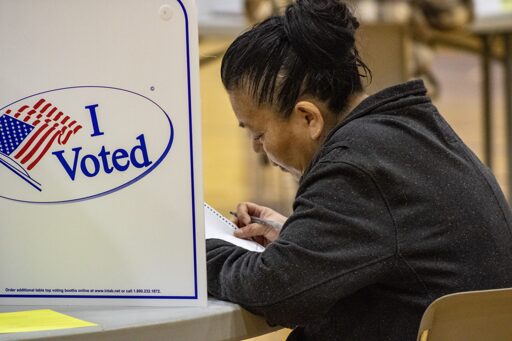
In Chicago, which is home to a majority of the state’s Indigenous population and one of the nation’s largest American Indian/Alaska Native populations, voters said they’re looking for candidates who care about Indigenous issues.
“It’s been an uphill battle for us over these past number of years, for our legislators, to truly recognize the Indigenous populations,” said Andrew Johnson, citizen of the Cherokee Nation and the head of the Chicago American Indian Community Collaborative’s political advocacy committee.
The Chicago American Indian Community Collaborative (CAICC) is a network of 17 Native American organizations and programs formed in 2012 to improve conditions for urban Native Americans in the Chicagoland area.
Johnson said what he is hoping for in a candidate is someone who is better at communication with the community when it comes to accessing funding for Indigenous organizations and tribal members living in urban areas.
With no federally recognized tribes headquartered in Illinois, Johnson said urban Natives commonly run into issues accessing programs or critical protections like the utilization of the Indian Child Welfare Act, a federal law which sets standards for the removal of Indian children from their families and ensuring they’re placed in adoptive homes that reflect their culture.
“We need more folks behind us to ensure that these laws are enforced and followed,” Johnson said.
On March 10, CAICC held a non-partisan ballot educational event to help voters understand who is on the ballot, what issues the candidates support and where to vote. Johnson said the event was well attended.
The event was also a way to gather information on what issues are important to Indigenous voters, said Pamela Silas, Menominee and Oneida and the Chair of Visionary Ventures, a group that works to promote affordable housing and economic development among the city’s Urban Indigenous population through CAICC.
For many Indigenous voters, access to affordable housing was a key issue of concern, Silas said.
Roughly 62 percent of Urban Native community members in Chicago are renters, according to data from the University of Illinois Chicago. The population has a median household income of $32,000, a stark difference compared to the regional average of $75,000 to $80,000 and a 14 percent unemployment rate, which is double the rate of white residents in the area.
“Having a place to live is core to any other economic efforts that families put in, whether it’s education or employment,” Silas said.
Silas said she’s looking for a candidate that understands affordability and issues the Native community faces when it comes to accessing housing.
“We’re not new to Chicago, some of us have been here for four generations,” Silas said. “We’re part of its fabric, and we want some understanding.”
Silas, who voted on March 17, said candidates need to understand what tribal sovereignty is and what it means.
Last year, CAICC helped pass a bill requiring Native American history to be taught in Illinois public schools. But the bill is underfunded, Silas said, making it difficult to actually carry out.
“We are looking for the kind of candidates that will support that now with some monetary support,” she said. “We know we’ve got to provide support for the teachers, for professional development for them and for resources that actually support the policy.”
Once a year, CAICC conducts a Native American Summit in Springfield, Illinois at the state’s capitol building. During the summit, community leaders meet with their elected representatives and the governor’s office to discuss issues facing the community. While the meetings have been well received by Illinois Governor J.B. Pritzker (D) who is running unopposed for a third term and Lt. Governor Juliana Stratton (D), not all elected officials accepted the meeting invitation, something else that Silas said she kept in mind while voting.
Silas said her representative, Jaime Andrade Jr., Illinois District 40 Rep. (D), is one of those officials who hasn’t accepted a summit meeting invitation, prompting her to vote for his opponent, Miguel Alvelo-Rivera.
“I’m voting for him because I want someone who cares enough,” she said. “And I asked his (campaigners) that were out in front (of the polling station), ‘Hey, y’all, does he have a platform on Indigenous issues? Because if he doesn’t, he needs one.’”
The one Indigenous candidate in the race, Anthony Tamez, is up for a difficult race against Mike Quigley, who’s held the position since 2009.
“Mike is a super supporter [of Indigenous issues],” Johnson said. “Congressman Quigley is someone that I hold in very, very high esteem. He has been very, very good to us and supportive to us through the years… I would go the extra mile for him.”
Tamez said he’ll be watching the polls tonight with his family.
“It’s going well,” he said. “We’re taking it easy and have visited some polling locations across the district.”
The post Illinois Primary – What Native voters are looking for appeared first on ICT.
From ICT via This RSS Feed.