

The Israeli military announced Tuesday that it had carried out an airstrike in Tehran assassinating the commander of the paramilitary Basij force, Gholamreza Soleimani. The Basij, otherwise known as the Basij-e Mostazafin, or “Mobilization of the Oppression” are a volunteer militia operating under the Islamic Revolutionary Guard Corps (IRGC) that is critical to the Islamic Republic’s internal security and has been blamed for carrying out some of its most extreme domestic oppression.
The strike came on the same day Israel assassinated Ali Larijani, the head of Iran’s Supreme National Security Council and a leading political figure in the country. Soleimani was killed along with several other Basij commanders in a separate strike on a combat tent encampment in the city, part of a bombing campaign targeting police stations, checkpoints, roadblocks, and other sites associated with the Basij.
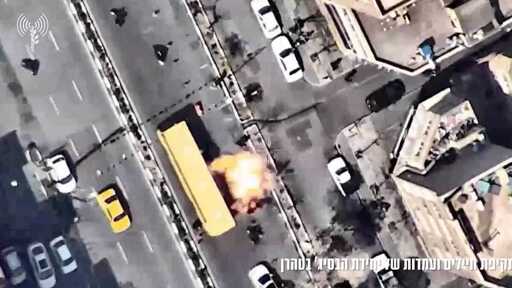
Israel has publicly said these bombings are aimed at provoking a revolution or coup via aerial bombardment. The Israeli military claimed it targeted ten Basij posts in Tehran on Tuesday and released a video of a strike targeting a checkpoint on a busy thoroughfare in the capital—firing a missile at what it called “Basij soldiers,” while a civilian bus and other traffic were directly passing through the area.
After the killing of Ali Khamenei and the naming of his son, Mojtaba, as the next Supreme Leader, Israeli Prime Minister Benjamin Netanyahu and U.S. President Donald Trump called on the Iranian people to revolt—portraying their own attacks on the country as an operation intended to clear the way for an uprising. Former Iranian crown prince Reza Pahlavi has also issued calls for individuals inside Iran to rise up and topple the government.
Trump has since taken a more ambiguous view of his endgame in Iran, however, and on Tuesday the Washington Post reported on a State Department cable circulated by the U.S. Embassy in Jerusalem claiming that Iranian protestors would “get slaughtered” if they launched an uprising. The cable stated that the Israeli assessment is that the Iranian government is willing to “fight to the end” and maintains continued capacities to rule and suppress internal dissent.
The Basij, established by Ayatollah Ruhollah Khomeini after the 1979 revolution, claims millions of registered volunteers and maintains units embedded across workplaces, universities, and neighborhoods throughout the country, though its actual numbers are likely smaller. They are widely known for carrying out waves of violence targeting internal dissenters—including a brutal crackdown on nationwide protests in response to the death in police custody of a Kurdish-Iranian woman named Mahsa Amini in 2022, as well as involvement in the killing of thousands of opponents of the Iranian government during the most recent uprising in January. In these episodes, as well as previous incidents of unrest, Basij units were deployed alongside police and Revolutionary Guard forces to disperse demonstrations, conduct arrests, and maintain neighborhood surveillance.
The following dispatch, filed by a reporter in Tehran, features interviews with members of the Basij as the U.S. and Israel continue their relentless bombing. If people do rise up against the government inside Iran, the Basij have vowed to forcefully confront anyone they see as supporting the U.S. and Israel. The interviews occurred before Soleimani’s killing. The reporter asked to remain anonymous for security reasons.
—Murtaza Hussain
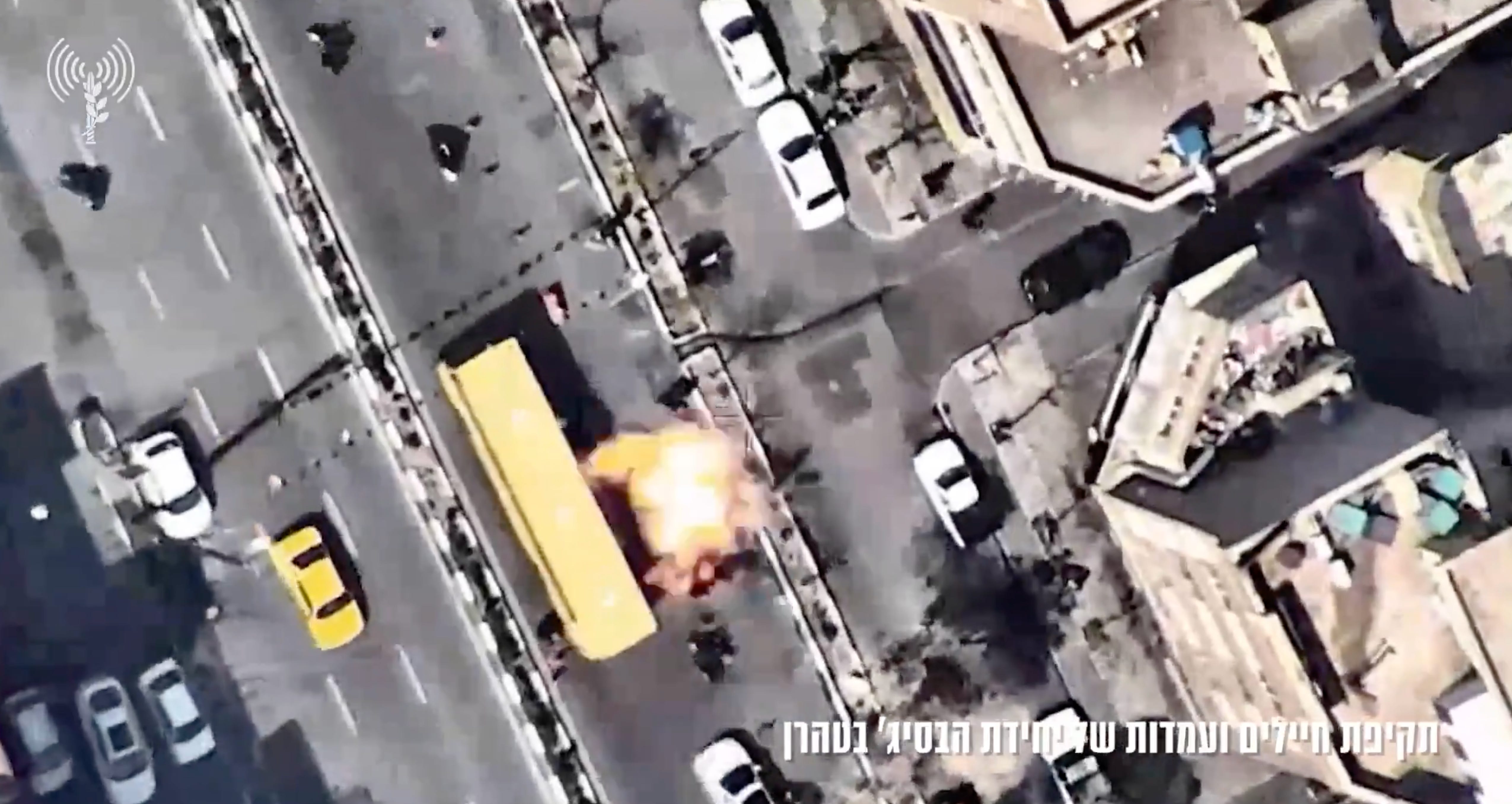
On Tuesday, the Israeli Air Force posted video of a strike it said targeted Basij militias in Tehran. The strike hit in one lane of a busy street as a bus passed by.
Story by a correspondent in Tehran
TEHRAN, IRAN—”We have to protect our sacred Islamic Revolution,” said Amir, a 29-year member of the Basij manning a checkpoint in Tehran on Saturday who joined the organization as a student in order to help defend the government. “I don’t care what the people think of us. Our Imam, and our Leader have said that protecting the Islamic Republic is the most vital thing we have to do, so we are protecting it however we can,” he said.
Amir and his friends have been stationed at the checkpoint since last week. They are armed with assault rifles and check every vehicle that passes for suspicious items, as the state braces itself against the threat of an internal uprising.
The checkpoints remind many Tehran residents of those set up by Basij in years past, when the group was primarily responsible for enforcing—often violently—the Islamic Republic’s strict morality codes. The group’s members were notorious for accosting women caught in public without religious headscarves, as well as policing the possession of contraband, including alcohol, while intimidating members of the public with their weaponry and authority to intervene in their lives.
Today, instead of attempting to enforce the increasingly relaxed morality codes of the government, the Basij are looking for weapons and Starlink equipment, used for internet connection during widespread and frequent blackouts. During the January uprising, the U.S. helped smuggle thousands of Starlink devices to help encourage opponents of the government to organize.
Since the war began, the Islamic Republic has held large state-approved public demonstrations in cities across the country to both rally support and signal in a concrete way that it has a base who are ready to retaliate against an uprising that they believe is being encouraged from abroad. “Your presence in the streets has bewildered and enraged the enemy. This humble soldier of yours has three requests from you: the streets, the streets, the streets,” said Mohammed Bagher Ghalibaf, the speaker of the Iranian parliament. “Your children in the armed forces have taken their lives in hand to defend Iran; strengthen their backs by holding the streets firm.”
The demonstrations have shown a degree of support among a significant sector of the Iranian public, but the government does not permit counterdemonstrations during wartime and the Basij, now mobilized throughout the capital, threaten to meet them with violence.
Amir described Tehran as a place that he loves and that shaped him as a person. But when asked how he feels that the city is under constant heavy bombardments, he told Drop Site that he “doesn’t care about Tehran right now.” He added, “Buildings can be rebuilt. Ideologies can’t. What matters to me the most is protecting the Islamic Revolution, and annihilating the evil Zionist regime off of the face of earth,” he said.
Like many members of the Basij, he also expressed a willingness to die in a coming confrontation.
“If I’m about to die, I’d rather die like my guide and leader, the great Khamenei,” he said. “There is nothing in this world I’d cherish more than martyrdom.”
“We are at war”
While the Basij was originally imagined purely as a defense against external aggression, the kind of help that it has provided to the state has changed drastically in over the past two decades as it has transformed into a paramilitary group that is tasked with suppressing Iranian protesters—or “rioters,” as members put it to Drop Site—during periods of domestic unrest.
Passing through Basij checkpoints is often a terrifying experience for people in Tehran, as individual members of the militia are empowered to detain individuals on suspicion of espionage or working for a foreign intelligence agency.
Sina, a 21-year old member of the Basij force, who is also out on the streets at another checkpoint, says he is “ready to shoot at anyone who’d come out on the streets” in response to calls from Israeli or Reza Pahlavi to revolt.
“I don’t see anyone on the streets now and that is a good thing. We are at war right now. This is no time to protest against the system. That can happen later. Right now, anyone I’d see on the streets of Tehran, I’d immediately shoot. These won’t be protesters. These guys would be the agents of the enemy. They’d answer the Zionist regime and Pahlavi’s calls. They certainly strike me as the enemy. We stand ready to shoot them,” Sina told Drop Site.
Sina expressed the same willingness as Amir to be killed for the cause of defending Iran and fighting the Israeli and American attack on the country.
“I’d rather die a martyr than to be alive and witness the Islamic Republic being—God forbid” said Sina. “Now, the child-killer Netanyahu says he wants to provide a condition for an uprising in Iran. Over my dead body.”
This uncompromising message of being willing to kill and die to protect the government from an existential threat line was echoed in a March 10 interview with Tehran’s Police Chief, Ahmad Reza Radan. During the interview, Radan said ”We don’t see people who come to the streets at the request of the enemy as protesters anymore, we see them as the enemy, and we deal with them just like we deal with the enemy. Our forces stand ready to shoot, to protect the Revolution.”
Since Radan issued that call, Tehran, already reeling from Israeli and American attacks, has felt like a soulless city. The normal bustle of commerce and social life—already heavily suppressed by the war—has come to a total standstill as people avoid unnecessary outings out of fear of both bombings, and the threat of an uprising and government crackdown that could target anyone.
Iranians, still bracing from the trauma of the violence in January that killed thousands, now face the prospect of both external aggression and renewed domestic infighting that many fear could lead to civil war.
From Drop Site News via This RSS Feed.