

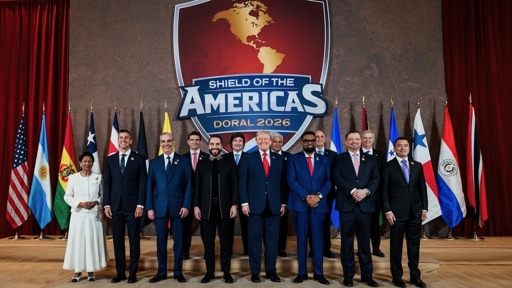
The summit in Miami
On March 7, 2026, at the Trump National Doral Golf Club in Miami, Donald Trump inaugurated the “Shield of the Americas” summit, convening right-wing leaders from Latin America and the Caribbean’s “Angry Tide” around what he called a “counter-cartel coalition”. Washington’s recipe was stated plainly: “The only way to defeat these enemies is by unleashing the power of our military.” Monroism is on the offensive, and the Angry Tide has become its shield – not against cartels, but against people-centered projects of national sovereignty.
The invited leaders – Milei of Argentina, Paz of Bolivia, Bukele of El Salvador, Noboa of Ecuador, Asfura of Honduras, Peña of Paraguay, Chaves of Costa Rica, Mulino of Panama, Abinader of the Dominican Republic, Ali of Guyana, Prime Minister Persad-Bissessar of Trinidad and Tobago, and President-elect Kast of Chile – are all to the right of the political spectrum. Conspicuously absent were the progressive leaders of Latin America’s largest economies: Brazil, Colombia, and Mexico. Of Mexico, Trump declared: “The cartels are running Mexico. We can’t have that.”
The images from Miami stood in stark contrast to regional gatherings of the last two decades, where Latin American leaders met on equal standing to build frameworks for political coordination and cooperation – such as the Council of South American Defense and the South American Health Council, of UNASUR, for example. In Miami, the assembled presidents competed in a publicity stunt to see who would stand closest to Trump in the photograph or keep the commemorative pen with which he signed the agreements.
Fifty years of the “War on Drugs”: a failed policy
It is alarming that this coalition commits to deeper collaboration with the United States on fighting cartels, given the balance sheet of US-led drug control. The Addicted to Imperialism study series, co-produced by the Tricontinental Institute for Social Research with the Lawfare Observatory, CEPDIPO, and COCCAM, lays out the record with devastating clarity: after more than fifty years of the “War on Drugs”, the DEA acknowledged before the US Congress that the Sinaloa and Jalisco cartels alone have “associates, facilitators and intermediaries in all 50 states of the United States.” This is the outcome of half a century of the most expensive and militarized drug control effort in human history.
The aggregate data confirms the verdict. In 2023, 316 million people consumed illegal drugs worldwide – a 22% increase from a decade prior. The US government has invested over USD 10 billion in counternarcotics efforts in Colombia since 1999, yet cocaine production more than tripled between 2013 and 2017. The study shows that between 2016 and 2022 – a period of intense US-Colombian cooperation – potential cocaine production in Colombia rose from 1,053 to 1,738 metric tons, while seizures and forced eradication also increased simultaneously. More eradication, more production. More cooperation, more cocaine.
Ecuador: a dramatic example
No contemporary case illustrates this more starkly than Ecuador, whose president Noboa stood prominently at Trump’s event in Miami. As the Addicted to Imperialism studies documents, Ecuador has been subjected to a process of foreign interference since at least 2017—producing marked deterioration of the social rule of law and a progressive militarization of public security across four structural axes: foreign interference, economic liberalization and external debt, institutional deterioration, and the the securitization of social problems.
Under Moreno (2017–2021), Ecuador restored US security ties suspended by Correa, rejoining Southern Command exercises. Under Lasso (2021–2023), a Memorandum of Understanding was signed, modelled explicitly on Plan Colombia, with a projected budget of USD 3.1 billion over seven years – repositioning Ecuador as the top recipient of US Foreign Military Financing in the region, with USD 310 million between 2022 and 2023, surpassing Colombia.
Under Noboa, after presidential candidate Fernando Villavicencio was assassinated during the 2023 campaign, General Laura Richardson of US Southern Command traveled personally to Ecuador to agree a “joint plan”, including the deployment of US military personnel with full immunity from Ecuadorian justice – the same conditions applied in Colombia, immediately dubbed a “Plan Ecuador”. The homicide rate reached 47 per 100,000 in 2023. Noboa’s Plan Fénix deployed armed forces in city streets, built mega-prisons modeled on Bukele, and sought a constitutional reform to permit foreign military installations – such as the base in the Galápagos. The militarization of public security has not resolved the crisis. It has deepened it, while subordinating Ecuador’s sovereignty to Washington’s hemispheric agenda.
Two hundred years after Panama: the amphictyonic compass
The militarized drug war framework does not protect populations from narco-trafficking. It protects political elites from democratic accountability and normalizes authoritarianism under the banner of security. Addicted to Imperialism documents that in 2008, 35% of Colombian senators and 13 percent of House representatives were under investigation for links to paramilitary groups that simultaneously ran drug trafficking operations. The “War on Drugs” did not dismantle these networks. It provided them with political cover.
This is not surprising when we recall the framework’s origins. Nixon’s chief domestic policy advisor admitted decades later that the 1971 declaration of drugs as “public enemy number one” had a different target:
The Nixon White House, after that, had two enemies: the antiwar left and Black people … “We knew we couldn’t make it illegal to be either against the war or black, but by getting the public to associate hippies with marijuana and blacks with heroin, and then criminalizing both heavily, we could disrupt those communities. We could arrest their leaders, raid their homes, break up their meetings, and vilify them night after night on the evening news. Did we know we were lying about the drugs? Of course we did.”
On a regional scale, from Plan Colombia to the Shield of the Americas, the alleged combat against cartels has consistently served as a pretext for military spending, interventionism, and the displacement of populations from their territories. The most recent illustration is Venezuela: the abduction of its sitting president, Nicolás Maduro, was framed as an anti-drug operation – but swiftly revealed as a mechanism for reinserting Venezuela into Washington’s oil economy.
In 1826, Simón Bolívar convened the Amphictyonic Congress of Panama with a vision of extraordinary clarity: a confederation of Latin American republics acting collectively, guaranteeing their independence, and negotiating with great powers from a position of sovereign equality. The Angry Tide is today’s antithesis of that spirit. At Miami, Trump declared: “we will not allow foreign hostile influence to establish itself in this hemisphere – including the Panama Canal” – while Panama’s president Mulino sat in the audience and listened in silence. It is Monroism at its most undisguised.
Latin America and the Caribbean –its movements, parties, and progressive governments – needs a renewed regional agenda of sovereignty and concrete cooperation, including institutions capable of coordinating a sovereign response to the drug economy. The price of a kilogram of cocaine rises from approximately USD 1,500 at the point of production in Colombia to USD 20,000 in the United States. The producers – the peasant farmers – capture less than 1% of the global cocaine market’s value. Meanwhile, over 70% of the weapons fueling cartel violence in Mexico are manufactured in and flow from the United States. The drug war, in its hyper-militarized version, creates the institutional framework for precisely the kind of health concerns, corruption, and impunity it claims to be fighting.
The first quarter of this century offers proof that a different ambition produces results. Operación Milagro restored sight to over 3 million people. The ALBA literacy programs eradicated illiteracy in Bolivia, Venezuela, Nicaragua, and Ecuador. Regional unity with a true purpose of reaffirming sovereignty and guaranteeing a dignified life for the population must not be abandoned for failed policies and publicity stunts.
Carlos Ron is Co-Coordinator of the Nuestra America office of theTricontinental Institute for Social Research. He is a former Venezuelan diplomat.
This article was produced by Globetrotter.
The post The shield of Monroism: The Angry Tide and the neo-colonial order in Latin America appeared first on Peoples Dispatch.
From Peoples Dispatch via This RSS Feed.