

The Trump administration is drastically undercounting the price tag of the U.S. war with Iran, peddling fragmentary estimates that offer Americans a skewed understanding of the costs.
The Pentagon on Thursday said the U.S. spent about $11.3 billion in just one week of its war on Iran; Trump economic adviser Kevin Hassett similarly put the figure at $12 billion on Sunday.
But these sums are dwarfed by estimates offered by experts in the costs of war, lawmakers experienced with the Pentagon budget, and two government officials briefed on Operation Epic Fury who spoke on the condition of anonymity.
At the very least, they say the war is burning through between $1 billion and $2 billion per day — or roughly $11,500 to $23,000 per second. The cost, the officials told The Intercept, could rise to a quarter trillion dollars or more over the coming months.
Even that is a drop in the bucket compared to the long-term expenses, which could cost the U.S. trillions of dollars in the decades to come. One of the officials lamented that Americans would be paying off the war for generations.
“If this war takes months rather than weeks, the costs will become astronomical,” said Gabe Murphy, a policy analyst at Taxpayers for Common Sense, a nonpartisan budget watchdog advocating for an end to wasteful spending,
Jules Hurst III, the War Department’s acting comptroller and chief financial officer, called the Pentagon’s initial $11.3 billion estimate a “ballpark number,” speaking at the Reagan Institute’s National Security Innovation Base Summit. Hurst said a more comprehensive figure would be provided with a supplemental budget request, which he said the Pentagon plans to soon submit to the White House and Congress.
Democratic lawmakers believe the true number is far higher because the Pentagon estimate did not include many expenses, including the massive buildup of military assets, weapons, and personnel in the Middle East ahead of the conflict. Lawmakers have said they expect the Iran War supplemental request to reach at least $50 billion — on top of a $1.5 trillion War Department budget request for 2027.
When he appeared before the House Armed Services Committee recently, Elbridge Colby, the under secretary of war for policy, said that the military campaign against Iran had been “scoped out” for up to five weeks, but that the president could extend it. He was, however, unable to tell Rep. Sara Jacobs, D-Calif., the cost. “I can’t give you an answer at this point,” he said. The Office of the Secretary of Defense as well as Pentagon press secretary Kingsley Wilson were no more forthcoming with The Intercept.
Jacobs told The Intercept that Americans had been conned into an open-ended conflict, with unclear goals and no exit plan.
“We haven’t gotten sufficient details in public or behind closed doors about the strategy, the objectives, the length of the operation, or how much this will cost taxpayers,” she told The Intercept. “The American people are demanding an end to this illegal war to prevent more killings of children, retaliation against U.S. service members, skyrocketing costs to U.S. taxpayers, and yet another endless war.”
Hassett, the director of Trump’s National Economic Council, said the war was still expected to take four to six weeks. But without accurate information from the Pentagon on the cost of the war, experts, lawmakers, and government officials have stepped into the breach with estimates of the financial burden of Trump’s war with Iran — his second war on the country within the span of a year.
The numbers are immense.
A three-week conflict could cost taxpayers between $60 billion and $130 billion, according to the two government officials, who spoke on the condition of anonymity in order to speak freely, with both stressing that the estimates were speculative. “It’s a back of the napkin estimate,” said one official.
“They really have no idea of the real cost.”
A five-week war could top out at $175 billion. Eight weeks could put the total at $250 billion. “They really have no idea of the real cost,” said one of the officials, noting that bookkeeping is not a Pentagon strong suit. The self-styled War Department has never passed an audit, despite almost a decade of attempts.
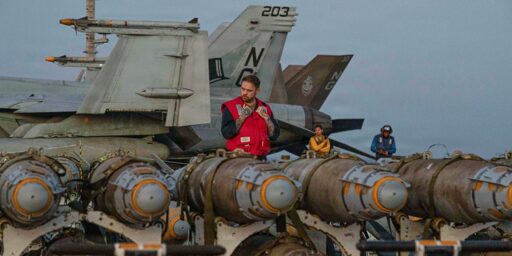
The Pentagon’s pre-war military buildup — which is missing from the $11.3 billion estimate — had already cost taxpayers an estimated $630 million, according to Elaine McCusker, a former senior Pentagon budget official now at the American Enterprise Institute. (McCusker said those costs are likely to be absorbed within the Pentagon’s existing $839 billion 2026 budget.) Initial estimates of the first 100 hours of the war tacked on around $3.7 billion in operational costs, munitions, and damaged or destroyed equipment, according to a cost breakdown by the Center for Strategic and International Studies, or CSIS. This and other estimates turned out to be drastic undercounts as Pentagon officials, in classified briefings, disclosed that the military burned through $5.6 billion worth of munitions in just the first two days of the war. An updated analysis by CSIS now estimates that Epic Fury cost $16.5 billion by its 12th day.
Estimates by Linda Bilmes, the co-author of “The Three Trillion Dollar War,” are in line with the government officials’ projections. Bilmes, a former assistant secretary and chief financial officer of the U.S. Department of Commerce under Bill Clinton and currently a public policy professor at the Harvard Kennedy School, says that the price tag of the war will exceed $50 billion if the conflict stretches into its third or fourth week. “Probably higher,” she added.
Bilmes cautioned that enormous short-term expenses — like spent munitions, the deployments of aircraft carrier strike groups, and aircraft shot down — will be eclipsed by even more significant expenditures like the long-term costs of veterans’ benefits and interest on the debt to pay for the war. The ultimate cost, Bilmes says, may reach into the trillions of dollars.
[
Related
Over Two Decades, U.S. Global War on Terror Has Taken Nearly 1 Million Lives and Cost $8 Trillion](https://theintercept.com/2021/09/01/war-on-terror-deaths-cost/)
Bilmes first called attention to the immense hidden costs of America’s wars in her groundbreaking analyses of the Iraq War. The George W. Bush administration initially put the likely cost of the Iraq War at $40 billion. In 2015, Bilmes and economist Joseph Stiglitz discovered that the real cost would be at least $3 trillion. Just six years later, that figure had ballooned to around $8 trillion.
Asked about the analogous long-term costs of the Iran war by The Intercept, the Office of the Secretary of War clammed up. “We have nothing to provide,” a spokesperson told The Intercept.
“The majority are being exposed to toxins, contamination, acid rain, dust from infrastructure destruction, and burning oil fumes.”
Bilmes notes that around 50,000 U.S. troops are deployed around the Middle East as the United States and Israel, as well as Iran and its proxies, strike fuel depots, oil facilities, and military sites — all of which release noxious substances shown to negatively affect human health. “The majority are being exposed to toxins, contamination, acid rain, dust from infrastructure destruction, and burning oil fumes, so we can estimate that at least one-third will be claiming disability benefits under the PACT Act,” she said, referring to a landmark 2022 law expanding health care and benefits for veterans exposed to burn pits, Agent Orange, and other toxic substances. “That is a major long-term cost that almost nobody looks at.” Bilmes said that if veterans claim benefits at the rate of the extremely short 1990 Gulf War — 37 percent of whom receive compensation today — this alone would add around $600 billion in costs over their lifetimes.
The Iran war also increases the likelihood that Congress will approve a larger Pentagon budget than Trump would have secured without it, Bilmes said. “If the budget would have increased by $100 billion, this war might bump it to $200 billion,” she told The Intercept. “That becomes the base budget and, over a decade, it’s another trillion dollars added to the defense budget.”
“ Now the gross debt is $38 trillion — and about 30 percent of that is due to the wars in Afghanistan and Iraq.”
Bilmes explained that these long-term costs are exacerbated by the fact that all the money is borrowed. “Back in 2004, the public debt was below $4 trillion. Now the gross debt is $38 trillion — and about 30 percent of that is due to the wars in Afghanistan and Iraq,” she said. A key contributor to that spike is the fact that the United States went to war in Afghanistan in 2001 and Iraq in 2003 while simultaneously cutting taxes — increasing spending while reducing revenues. “This combination had never happened before in the history of U.S. wars,” she said. With interest rates almost double what they were in the 2010s, Bilmes notes that 14 percent of the federal budget already goes to interest payments, which are destined to rise further with the Iran war.
Hurst, the War Department comptroller, declined to specify exactly how much money the War Department would ask for in the supplemental request. Most sources say it will top $50 billion. Asked about the likelihood the Iran war supplemental request would pass, given Democrats’ opposition to the conflict, Rep. Rob Wittman, R-Va., was optimistic due to bipartisan concerns about weapons stockpiles. “There is a need that was there before the Iran conflict,” said Wittman, the vice chair of the House Armed Services Committee, at the Reagan Institute summit last week. “There’s a need there to build our weapons magazine depth. There’s a need there to make sure we’re building more expendable and attritable platforms. So those things extend even beyond the Iran conflict. This just makes it more immediate.”
House Minority Leader Hakeem Jeffries, D-N.Y., pushed back on talk of additional funding. “The administration has not even made the case to the American people as to why we are spending billions of dollars and dropping bombs every day in Iran,” he said during a Monday press conference. “So the notion that they would come up here and ask for additional money is beyond the pale at this moment.”
Murphy, the policy analyst at Taxpayers for Common Sense, noted that the reconciliation bill enacted last summer included over $60 billion for munitions, missile defense, and low-cost weapons. The lack of specificity in the bill would allow the Pentagon to easily utilize around $90 million for Trump’s war of choice with Iran, he said.
“Billions of taxpayer dollars have already been spent on this unauthorized war. We’re facing a spiraling debt crisis, skyrocketing health care premiums, dire food insecurity, and natural disasters that are growing more frequent, extreme, and costly. These are national security issues,” Murphy told The Intercept. “If Congress believes this war is a good use of taxpayer dollars, it should vote on an authorization for the use of military force. Congress has a duty to consider any supplemental funding requests, but absent an AUMF, Congress shouldn’t approve additional funding.”
The Pentagon, Murphy said, “got a boatload of extra cash, more than $150 billion, in last summer’s One Big Beautiful Bill Act.”
With the goals of the war undefined, there is no way to project how long the war on Iran will rage on. “There will be no deal with Iran except UNCONDITIONAL SURRENDER!” Trump wrote on Truth Social on March 6, following a statement that the war could go on “forever.”
Murphy told The Intercept that the White House needed to provide far more clarity. “Taxpayers deserve answers on the precise costs and timeline for this war,” he said. “‘Indefinitely’ isn’t an answer.”
[
Related
Pentagon Report: U.S. Military Fired Missile at Elementary School in Iran](https://theintercept.com/2026/03/11/iran-school-missile-investigation/)
More recently, the president seemed to indicate that there has been no reason to fight since the first day of the war. “Let me say, we’ve won,” Trump said last week. “You know, you never like to say too early you won. We won. We won, in the first hour it was over, but we won,” Trump said. Jacobs highlighted this uncertainty underlying the conflict, noting that Americans have been “misled into another regime-change war in the Middle East under false pretenses and with fairy tale ideas about what will happen next.”
The Intercept presented Bilmes’s long-term cost estimates to one of the government officials who offered the more immediate quarter-trillion-dollar estimate. That official agreed that Americans would be paying massive sums of money for generations to finance Trump’s second war with Iran. “These costs aren’t known to the American people. You’re never going to hear about them from the White House or the DoD,” said the official of the long-term expenses highlighted by Bilmes. “My kids’ kids, and probably their kids, are going to be paying for this.”
The post Trump’s War on Iran Could Cost Trillions appeared first on The Intercept.
From The Intercept via This RSS Feed.