


Bullets:
The modernization of China’s military has no precedent in human history.
In just one decade, the PLA has built the world’s largest navy, and fleets of advanced aircraft and long range missiles.
They also did so with modest annual increases in defense spending, while achieving self-sufficiency in the most cutting-edge aerospace technologies.
China’s massive military industrial complex is mass-producing 5th-generation aircraft, and is now a major exporter of advanced jets to friendly countries.
Inside China / Business is a reader-supported publication. To receive new posts and support my work, consider becoming a free or paid subscriber.
Report:
Good morning.
While China’s civilian manufacturing sector transformed from low-cost mass production to high-quality mass production, the same dynamic was at work in their military industrial complex.
A decade ago, China’s armed forces was regional, and built around “quantity over quality.” Quantity has a quality all its own, as it is said, and that was the foundation, back then, of Chinese strategy. The PLA was always twenty years behind.
Nobody believes that anymore. The People’s Liberation Army modernized at the fastest rate in modern history. And it’s across all the branches, all the weapons platforms and systems.
That change, in only 10 years, is unprecedented in peacetime. And we’ll start with this surprising chart:
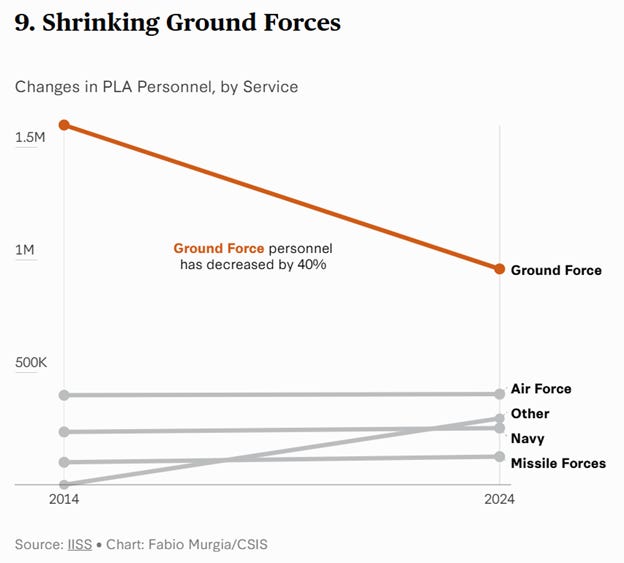
Air Force, Navy, and Missile Commands have maintained personnel levels over that time. Ground forces are dropping in number, down 40% in ten years, while “Other” has beefed up from zero to around 400,000. What all those “other” troops are up to they’ve left to our imagination. But their overall manpower levels have dropped, slightly, while military spending has risen.
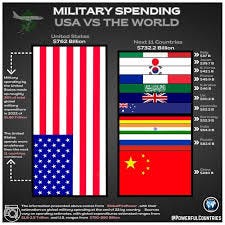
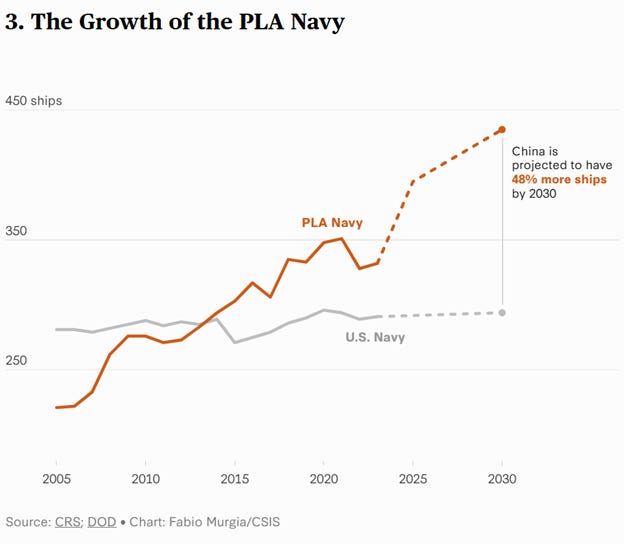
Military spending at the Pentagon still dwarfs everyone else, but we need to ask if China is getting a lot more for their money: These data are the “key indicators of PLA capability” for today, compared to 10 years ago. We have reported before that China’s shipbuilding production is greater than the rest of the world, combined, and China’s Navy is today the world’s largest.
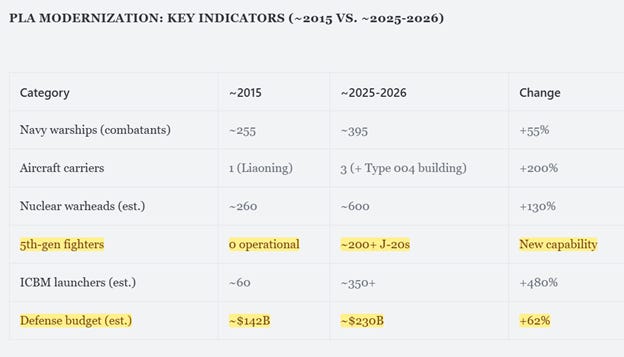
But these other platforms are up high double digits, or even triple. Nuclear warheads, more than doubled, launchers, up over 5 times. 5th generation fighter jets went from zero to over 200, and this while China’s military spending rose by 62%. Our point here is that China has modernized at the fastest rate in world history, at least in peacetime, with just about 5% annual increases in defense budgets.
The Chinese Navy previously was older frigates and small patrol boats, today they are advanced destroyers comparable to anything floating from Western navies. They were building much better ships, along with a lot more of them. China’s shipbuilding effort, again, no modern parallel exists:
In defense aerospace, China previously was dependent on Russian engines, and its domestic industry was uncompetitive. No longer: The J-20 is a fifth-generation fighter, and there are at least 200 of those. They come with Chinese engines, instead of Russian ones, and these aircraft are designed with Asia-Pacific in mind. So besides what’s happening on the Navy side, where China’s fleets are the world’s largest and still growing fast, China’s Air Force is also modernizing, and growing fast. Over 2,000 aircraft, with over half of them exceeding fourth-generation capabilities:
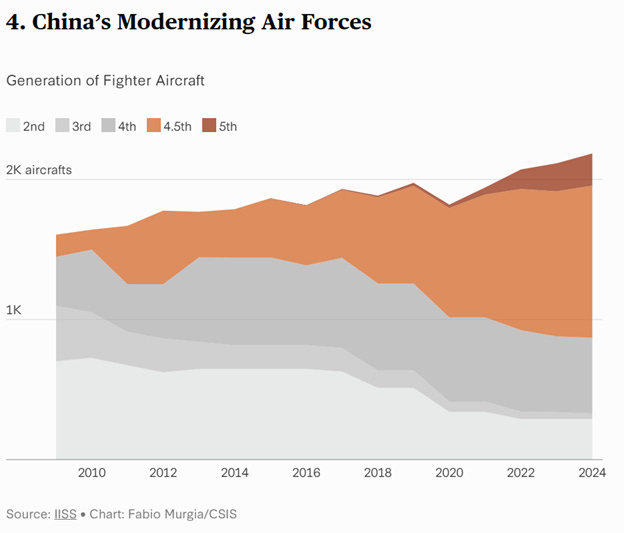
These aircraft are in mass production. Five production lines for the J-20’s, with a new model rolling off every eight days. In contrast, the United States doesn’t build F-22’s at all, and the F-35’s only have a 60% readiness rating across 400 airframes. We don’t know how many J-35’s China has in active service, but production on those are spinning up, and those, too, are coming off the lines at the rate of one every eight days.
It might appear that the Pentagon still enjoys a quality advantage, as well as in absolute numbers. But China is already building 6th-generation aircraft, and coupling advanced drone technologies with their fifth-generation planes, which are beyond the capabilities of Pentagon contractors.
Add it up, and China’s rate of production means that China will have the biggest fleets of advanced fighter jets in just a few years, with hundreds of airframes a full generation ahead of the top planes in Western militaries.
—
Then we have the concentration problem. The Pentagon’s commitments are global, and aircraft are dispersed across Asia, Europe, the Middle East, Africa, and obviously North America. China does not have a sprawling network of overseas bases, and all their planes can be called upon close to home.
What’s more, China is now a leading exporter of fighter aircraft. This is another monumental shift—going from a huge importer and buyer of military hardware, to producing most of it domestically, and then further on to be a leading exporter. Just like for everything else—food, electronics, energy—now China is self-sufficient in advanced armament production, is ramping up exports, and taking market share across the world.
Be good.
Resources and links:
China’s military in 10 charts
https://www.csis.org/analysis/chinas-military-10-charts
China’s Military Buildup by the Numbers: How the PLA Became a Superpower in a Decade
https://militarymachine.com/china-military-buildup-pla-superpower
How China Built an Arms Industry to Rival the West
https://www.wsj.com/world/china/how-beijing-built-arms-industry-to-rival-the-west-2ef824c7
Infographic: US military presence around the world
https://www.aljazeera.com/news/2021/9/10/infographic-us-military-presence-around-the-world-interactive
China Is Building Fifth-Generation Warplanes Far Faster than America
https://nationalinterest.org/blog/buzz/china-building-fifth-generation-warplanes-far-faster-than-america-bw-093025
China, Pakistan are winning big contacts to modernize air forces in Asia, Middle East, and Africa
Inside China / Business is a reader-supported publication. To receive new posts and support my work, consider becoming a free or paid subscriber.
From Inside China / Business via This RSS Feed.