

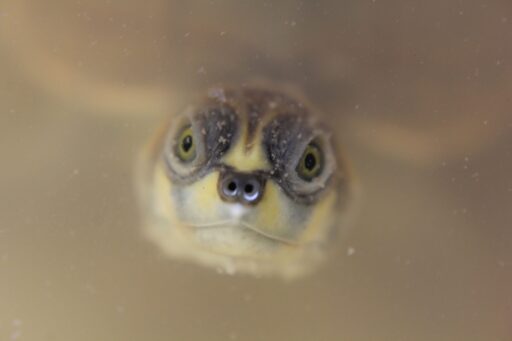
It’s just a sweet, squeaky sound, like that of a rubber duck. For scientists, however, it could have various meanings, ranging from “Time to spawn!” to “Come on, little ones!” to “Time to migrate!” Researchers studying the Amazon river turtle (Podocnemis expansa), South America’s largest turtle, found that hatchlings begin communicating even before birth, probably to agree on the best time to break out of the eggs and burrow up from the sand to the beach. “The Amazon turtle is one of the most social species of turtles in the world,” Camila Rudge Ferrara, the researcher who first proved the turtle’s communication skills, told Mongabay. “They migrate in groups, lay eggs in groups, and hatch in groups,” added the coordinator of the Chelonian Conservation Program in the nonprofit Wildlife Conservation Society in Brazil (WCS Brasil). Soon, however, the chatter of Amazon river turtles in the Tapajós River, a major tributary of the Amazon, may be disrupted by the noise of dredgers, ferries and boats circulating in the river: An ambitious waterway is being planned to ship minerals and grains to the port in the city of Santarém, in Brazil’s Pará state. “The frequency of the sound, dredging and boats may interfere with the turtles’ communication,” Ferrara told Mongabay, but noted that scientists haven’t yet been able to establish this as fact. “The high-frequency underwater noise will disrupt the migration of these animals.” The latest conservation assessment for the species is expected to declare it endangered on the IUCN Red List,…This article was originally published on Mongabay
From Conservation news via This RSS Feed.