


This article by Atzayacatl Cabrera originally appeared in the March 17, 2026 edition of El Sol de México.
Regardless of whether a person owns a home, rents it, lives in a cooperative, or even lives in an informal settlement, the reforms to the Housing Law propose to provide protection and legal certainty to all people to prevent evictions, dispossession, or other threats.
Last Wednesday, an initiative from President Claudia Sheinbaum Pardo to reform the Housing Law arrived at the Chamber of Deputies, proposing to change the concept of “decent and dignified housing” to “adequate housing” as a human right enshrined in the Constitution.
The initiative details that to be considered adequate housing, it must have seven essential characteristics: security of tenure, availability of services, materials, facilities and infrastructure, affordability, habitability, accessibility, location and cultural appropriateness.
“What passes with this proposed reform is that these seven elements are part of an international source of human rights, which is General Comment No. 4 of the United Nations Committee on Economic, Social and Cultural Rights,” Daniela Sánchez Carro, coordinator of the “María Luisa Marín” Housing Law Clinic at the Ibero-American University, explained to El Sol de México.
“These seven minimum elements are established, which are the necessary conditions valid in any context and at any time to consider that a home is adequate,” she explained in an interview with this newspaper.
The proposed reform aims to include these seven characteristics in the Housing Law, and in the case of security of tenure it specifies that this is the “condition that guarantees that the occupants of the dwelling have legal protection against forced evictions, harassment or other threats, whatever the type of tenure.”
The Housing Bill states, “Everyone should have some degree of legal protection against eviction, harassment, or other threats, regardless of their housing tenure.”
Although the previous concept of “decent and dignified housing” was included in the Constitution and the Housing Law of 2006, this was not reflected in the massive construction of houses during the last decades.
According to the initiative’s explanatory statement, it does not matter whether a person owns, rents, lives in a cooperative, rents, lives in an informal settlement, or occupies land; and it states that all people should have “some degree of legal protection against eviction, harassment, or other threats.”
Sánchez Carro explains that legal security of tenure is a concept that has been part of the country’s housing regulations for many years; “we live with it through many forms of deed registration, notary sessions through incorporation programs, regularization programs. This, let’s say, strengthens the legal security of tenure, which implies that all homes and all people have this recognition from the State,” she points out.
The specialist explains that, based on General Comment No. 4 of the United Nations Committee on Economic, Social and Cultural Rights, housing is considered an essential need for families and individuals; and all have the right to some form of protection from the State.
“It doesn’t matter if I’m an illegal occupant, I need and deserve a degree of legal security. And that’s what the observation mentions,” she explains.
After the Chamber of Deputies sent the initiative to the Housing Committee for its review, the presidential proposal is expected to be discussed in the coming days by the committee chaired by Maribel Martínez Ruiz of the Morena party. As of press time, no meeting has yet been scheduled for this discussion.
If the initiative is approved in committee, the reform would then be discussed in the plenary session of the Chamber of Deputies and sent to the Senate for discussion and possible approval.
A New Concept: Adequate Housing
In addition to this characteristic for “adequate housing,” the presidential initiative proposes six others. Carlos E. Ramírez Capó, President of the National Chamber of the Housing Development and Promotion Industry (CANADEVI), explains that the availability of services, materials, facilities, and infrastructure is of utmost importance.
“We are linking the human right to water to housing to ensure that any development, any new housing complex, has guaranteed access to water,” he says.
Ramírez Capó adds that affordability is seen, for its part, in programs such as the Housing for Well-being Program , whose six-year objective is to build 1.8 million homes at affordable prices, of around 600,000 pesos; and that habitability must consider that homes require safe structural conditions in the face of seismic risks, tropical storms, hurricanes, etc., which are problems that Mexico faces.
“Another very innovative feature is the theme of cultural education , which takes into account the characteristics and practices of each region. For example, in Yucatán, cultural education would mean having the necessary space to hang a hammock, which are very typical things in that region of the country,” he points out.
In a conversation with this newspaper, Luis Alberto Salinas Arreortua, a researcher at the Institute of Geography of the UNAM , questions whether, if the initiative to reform the Housing Law is approved, it would be necessary to consider creating mechanisms for oversight, review, or supervision to ensure that the construction of homes actually meets the seven characteristics of adequate housing.
This is because the previous concept of “decent and dignified housing”, although included in the Constitution and the Housing Law of 2006, was not reflected in the massive construction of houses during the last decades.
“Since the Constitution was enshrined stating that every Mexican has the right to decent and dignified housing, what has happened in recent decades of massive construction has not been reflected in any way, even though it was in the Constitution and the 2006 law, it was not put into practice,” the researcher criticized.
Necessary to Discuss Housing Tenure
Salinas Arreortua explained to El Sol de México that, in his opinion, Mexico needs to promote general regulations for access to housing through rental agreements or cooperative societies.
The UNAM researcher mentions that in our country, the idea that owning a home is essentially the only way to access housing is deeply ingrained in the collective consciousness. However, he emphasizes that there are many other ways in which people can live in a house.
“As long as this situation persists, and access to homeownership continues to be favoured, I believe we will continue to have a society that is completely indebted, where the costs of mortgage loans are increasingly absorbing workers’ incomes, and where, to cope with this, they must make many changes in their daily lives,” he says.
Sánchez Carro agrees with this point and explains to El Sol de México that “historically we have this culture of not feeling completely fulfilled as people if we do not own a property.”
But for the coordinator of the Housing Rights Legal Clinic, there are many ideas in other countries around the world that can broaden the discussion in Mexico about how people can live in a home.
As an example, he points out that in Austria or Germany, 80-90 percent of homes are rented; and that most people living in Europe are renters.
“We need to broaden our perspective and provide greater incentives, for example, to housing cooperatives , to create conditions for more social housing loans, to build more social housing, and to support renting. In the United Kingdom, for example, there are subsidies for those who rent housing to students,” he concludes.
Atzayacatl Cabrera is a poet and journalist who navigates between verse and hard data, and a reporter for the Presidency who also covers the Legislature.
-

Housing Law Reform Boosts Legal Protection Against Forced Evictions in Mexico
March 17, 2026
Enshrining security of tenure specifies that this is the “condition that guarantees that the occupants of the dwelling have legal protection against forced evictions, harassment or other threats, whatever the type of tenure.”
-
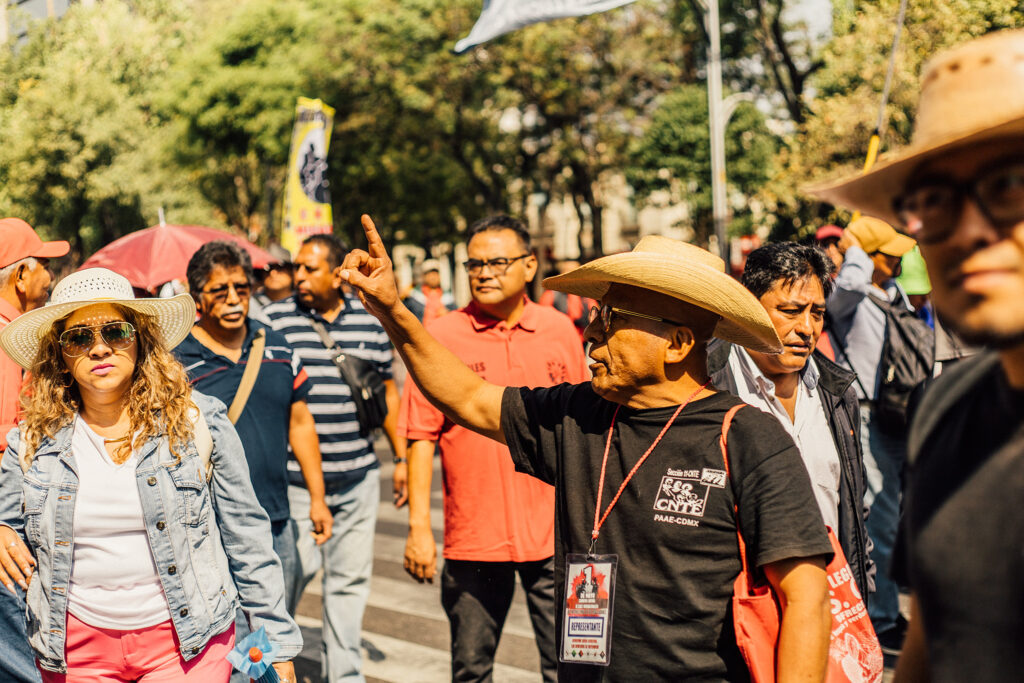
CNTE Teachers Will Hold National Strike March 18th to 20th; Sit-in at Mexico City’s Zócalo
March 16, 2026
The CNTE urged unions and workers to join actions to demand repeal of the 2007 ISSSTE Law, & for the defense of a social security system that “provides all with health services and decent pensions.”
-

Zacatecas Normalistas Join Solidarity with Cuba
March 16, 2026March 16, 2026
The national association of alumni of the Emiliano Zapata Rural Teachers’ College in Loreto, Zacatecas—founded in 1958—joined La Jornada’s call to stand in solidarity with the government and people of Cuba.
The post Housing Law Reform Boosts Legal Protection Against Forced Evictions in Mexico appeared first on Mexico Solidarity Media.
From Mexico Solidarity Media via This RSS Feed.