

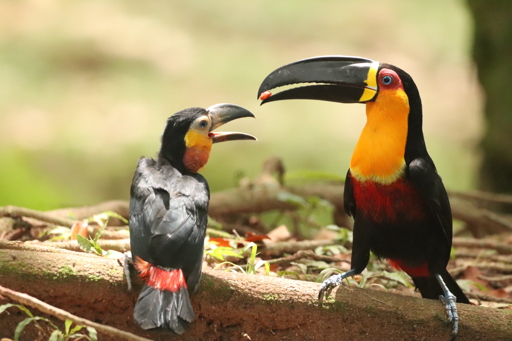
More than 50 years ago, the ariel toucan was reintroduced to Tijuca National Park, the world’s largest urban forest, located in Rio de Janeiro in southeastern Brazil. Now, a new study finds that the bird, which became locally extinct in the 1960s, has almost entirely settled back into its original role in the ecosystem, serving as a critical species for forest restoration. Researchers tracked ariel toucans (Ramphastos ariel) through the Tijuca forest for a full year, logging every plant species it consumed compared with a list of 101 native plant species the bird had historically interacted with. The research team often walked more than 20 kilometers (12.4 miles) a day through the forest observing the toucans’ dietary habits. They found that the bird, recognized for its colorful feathers and signature black beak, had interactions with at least 76% of the plants historically on the menu for ariel toucans. “They are such sociable and intelligent beings. The way they are able to handle fruits: Sometimes it has a hard capsule on the outside, and they hold it with their little feet and open it with their beaks,” lead author Flávia Zagury, an urban ecology researcher at the Federal University of Rio de Janeiro, told Mongabay by phone. “They have an incredible ability to access these resources.” They were observed feeding on the fruits and seeds of plants that few other animals can crack open, potentially making them key dispersers for endangered trees, including the jussara palm (Euterpe edulis) and the bicuíba-branca…This article was originally published on Mongabay
From Conservation news via This RSS Feed.