

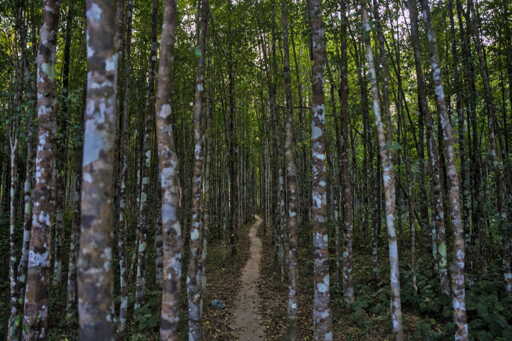
Standing precariously on the slope of a tree-covered hill in Kaptai National Park in southeast Bangladesh, Mohammad Musa was clearing bushes with a machete. Our eyes widened in shock when he ran the machete over a couple of 2.4-meter-tall (8-foot-tall), healthy young fig plants that stuck their heads out of the bushes. “These will attract mama,” he murmured. “See what this garden has become with all this nonsense.” Local Bengalis call elephants mama (maternal uncle) out of fear and respect, just like people living around the Sundarbans call tigers mama. The native wildlife-supporting fig plants are ‘nonsense’ to Musa because they grew on the edge of his agarwood (Aquilaria spp.) plantation, or garden as he calls it, planted on a 2-hectare (5-acre) piece of land in the national park in Kaptai upazila (sub-district) in Rangamati Hill district. Between 1998 and 2011, the Bangladesh Forest Department undertook two projects to create a total of 4,822 hectares (11,915 acres) of agarwood monoculture plantations in five divisions of the Forest Department. In the second project, from 2007 to 2011, 443 hectares (1,095 acres) of agarwood plantation was established in Kaptai National Park, according to official data gathered from the Management Planning Unit of the Forest Department. Musa is one of the local beneficiaries who cleared the forest patches and created the monoculture to earn revenue. The plantations are established under a participatory social forestry approach involving beneficiaries from local communities who plant and manage approved tree species on degraded forests and public lands…This article was originally published on Mongabay
From Conservation news via This RSS Feed.