


Nika Bartoo-Smith
Underscore Native News + ICT
Wildlife biologists are cautiously optimistic that a pair of free-flying condors may have begun tending to a newly laid egg in February in Northern California. The pair recently established the region’s first nest in over a century. The two condors, released in 2022, are part of the Northern California Condor Restoration Program that is a partnership between the Yurok Tribe and Redwood National and State Parks.
If successful, it would be the first wild condor chick in Northern California raised by birds in the wild in approximately 130 years. Other flocks have been established by recovery programs for longer in Southern California, Arizona, Utah, Central California and Baja California, Mexico.
“If you don’t have breeding at all, you never even take your first footstep towards self sustaining. So I really feel that this is the first step that this population has made in that direction,” said Chris West, the northern California condor restoration program manager and Yurok Wildlife Department senior biologist. “Seeing that the birds are doing what they’re doing, seeing that they chose a nice, remote site for a nest, they’re doing all their switches for incubating the egg. It’s just really good to see.”

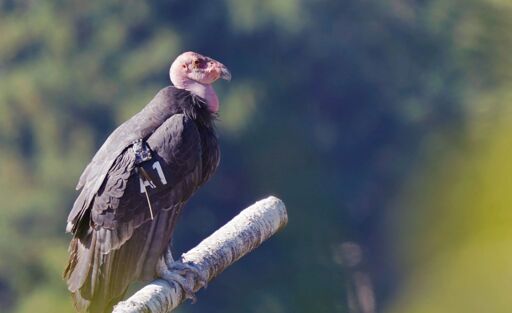
An image of A0, or Ney-gem’ ‘Ne-chween-kah in Yurok and A1, or Hlow Hoo-let in Yurok, the two nesting condors. (Photo courtesy of Matt Mais/Yurok Tribe) Credit: Acclaimed Indigenous chef Anthony Warrior, a citizen of the Muscogee (Creek) Nation and is also Absentee Shawnee of Oklahoma and Sicangu Lakota, produced a lunch of traditional foods at the Cultural Connections summer youth camp at the Neihardt Center in Bancroft, Nebraska, in June 2023. Warrior, who owns Warrior’s Palate Catering and Consultation, works to educate young people and promote the importance of Native foods. (Photo by Aryn Halsey, courtesy of Cultural Connections)
The female in the nesting pair is called A0, or Ney-gem’ ‘Ne-chween-kah in Yurok, which translates to “she carries our prayers.” She was bred at the Oregon Zoo. The male is called A1, or Hlow Hoo-let in Yurok, which translates to “at least I (or we) fly!” He was bred at the World Center for Birds of Prey. Both birds are about 7 years old.
The egg is believed to be tucked into an old-growth redwood tree in a remote part of Redwood National and State Parks. Wildlife biologists monitor the birds around the clock with satellite and radio transmitters, but due to the remote nature of the particular tree they chose, they are unable to confirm the existence of an egg, though all signs indicate that there is likely one in the nest.
Early signs of an egg started with a mortality signal for the male of the pair, according to West. If the condors do not move for a while, the tracking system flags that lack of movement as a need to be checked on. But it’s also common for a nesting bird to sit still for long periods of time.

An image of Tiana Williams-Claussen, the Yurok wildlife department director and a citizen of the Yurok Tribe. (Photo courtesy of Matt Mais/Yurok Tribe)
“When they nest, they’re very good parents,” said Tiana Williams-Claussen, the Yurok wildlife department director and a citizen of the Yurok Tribe. “They both co-parent equally. And so both the male and the female will, after she lays the egg, co-incubate. So if one is on the egg, the other is out, taking care of themselves, feeding themselves, finding water. Then they swap, and the other will go out and take care of themselves while the first parent takes care of the egg. So that was our biggest clue, right there.”
Condors are the largest land birds in North America with wingspans that can reach up to 10 feet. They have a lifespan of about 40 to 60 years in the wild.
Condors historically ranged from British Columbia, Canada, down to Baja California, Mexico. Decrease in condors was largely a result of colonizers moving west which resulted in habitat degradation along with shooting, poisoning and the collection of eggs and feathers.
Currently, one of the biggest threats to wild condors is lead poisoning. This most often occurs when the birds scavenge animals killed by lead bullets, according to West.
Once abundant, condors were listed as endangered in 1967 by the federal government under the Endangered Species Preservation Act of 1966, the precursor to the Endangered Species Act. By 1982, only 22 condors remained and by 1987 all remaining wild condors were placed in captive breeding programs. In 1992, the U.S. Fish and Wildlife Service began reintroducing captive-bred condors into the wild.
Thanks to recovery efforts, there are now 607 in the world with a wild population of 392 condors.
Though the birds remain endangered, their restoration has come a long way and is hailed as a success story by Williams-Claussen, West and other wildlife biologists.
The Yurok Tribe first got involved in condor restoration efforts in 2003 when a panel of elders came together to talk about the need to prioritize natural and cultural resource needs, according to Williams-Claussen. The California condors fall into both of these categories.
“They’re really a story of hope,” Williams-Claussen said. “When things seem like you’re down to the absolute worst possible scenario, we can come back, if we come together to make good things happen, if we really care and commit ourselves. I think that [the condors are] generally a sense of hope to recover the world again, to heal it and move forward in a good way.”

An image of A1, or Hlow Hoo-let in Yurok, one of the two nesting condors. (Photo courtesy of Matt Mais/Yurok Tribe)
This particular nesting pair in Northern California is part of 26 captive-bred California condors that have been released through the Northern California Condor Restoration Program since 2022. Since two have died, the program now actively monitors 24 birds in the wild. They plan to release at least one group of birds into the wild every summer for at least 20 years.
As scavenger birds, condors are important for overall ecosystem health.
For the Yurok Tribe, the birds also relate to a sense of renewal, something that is important as “world renewal or fix the earth people,” according to Williams-Claussen.
“On the one hand, from an ecological perspective, being a scavenger he’ll take something that is gone, is dead, is otherwise inaccessible in a lot of ways, and help bring it back into the cycle, and help bring that balance back to life,” she said.
The condor is distinctly important culturally as well.
“Condor was one of our elder parents who helped devise, or create our world renewal ceremonies. Which are ceremonies that, as most of the tribal peoples in this area, we engage in to help keep that spiritual balance as well and help cleanse the world of any bad energies that might be out there,” Williams-Claussen said. “He also flies higher than any of the other birds in the area, at about 15,000 feet. And so we believe he’s the one to carry our prayers to the heavens when we ask for the world to be in balance.”
As Williams-Claussen and other wildlife biologists continue to closely monitor this nesting pair and the other 22 condors in the region, they are watching for signs of a new chick.
“We’re hopeful for this nest, but it’s their first time,” West said. “Oftentimes first time nesters don’t produce a chick or fledge a chick, just because they’re trying to figure things out. They’re learning as they go.”

An image of Chris West, the northern California condor restoration program manager and Yurok Wildlife Department senior biologist. (Photo courtesy of Matt Mais/Yurok Tribe) Credit: A totem pole taken from the Nisga’a Nation is headed back to Canada. (Photo courtesy of National Museum of Scotland)
“So even if they don’t succeed this time, you know, the next time they try, everything will click right in so it’s really a big process for the new parent,” he added.
Scientists believe that the egg would have been laid in early February, so potential hatching could happen as soon as April, with approximately a 60-day incubation period.
“If [A0 and A1] show up together and just seem to be not taking care of the nest anymore, then we’re pretty confident that the egg failed,” Williams-Claussen said. “If they continue to hone in there, trade back and forth, it’ll take six to seven months for the chick to fledge, so there’s still a lot of heavy parental need there. Then, the next thing we’ll be looking for is a young condor flying over our release site.”
This story is co-published byUnderscore Native NewsandICT, a news partnership that covers Indigenous communities in the Pacific Northwest.
The post Nesting condors spark hope of an egg in northern California appeared first on ICT.
From ICT via This RSS Feed.