

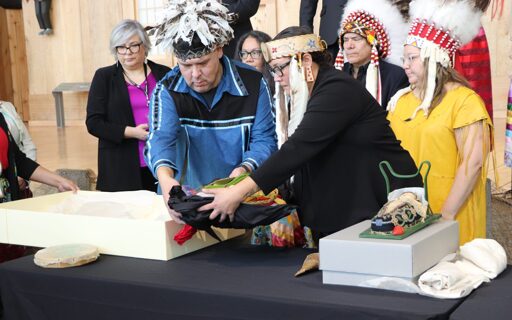

Leonard Akwiratekha Lazore, grand chief of the Mohawk Council of Akwesasne, and Anishinabek Nation Grand Council Chief Linda Debassige uncrate items returned from the Vatican on March 10. Photo by Julie Chadwick
Smudge smoke wafted through the Canadian Museum of History’s grand hall last week, as dozens of Indigenous cultural belongings made their homecoming from the Vatican Museums archive.
Dozens of First Nations chiefs, leaders and supporters from across the country gathered at the “Gatineau, QC” museum on March 10 as five of the artifacts were ceremonially uncrated. Another 47 items were held back to share in a private ceremony later that day.
Sixty-two items in total were returned on December 6, 2025, by Pope Leo XIV and will be transferred to their Indigenous home communities in “Canada” once they are all identified.
In a press conference after the event, Assembly of First Nations National Chief Cindy Woodhouse Nepinak said that the process of repatriation has been challenging.

AFN National Chief Cindy Woodhouse Nepinak says advocating for the return of Indigenous cultural items from the Vatican has been ‘a very difficult process.’ Photo by Julie Chadwick
Indigenous-owned belongings and ancestral art are housed in museums, archives and institutions all over the world, and AFN leadership has been a driving force behind the push for their repatriation.
“It wasn’t easy for First Nations. It was a very difficult process as national chief,” she said, and added that “it was a lot easier with the Vatican than it was sometimes within our own country.”
Nepinak described barriers in trying to liaise with the Canadian Conference of Catholic Bishops, noting that they were not at the repatriation event.
“In order to meet the pope, I couldn’t even go through them. I’m just going to be open and honest about it, because this is how difficult it has been,” she said.

Items returned that were ceremonially uncrated on March 10 included a baby cradle and embroidered gloves, which will be returned to their home communities. Photos by Julie Chadwick

Among the items uncrated last Tuesday were a tikinagan baby cradle, embroidered leather gloves from the Athabasca Chipewyan First Nation, a birch bark sap collector from the nearby Akwesasne Mohawk community and a bowl and spoon from the Manitoulin Island region.
The bowl and spoon were made by Anishinabek Nation Grand Council Chief Linda Debassige’s ancestor, whose great-great-great-great-uncle had carved his name into the bottom.
Debassige was careful to note that some of these sacred items “were not actually gifts,” as they’ve been described by the Vatican. The feeling came to her strongly during a private pipe ceremony earlier that day that was filled with the presence of ancestors, tears and love, she said.
“They were taken from people across this country. And today, while we recognize the unfortunate events that many of our people have been through, we celebrate the return of these ancestors to their homelands, to where they belong,” she said. “We welcome them home.”

Anishinabek Nation Grand Council Chief Linda Debassige has a family connection to one of the returned items, and says they are ancestors rightfully returning home — not ‘gifts,’ as the Vatican has described them. Photo by Julie Chadwick
Though their return is a significant step for “Canada,” Debassige also noted there were “dark times ahead” on the country’s path of reconciliation.
“We feel it today. We feel the rise of anti-First Nation hate across this country and an increase of residential school denialism, which are part of our true history. It’s part of our people’s journey. It’s part of this country’s legacy,” she said.
“So we ask government, allies, friends to join us in ending that. Let us recognize the truth and let us move forward in this journey together of true reconciliation.”
In the spring of 2022, a delegation of First Nations, Inuit and Métis traveled to meet with then-Pope Francis after the AFN issued letters and held regular meetings with the local Canadian Conference of Catholic Bishops seeking a Papal apology as part of wider reconciliation efforts.

A crowd views returned items at the Canadian Museum of History in ‘Gatineau, QC’ last week. Photo by Julie Chadwick
The apology from Pope Francis took place that July in the homelands of Maskwacis. This work continued under Pope Leo XIV and led to the arrival of artifacts to “Ottawa” via Frankfurt and “Montreal” on an Air Canada flight in early December. Some of these items included a century-old Inuvialuit sealskin kayak and a wampum belt.
But how did the Vatican get these belongings in the first place? Most of them were gathered and sent to Rome by Catholic missionaries between 1923 and 1925 as part of what became the Anima Mundi, a Vatican Missionary Exhibition organized by Pope Pius XI. This exhibition aimed to highlight the cultural, artistic and spiritual traditions of people all over the world, according to the Vatican Museum.
Though the Vatican also describes its own return of these belongings as “gifts,” and claims that they were “part of the patrimony received” as a component of the missionary exhibition, the majority of these items were actually stolen from these communities throughout the 1920s, according to Gloria Jane Bell, an associate professor of art history at McGill University, whose 2024 book Eternal Sovereigns details the history of this exhibition.

Indigenous leaders gather to celebrate the return of cultural items from the Vatican on March 10. Photo by Julie Chadwick
For the home communities, these ancestral items are so much more than artifacts, said Leonard Akwiratekha Lazore, grand chief of the Mohawk Council of Akwesasne.
“Knowing that one of our items is among those being returned is meaningful for our people. It’s not simply an object. It’s our history. It’s our connection to our past, our ancestors,” he said. “That’s how we pass on our culture with our children. It unites us.”
Lazore smiled as he recalled how as a child he would watch his dudah (grandmother) making baskets and how all the kids would fight over who got to help pull the splints so she could cut them.

Leonard Akwiratekha Lazore, grand chief of the Mohawk Council of Akwesasne, cradles a birchbark basket that was returned from the Vatican at the Canadian Museum of History on March 10. Photo by Julie Chadwick
“It was a part of being connected to her, as a part of something big,” he said. “There’s so much involved in this. It’s not just an item. There’s spirits into this. There’s a lot of energy into this.”
In April, delegates from the AFN plan to meet with Pope Leo at the Vatican, something Woodhouse Nepinak described as a “crucial opportunity” to advance the work that started under Pope Francis.
“The journey home for these items has been a long one but it is not over, just as our journey to reconciliation is not over,” said Woodhouse Nepinak in a statement.
“Our goal is to truly repatriate the items, to see them returned to their communities of origin. We will honour the work of our ancestors and continue our efforts to bring all our relatives home from all institutions, in Canada and across the globe.”
The post In ‘Gatineau,’ Indigenous leaders celebrate belongings returned from the Vatican: ‘We welcome them home’ appeared first on Indiginews.
From Indiginews via This RSS Feed.