

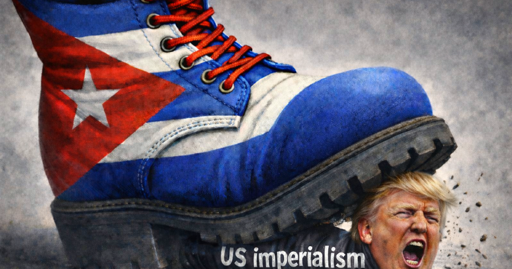

The recent events in Morón have once again exposed the real dynamics at play in Cuba: a people enduring material hardship under siege, and a handful of disruptive elements attempting to turn those hardships into political destabilization.
In the early hours of March 14, a group of individuals carried out acts of vandalism against the local headquarters of the Communist Party, setting fire to property and attempting to manufacture an image of generalized unrest.
Cuban authorities moved swiftly, arresting those responsible and identifying the acts for what they were — not legitimate protest, but criminal violence targeting the institutions of the Revolution. What followed is even more revealing — and largely ignored by hostile international coverage. Within hours, pro-Revolutionary forces mobilized in Morón, organizing a political act at the very site of the attack and reaffirming support for the Revolution, rejecting vandalism, and defending the country’s sovereignty in the face of provocation.
Addressing the situation, President Miguel Díaz-Canel Bermúdez issued a full and politically clear statement:
“We understand the frustration and discomfort that prolonged blackouts are causing our people. These are difficulties that have been intensified by the energy blockade imposed by the United States, which has become harsher in recent months. Complaints and demands are legitimate, as long as they are expressed with civility and respect for public order. What will never be understandable, justifiable, or acceptable is violence and vandalism that threaten the peace of citizens and the security of our institutions. There will be no impunity for vandalism and violence.”
This intervention draws a decisive line: recognition of hardship — and total rejection of attempts to weaponize it against the country.
Roberto Morales Ojeda, a leading cadre of the Communist Party of Cuba, reinforced this position, pointing directly to the root cause of the crisis. The worsening energy situation, he stressed, is inseparable from the tightening U.S. blockade, particularly its impact on fuel supplies, which has severely affected the national electrical system. While acknowledging the people’s frustration, he was equally clear: disorder, vandalism, and attacks on institutions are unacceptable, and respect for legality and revolutionary order will prevail.
What is unfolding in Cuba is not an isolated “social disturbance,” but a textbook case of imperialist pressure producing material strain, combined with attempts — however limited — to convert that strain into political rupture. The U.S. blockade, now intensified into an open economic and energy siege, is designed precisely to generate such conditions: shortages, blackouts, exhaustion — and ultimately, instability.
In that context, the role of so-called “dissident” elements becomes unmistakable. These are not neutral actors. Whether consciously or objectively, actions such as those in Morón align with a long-standing strategy aimed at undermining the Cuban state from within, feeding narratives that justify further intervention and pressure.
Yet the immediate response in Morón tells a different story than the one promoted abroad. The rapid mobilization of revolutionary forces demonstrates that Cuban society is not passively collapsing under pressure, but actively resisting — politically, socially, and collectively — in defense of its institutions and its sovereignty.
The Cuban leadership’s message is therefore clear and uncompromising: yes, the people face hardships — hardships deliberately intensified by relentless U.S. imperialist aggression — but the answer to those hardships will never be the destruction of revolutionary institutions, nor the surrender of national sovereignty. Those who attempt to exploit difficulties in order to destabilize the country stand exposed, whether they act from within or echo the designs of forces abroad. Cuba will not bow, will not break, and will not return to the era of submission — its path will be decided by its people, not by imperialist pressure or its local accomplices.
Also Read:
Cuba Sends Doctors. The USA Sends Bombs

From In Defense of Communism via This RSS Feed.