

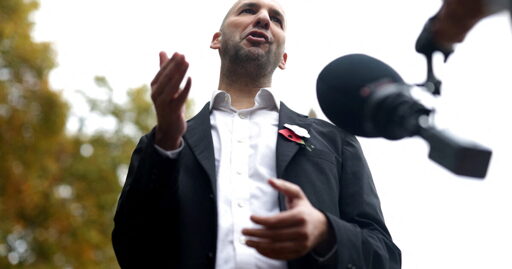
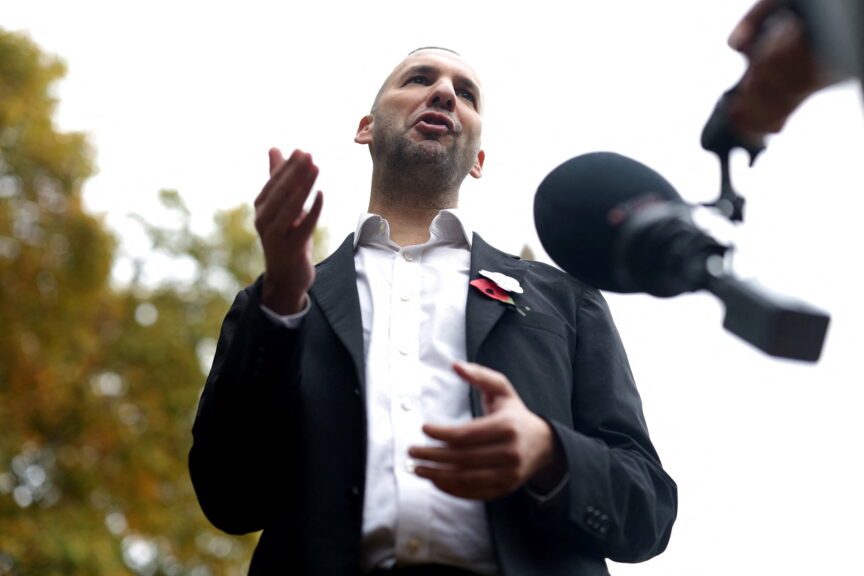
The scenes in the Green party press office were oddly familiar. Not a Mandelson-style tsunami of stories, but a slow drip. A weekly call – always 2pm on a Saturday – from a journalist on a 4pm deadline, requesting comment. More than one Green press officer worked for Labour during the Corbyn years, spending much of their time parrying accusations of antisemitism. Yet having recently been hired by the Greens’ first Jewish leader, they hadn’t expected to be thrown back into the fray so soon.
Some had hoped that liberal identity politics might insulate Zack Polanski’s party from allegations of antisemitism – how could a nice Jewish boy from Manchester possibly be thought to lead an anti-Jewish party? They were swiftly disabused of that notion. If anything, it’s made the press play dirtier: the Greens’ anti-Zionist stance would put Polanski against his own mother, the Daily Mail recently warned, while the Jewish Telegraph wheeled out Polanski’s old headteacher to brand him a disgrace, a favoured tactic of the rightwing Jewish press. For as long as it has been apparent that the Greens could become a force to rival Labour, it has been clear that antisemitism could be deployed to wrong-foot them in a way it couldn’t Reform UK. Farage’s would-be supporters don’t care if he was the class antisemite. Polanski’s do.
While the Green party was a political sideshow in the 2010s and early 2020s, Green antisemitism was a non-story. There were grumblings about a long-forgotten speech by a former deputy leader; a kerfuffle over which antisemitism definition the party should adopt. It wasn’t until around 2023 – soon after Polanski, a new style of “eco-populist” intent on raising the party’s profile by way of spicy tweets, was elevated to deputy leader – that the media’s antisemitism tennis ball launcher roared into life, volleying a steady stream of allegations the Greens’ way. It hasn’t stopped since.
“I do think it’s inevitable that as the Greens become more popular … [antisemitism] will continue to be a point of potential attack,” Em Hilton, international policy director of Diaspora Alliance, a Jewish organisation that combats antisemitism and its weaponisation, told Novara Media (Hilton and I worked together at the Jewish media outlet Vashti). “This is a way to undermine progressives.” Hilton’s organisation has been advising the party how to deal with antisemitism, both real and weaponised. The Greens’ press officers have also been swapping notes with Zohran Mamdani’s team, Novara Media understands.
There’s plenty of time for the Green party to succumb to an antisemitism crisis of its own. Still, many note that the accusations aren’t hitting like they used to, and not just because Polanski is Jewish. “We’ve wised up,” said Jo Bird, a Jewish Green party councillor expelled from Labour in Morgan McSweeney’s purge of the party left. “We don’t take every accusation at face value.” The days of being able to accuse someone of antisemitism for mispronouncing a sex offender’s name, it seems, are over.
The flea circus.
Just as energy cannot be created or destroyed, only change form, so too with antisemitism, or so the Greens’ accusers claim. By their logic, the “fleas” that Labour shook off in 2024 did not go away; they simply hopped onto a new host, bringing the scourge of antisemitism with them. Never mind that a disproportionate number of Labour exiles were themselves Jewish. People had built careers on sustaining this particular moral panic, and they weren’t about to give up now.
The Jewish Labour Movement (JLM), a Labour affiliate group originally founded to promote socialist Zionism within the party at a time when such a thing could plausibly be said to exist, latterly became a vehicle for rallying opposition to Corbyn’s leadership. Its parliamentary chair, Margaret Hodge, notoriously called Corbyn a “fucking antisemite” to his face. Aligned closely with the Labour right, JLM fell quiet when Starmer took charge, the cancer it had spent years endlessly re-diagnosing miraculously cured.
In May 2023 – two days before the local elections in which the Greens won an additional 241 councillors, almost half as many as Labour – the JLM took it upon itself to write to Green co-leaders Adrian Ramsay and Carla Denyer. In a stunningly chutzpadick letter, Mike Katz and Adam Langleben instructed their opponents to “avoid the temptation of becoming a refuge for those thrown out of Labour for antisemitism”. Denyer and Ramsay ignored them. A year later, JLM followed up, vexed by its apparent impotence. “Rather than heeding this warning, it seems that you have doubled down,” it said. “Please don’t ignore our letter this time,” JLM asked, in vain.
Yet if the Green party was content to ignore their opponents’ allegations of antisemitism, the media was happy to find them a home. From all the way in New York, the CEO of the Anti-Defamation League (ADL), Jonathan Greenblatt, raised the alarm about the Greens. The Times combed council candidates’ social media histories, while the Board of Deputies warned the party was “sinking into a growing cesspit of racism’’.
A weathervane of political nervousness, lobbyists began fearing reputational damage for associating with the Greens. Reform UK are “advanced in their preparations for government relative to other opposition parties, so it’s normal to try and influence their policy positions,” someone who works for one of the “B5” major business lobby groups told Novara Media. “But, despite their electoral gains and an economic policy platform growing in influence, some trade associations representing politically powerful industries still refuse to engage the Greens because of perceived antisemitism,” they said (they added that Polanski’s speech to the New Economics Foundation this week could begin to turn the tide, as the business community begins to see the urgency of engaging with the Greens).
Polanski’s landslide election as Green party leader in September 2025, and the subsequent “Polanski boom” in members (from 60,000 to over 200,000 in just 10 months), cranked up the heat on Labour. Its outriders began casually lobbing accusations of antisemitism at the Greens, though Labour’s HQ and front bench refrained, perhaps to avoid conjuring the ghost of Corbyn. Then the Gorton and Denton byelection was called, and the gloves were off.
“The honeymoon is over for Zack Polanski’s party,” an anonymous government source fumed to HuffPost UK, the day after Labour’s Andrew Gwynne resigned as MP for the Manchester constituency after his WhatsApp messages were leaked, including his sexist remarks about Angela Rayner and racist remarks about Diane Abbott (Labour councillor Jack Naylor, a fellow member of the group ‘Trigger Me Timbers’, also made antisemitic comments). “Under his leadership, the Greens have become a hotbed of anti-semitism and economic incompetence that would make Britain defenceless, drug-addled and bankrupt within a week.”
Much to the unnamed source’s chagrin, one imagines, their quote appeared in a piece not about the Greens’ antisemitism, their economic incompetence or reckless drug policy, but about Labour’s escalating smear campaign against the Greens.
Those criticising the Green party seemed repeatedly to miscalculate their influence over the news cycle. What they had failed to realise was that, in the time since the Labour antisemitism crisis, the political terrain had shifted dramatically, leaving their own moral standing far shakier. The reasons were manifold, but by far the most significant was Gaza.
‘See you again tomorrow, lads.’
In 2018, Polanski remarked that he couldn’t, as a “pro-European Jew”, vote for Labour under Corbyn. In my interview with Polanski last June, he expressed some regret about his former beliefs: “As someone who was new to politics, I really trusted the sensibles, the people walking around who sound like they know what they’re talking about.” Polanski cites Paul Holden’s book The Fraud, “which I think has laid out the cynical and systemic deliberate obfuscation of a really serious issue like antisemitism”, as having torn the scales from his eyes. “I believed what I was reading and what I was seeing,” he said in a recent interview.
(Polanski wasn’t the only one to be taken in: in November 2019, I wrote that my stomach turned watching a former Labour staffer recount how two party members accused of antisemitism had asked him, “Are you from Israel?”. It later transpired that the staffer had misrepresented the incident.)
Yet what really disabused Polanski of any notion of the credibility of Corbyn’s critics, now his critics, was the Gaza genocide. “Why would the Jewish Labour movement – a group standing alongside a government enabling genocide – comment on training within the Green Party?” he tweeted in 2024. “If we want to talk about conflation,” he told the Campaign Against Antisemitism, “let’s talk about how often you conflate being Jewish with the Israeli government.” He accused the Board of Deputies of much the same.
Corbyn’s team felt he needed to answer to his critics, because they retained a modicum of credibility. In 2018, they organised a long sit-down interview for Corbyn with the Jewish News, deemed less hostile than its competitor, the Jewish Chronicle. The Labour leader’s responses in that interview, as to all allegations of antisemitism, oscillated between insincere apology and spiky self-defence. Polanski’s, on the other hand, have taken one main form: social media clapbacks.
“Two days into a leadership campaign. And the Jewish Chronicle have written two articles about me,” he tweeted last May. “See you again tomorrow, lads.” (It helps that between Corbyn and Polanski, the Jewish Chronicle was embroiled in a scandal over its publication of a fake Israeli journalist, leading its last remaining centrist columnists to abandon it). If Corbyn was reluctantly jostled into appeasing his critics, Polanski has felt emboldened to return their fire. Both Polanski and the party declined to comment for this article.
The result of the Gaza genocide, said Hilton, is that the Jewish community is “more divided than it ever has been” on Israel, meaning “there’s an opportunity to show that there is really no such thing as a representative organisation”. Polanski has seized that opportunity with both hands. “I’m … blown away by the audacity of the few Jewish organisations who try to demand what Jewish people should say and feel,” he tweeted at the ADL’s Greenblatt in September. Next up was none other than the UK chief rabbi: in an interview with The Rest Is Politics in December, Polanski took aim at the hardline Zionist Ephraim Mirvis, whom he said doesn’t represent Jews. In January, Polanski engaged in a protracted social media spat with John Mann, Labour’s antisemitism tsar. The same critics who would have sent Corbyn’s office into a spin are now fair game.
Novara Media approached several Jewish communal organisations that declare themselves representative of British Jews in the UK, including the Board of Deputies, Jewish Leadership Council and Community Security Trust, asking whether they were concerned about antisemitism within the Greens. None responded to Novara Media’s request for comment.
“Those attacks don’t work anymore,” said Mish Rahman, a former Labour NEC member and recent Green defector, “when people have seen to what extent those parties – whether it’s Reform, Conservatives or Labour – are willing to excuse genocide.” He added that the Greens’ critics’ “attacks won’t land” in the way they did during the Corbyn period “because their hypocrisy and double standards have been laid bare since then.”
They certainly don’t seem to be working on Jewish Green party members. Manchester-based Rachel Cohen joined the Greens after seeing Polanski’s condemnation of the synagogue attack on a local synagogue in October last year; he was the only political leader, Cohen noted, who didn’t indirectly blame the attack on Palestine protesters. “I don’t feel I’m naive to the existence of antisemitism on the left – in fact, I feel it’s something I’m pretty fucking astute on” – her Dad wrote a book on the subject – “and it is not something I’ve personally experienced whatsoever [in the Greens],” Cohen told Novara Media.
Ditto Simon Kendler, a London-based Jewish Green who joined the party after bumping into Polanski in a park, and was shocked to discover what a “normal human being” he was. “In the short time I’ve been a member of the party, I’ve seen absolutely nothing, both in the local party or kind of nationally, from the likes of Green party spokespeople, that have suggested anything to be antisemitic,” he said.
Joshua Alston has been an active Jewish member of the Greens for 10 years (I previously commissioned Alston to write for Vashti). A much longer-standing member than either Cohen or Kendler, Alston has had hairy moments, but they’ve been few and far between. “I don’t think [the antisemitism I’ve encountered] is at all representative of the party … I’ve had my issues inside the party, but if I thought we were a party that was hostile to Jews, I would not be here.”
Stand by your man.
The result is that Green politicians feel increasingly protected from bad-faith attacks. Bird compares Labour’s response to complaints about her with the approach taken by the Greens. When, as a Labour councillor, Bird was accused of antisemitism, she was suspended immediately. Bird had joked about Labour’s “Jew process” privileging antisemitism complaints, a remark she described as a “self-deprecating play on words”; the Forde report effectively corroborating her, finding that Labour “was in effect operating a hierarchy of racism” with forms of racism other than antisemitism being “ignored”.
Yet when the Greens were later criticised for letting Bird stand as a councillor, Polanski leapt to her defence. The Greens are better, Bird said, at “and looking into the evidence of accusations rather than [issuing] a kneejerk suspension or apology. It’s actually making evidence-based decisions.” It helps that, unlike Corbyn, Polanski isn’t at war with his own party bureaucracy.
The Greens’ willingness to stand by its people is even starker in the case of Mothin Ali. If Polanski is, if not a nightmare, at least something of a hindrance for those who wish to portray the party as antisemitic, Ali is, as he himself put it to me, “the right wing’s wet dream”. A working-class religious Muslim complete with thawb, turban and long beard, the establishment identified Ali as someone who could puncture the Greens’ inflating popularity long before he became its deputy co-leader in September.
In May 2024, Ali was elected a Green councillor in Leeds. Within days of his election, the media was awash with stories about Ali’s supposed antisemitism. These stories focused on Ali’s comments about the 7 October attack, particularly his saying that Palestinians have the right to “fight back” (they do: UN resolution 45/130 “reaffirms the legitimacy of the struggle of peoples for independence, territorial integrity, national unity and liberation from colonial domination, apartheid and foreign occupation by all available means, including armed struggle”, though this must comply with international law). Ali apologised for the “upset” caused, saying, “I do not support violence on either side: violence leads to more violence and this is what I have tried to convey.”
After his promotion to co-deputy leader, Ali returned to the spotlight. This time, it was for his criticism of Leeds rabbi Zecharia Deutsch for serving in the IDF, which the Times reported had precipitated a barrage of threatening phone calls to Deutscher’s home. This time, Ali refused to apologise. What changed? The party leadership.
As the Greens overtook Labour in the polls – pushing them into humiliating third place in Gorton and Denton – Ali reentered the spotlight once again. Shortly after the US and Israel began their attacks on Iran, a pro-Israel X account claimed to have unearthed evidence of Ali attending a rally in support of the Iranian regime. JLM’s Katz strongly hinted that this was proof of Ali’s antisemitism: “The Iranian regime is … a direct threat to people here in the UK, particularly … the Jewish community,” Katz wrote.
The rally was in fact an anti-war demo organised by the Stop The War coalition. The prime minister amplified the disinformation regardless, saying it is “important that all of us set our face against antisemitism”. Three years ago, politicians and pundits might have reasonably expected a scalp. This time, they weren’t going to get one.
Where the former Green leadership encouraged Ali to apologise for his 7 October tweets, Polanski stood by his deputy, calling out the prime minister’s “Islamophobia” for “smearing” him. Ali demanded an apology from Starmer and wrote an opinion piece defending himself. The story rapidly became one not about Ali’s antisemitism, but about his victimisation by the media and political classes. The BBC, Independent and Guardian reported that police were investigating death threats made against Ali as a result of the false claim.
Arguably, the difficulty of attacking Ali over his views on the Iran attacks wasn’t just that they had been substantially misrepresented. It was that opposing Israel’s actions, whether in Iran or in Gaza, is now politically mainstream: recent YouGov polling found Britons opposed the US-Israeli attacks on Iran by 49% to 28%. 57% of Britons support a full arms embargo on Israel.
Yet for Corbyn, the nail in the coffin wasn’t his external critics, but his internal ones: the party “whistleblowers” and Jewish affiliate groups whose complaints were unscrupulously regurgitated by the media; the party machine that impeded the handling of antisemitism complaints. Such infighting could be brewing even among the famously collegiate Greens.
Is Zionism racism?
In mid-February, a Green party “whistleblower” briefed the Daily Mail that they had reported their party to counter-terrorism police. “Fears are growing that the party is becoming a breeding-ground for anti-Jewish extremists,” the Mail reported. The reason was a forthcoming motion submitted to the party’s spring conference, happening later this month, entitled ‘Zionism is racism’.
The motion, forwarded by a member of Greens for Palestine, is a strongly-worded attempt to assert the party’s “anti-Zionist” character. It commits the party to treating Zionism “as any other form of racism”; calls for the release of all Palestinian political prisoners, including Marwan Barghouti; and rejects both the IHRA definition of antisemitism and the Jerusalem declaration on antisemitism, both of which it says “have been weaponised to silence legitimate criticisms of the actions of the state of Israel”.
The motion builds on previous motions aligning the Green party with the Boycott, Divestment, Sanctions (BDS) movement and calling Israel’s assault on Gaza a genocide. It received 332 co-proposers, more than any in the Greens’ history (the party requires at least 11 members to endorse a motion for it to be considered for discussion; most receive just a few more than that).
The ‘Zionism is racism’ motion soon caught the media’s attention, with journalists pressing Polanski on it at every opportunity. It even made its way to the Israeli embassy in the UK, which released a statement saying the motion “provid[es] a justification for further antisemitic hostility”. “I can’t remember the last time the Israeli embassy went out of its way to comment on a potential motion being moved at a conference of a political party not yet in power,” said Bird.
For the first time, Polanski has found himself tongue-tied on the question of Palestine. The Green leader has struggled to orient himself to the motion, which clearly goes further than his own personal views. “It depends what you mean by Zionism,” he said when asked by LBC’s Iain Dale whether Zionism is indeed racism. Polanski will support the motion, he has said, if its definition of Zionism is what the Netanyahu government is doing in Gaza right now. It isn’t: the motion defines Zionism as a “political ideology”, not any one incarnation of it.
Less concerning to Polanski than what the media or Israeli embassy thought was the fractiousness the motion caused within his party. The motion has drawn the ire of the Jewish Greens, a Green-affiliated special interest group with around 150 members (including Alston).
Jewish Greens released a statement outlining its concerns with the motion, which it said risks disproportionately targeting Jewish members, since “most Jewish institutions in the UK have some sort of connection to Zionism”. The motion, the group added, “is likely to make Jews feel unwelcome in the Green party”. Greens for Palestine offered a detailed rebuttal, saying that the suggestion that Jews inherit the Zionism of their communal institutions “is to conflate the ideology with the people, the very error the motion seeks to correct”.
For Hilton, “the motion has the potential to become a very big political distraction”.
“I’m questioning whether, just before the May elections, that’s the fight they want to have,” he said. “I’m sure the rightwing press would love to have a conversation with the Green party about whether Zionism is racism for the next two months.”
Hilton’s question may now be moot. The motion is twelfth in the list of online motions for the spring conference, making it unlikely it’ll make it onto the agenda. The party may have avoided a furore just before the May elections, though by kicking the can down the road: party rules dictate that any motions not debated at this conference will receive priority at the next one.
Alston – whose brother, Sam, has proposed his own toned-down version of the ‘Zionism is racism’ motion, titled ‘Peacebuilding in Israel and Palestine’, which is likely to be debated at the conference, having been bumped in the autumn – is hopeful that the differences can be worked out amicably.
“We as Jewish Greens have been working really hard to make it so that it is not the case that antisemitism is factional in the Greens,” he said. What about the Daily Mail briefing? “At best overblown, irresponsible, and a total loss of perspective and at worst racist.” That kind of behaviour – preferring public laundry-airing to private conversation – was the hallmark of Labour’s antisemitism crisis. With voracious editors hungry for bad news about the ascendant Greens, the party will require considerable discipline to ensure it doesn’t fall into the same trap.
From Novara Media via This RSS Feed.