

As a reader-funded independent news outlet, we operate free from the influence of governments, advertisers, and corporate backers. This is essential to our mission: to report on what matters most, beholden only to the truth. In that spirit, we made a commitment to ensure that our journalism is free for everyone, not locked behind a paywall. But that means we rely on the voluntary support of our community of readers. Please consider making a tax-deductible donation to support our work today.
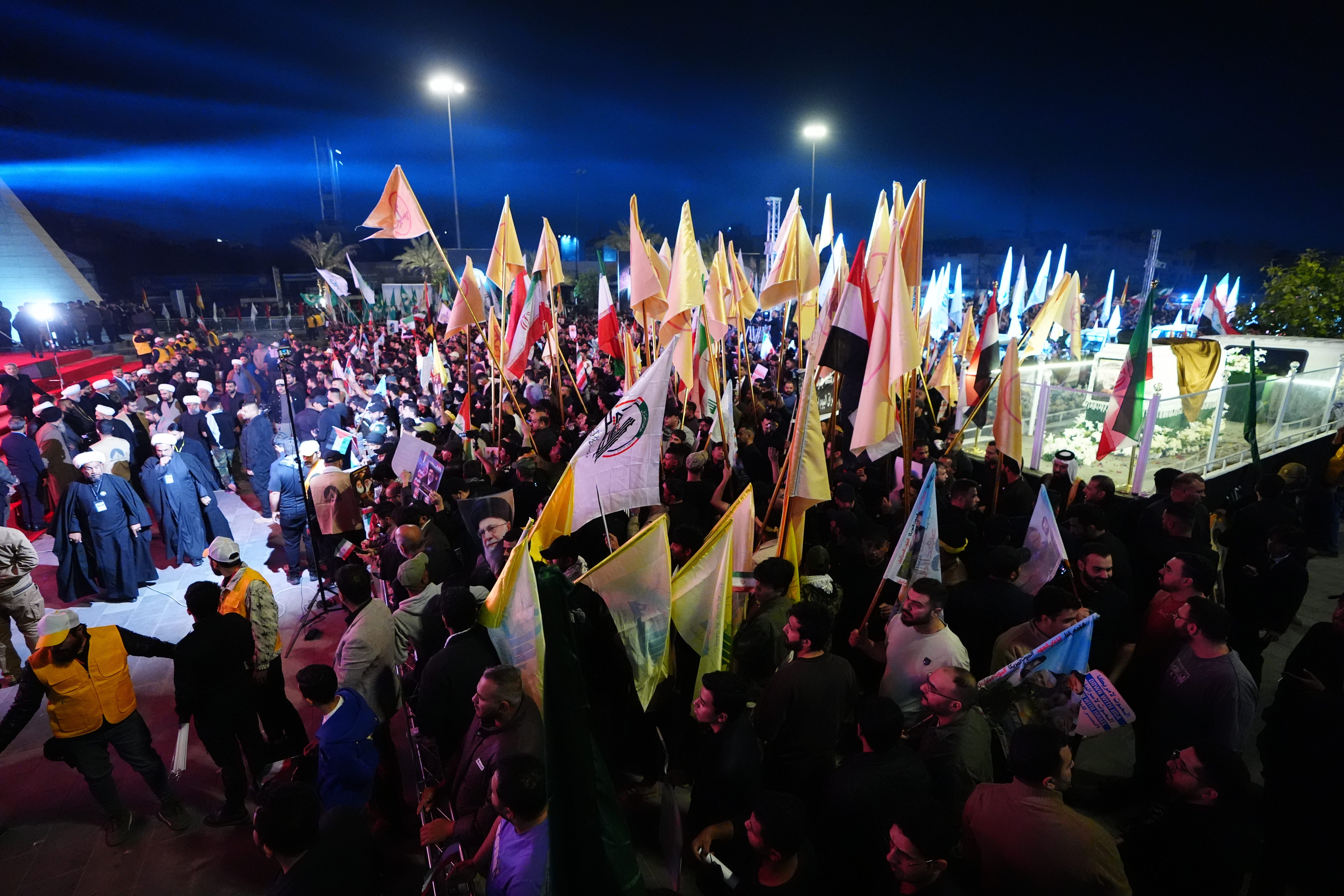
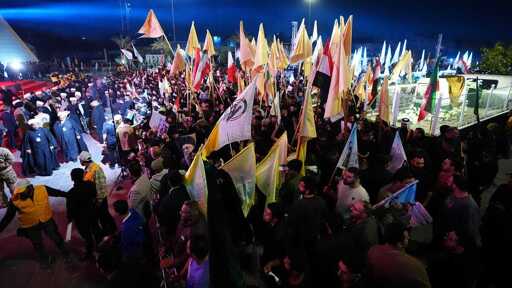
Hundreds of people gather at Tahrir Square in Baghdad, Iraq, on March 13, 2026, to participate in the ‘International Quds Day’ event in solidarity with the Palestinian people. Photo by Murtadha Al-Sudani/Anadolu via Getty Images
Story by Nabil Salih
BAGHDAD, IRAQ—Through two improvised checkpoints, men filed into Al-Ummah Park in central Baghdad’s Al-Tahrir Square on Friday to mark the celebration of Al-Quds Day (Jerusalem Day). Behind the artist Jewad Selim’s Monument to Freedom, a relic from a secular society that seemed so out-of-place and obsolete, a few hundred mourners gathered underneath a sea of paramilitary flags. A succession of defiant chants came in unison, condemning the U.S. and pledging loyalty to the Supreme Leader in Tehran. Projected on a giant screen before them were the smiling faces of Ruhollah Khomeini and his successor, the recently murdered Ali Khamenei. The image soon gave way to another, with Ali’s son, the new Supreme Leader Mojtaba Khamenei, flanked by his elders and crowned with the words “fa‘azazna bi thalithin,” a cursive allusion to a Quranic verse from Surat Yasin: “We sent them two messengers, but they rejected both. So We reinforced the two with a third.”
None of this was likely to impress U.S. President Donald Trump. As his air force rampages through history and geography, he placed a bounty on Mojtaba’s head and issued diktats on who may or may not be in charge in Baghdad. That night, “Death to America” rang against the derelict towers of Al-Tahrir. A child held an Iranian flag in one hand and an anti-Israel poster in the other. His fragile voice struggled to match the cacophonous chorus from the surrounding men: “Yes! Yes! Khamenei!” The Iraqi tricolor was a rare sight.
Looming over the commotion was the immeasurable calamity of the U.S.-Israel war against Iran, a regional conflagration into which Iraq, and the crisis of its government formation, have already been pulled. Only a few years ago, in 2019, hundreds of thousands of protesters marched into Al-Tahrir against the U.S.-made regime and its neoliberal policies. Hundreds were mowed down with impunity by militiamen and security forces. In Al-Tahrir, their faded slogans and graffitied art remain, profane traces from a defeated generation. Now, 23 years after George W. Bush and his neoconservative mob bombed Iraq into a fractured death world, U.S.-Israeli strikes have returned, committing massacres against the destitute youth who fought the terror the War on Terror had engendered in the image of the Islamic State. By March 12, 27 members of Al-Hashd al-Shaabi, the constellation of paramilitary units also known as the Popular Mobilization Forces, were killed and 50 others were wounded.
A few days later, on March 16, news of another massacre came from the border town of Al-Qa’im, in western Iraq. Sabah al-Nu’man, a spokesman for the Commander-in-Chief of the Iraqi military, said in a statement that eight paramilitary members were killed in “a treacherous aggression” that left seven others wounded. By the time news arrived in Baghdad, plumes of smoke towered over Al-Rasheed Hotel, a 1980s landmark inside the Green Zone where foreign reporters and diplomatic missions have long stayed. No casualties were reported.
Iraqis are not oblivious to Iran’s role in their politics, nor have they forgotten the corpses dumped by sectarian Sunni and Shia death squads in their streets during the occupation. But like the Shia, the paramilitaries are not a monolith. Not all factions are involved in the current mayhem, and their role in fighting the Islamic caliphate cannot be dismissed. The modest meals around which the fallen volunteers gathered are far removed from the extravagant villas of the Shia elite. Their images, already adorning city streets before the war broke out, have become a symbol of the country’s unspeakable inequality. After George W. Bush’s “regime change,” Iraqi bodies became superfluous. They filled morgues, perished along perilous migration routes to Europe, or joined the sprawling state apparatus and its paramilitary groups. Some still dare to die fighting in Vladimir Putin’s army for a living. The U.S. bombing is condemned by many, as are the paramilitaries’ attacks on oilfields and the misfiring rockets landing on people’s homes. The resurgent violence evokes familiar images, when decades of war erected the misshapen future they inhabit today.
On Friday night, security forces marked every corner and side street, their amphibious combat vehicles and SUVs blocking civilian traffic. Dozens of women sported black abayas and trekked from the downtown’s squalid sidewalks into the park. The buses shuttling them in were parked in lifeless streets nearby. Along Al-Saadoun Street, where Baghdadis once flocked into now-dead cinemas for the likes of Costa-Gavras and Jean-Pierre Melville, some two dozen school kids marched towards Al-Tahrir, a poorly choreographed spectacle missing its audience. Leading them was a flagbearer waving the Iranian flag. In their hands were images of the schoolchildren made forever asleep by the cowardly strike in Minab. The atrocity reminded Iraqis of both the 1991 Al-Amiriyah shelter massacre and the 1987 bombing of Bilat al-Shuhada’ elementary, where an Iranian rocket killed dozens and wounded hundreds of students in Baghdad during the Iraq-Iran war. I stood watching as a paramilitary parade coursed its way through the unlit avenue when someone dangled his penis and relieved himself on the curb. He busied himself with a phone call as the urine splattered between his legs. The procession passed; the pool of piss remained.
Later that night, three members of Al-Hashd al-Shaabi were assassinated in Arasat al-Hindiyah, a former bourgeois neighborhood where Saddam Hussein’s cronies caroused before the new Shia elite moved in. Among the murdered was a prominent figure in Kata’ib Hezbollah known by his nom de guerre Abu Ali al-Ameri. At dawn, the U.S. embassy was attacked for a second time since the start of the war. It later urged U.S. citizens to leave the country at once. The “Islamic Resistance in Iraq” put a $100,000 reward for tips leading to the capture or elimination of U.S. officials—and claimed responsibility for the downing of KC-135 refueling aircraft and the death of its six crew members. U.S. Central Command denied the claim, saying “the loss of the aircraft was not due to hostile fire or friendly fire.”
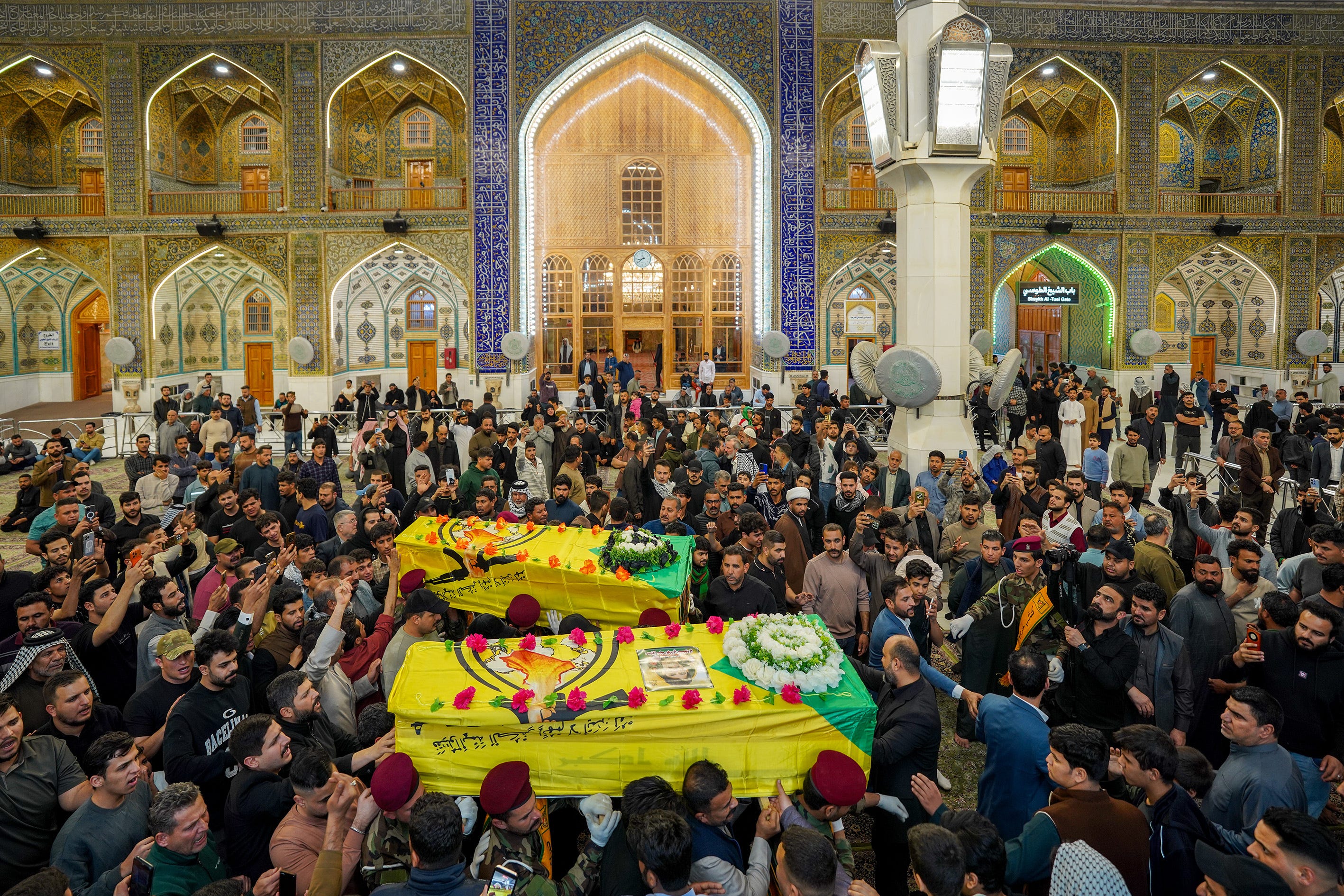
Coffins of Kataib Hezbollah members killed in a US-Israeli airstrike in Iraq are carried during a funeral ceremony at the Imam Ali Shrine in Najaf, Iraq, on March 14, 2026. Photo by Karar Essa/Anadolu via Getty Images.
After Al-Ameri’s murder Kata’ib Hezbollah announced the death of Abu Ali al-Askari, another senior figure. A chasm widened within the Shia establishment. Qais al-Khazali, leader of the powerful Shia paramilitary group Asaib Ahl al-Haq, said “let the criminals know their punishment would be severe.” Kata’ib al-Imam Ali, whose units were the target of repeated strikes, said “our partners at home” had tipped off the Americans, and “both the murderers and the agents shall pay a heavy price.” Kata’ib Sayid al-Shuhada, whose positions were attacked by Apache helicopters on March 7, issued repeated statements urging the state to protect its torn sovereignty. As the incumbent Prime Minister Mohammed al-Sudani reiterated a tired message that Iraq will not be “a launchpad” against its neighbors, a Telegram channel affiliated with Kata’ib Hezbollah issued another statement threatening to attack Syria in the event of “any hostile move” from Damascus against Hezbollah, the staunch ally repelling another attack on Lebanon. Al-Sudani dismissed a number of intelligence officials and pledged to hold those jeopardizing Iraq’s stability to account, but few believed he’d act on his words. One paramilitary member threatened to “cut the ears and shave the moustache” of anyone who stands in the way. By Sunday, images from a local TV station showed another drone winding its way to U.S. positions in Baghdad. By nightfall, a succession of explosions rattled western Baghdad, targeting Victory Base and the Baghdad Diplomatic Support Center, a U.S. logistic and diplomatic hub near the city’s airport. Security forces said five were wounded, including an engineer. Saraya Awliya’ al-Damm offered another version, claiming to have killed six U.S. troops and wounded four others.
I spoke with Safaa Khalaf, the analyst and investigative journalist, in a self-imposed exile in Norway. He said, “the current escalation exposes the fragmentation of Iraq’s political order, proving the failure of the political system in transitioning towards an accountable state in control of its political and security decisions more than twenty years after the U.S. invasion.” By Friday, the government resembled a harmless spectator. A French soldier was also killed in another drone attack in Kurdistan, where the Islamic Resistance has been launching barrages against U.S. and NATO forces. Italy was forced to pull its troops out of Camp Singara in Erbil.
The Next Head of State
Suspended over the broiling turmoil is the question of the next Iraqi head of state. The Coordination Framework, the ruling coalition of Shia parliamentary blocs, is torn between placating Washington and preserving their domination over the state apparatus or succumbing to pressure from the Western hegemon and finding its alternative in Al-Sudani, whose Reconstruction and Development bloc won the parliamentary elections in the fall. In a column for the Arabic-language newspaper Al-Sharq al-Awsat, Iraq’s top judge Faiq Zidan opined on a decades-old question. He said, belatedly, that according to the Iraqi constitution, the “largest parliamentary bloc” is the one that wins the election, not the one later formed, after backroom deals are sealed.
It remains unclear what impact his words will have on government formation, and the backroom intrigue continues. Nouri al-Maliki, the discredited former premier, is grooming himself for another stint in power, and behind him lurk a host of political figures and an embattled Iranian regime keen on preserving their material interests in Iraq. A leader of the Da‘wa Party, he is a pillar of Shia politics. Despite his contempt for the lower caste followers of the Sadrist movement, his anti-Sunni rhetoric, and the blame he assigned the Kurds for the rise of the caliphate, he is the image of the strongman needed by an increasingly obsolete generation of exiled Shia politicians to overcome their anxiety in a shape-shifting region.
But Al-Maliki was singled out by Trump. “I’m hearing that the Great Country of Iraq might make a very bad choice by reinstalling Nouri al-Maliki as Prime Minister,” Trump said on Truth Social. “Last time Al-Maliki was in power, the Country descended into poverty and total chaos.”
He was right. “Iraqis’ [collective] memory is burdened with distressing memories,” Sajjad Salim, a former parliamentarian who rose to prominence after the anti-establishment uprising of 2019, told me over the phone. In Al-Maliki’s first year in power alone 30,000 civilians perished in violence, according to Iraq Body Count.
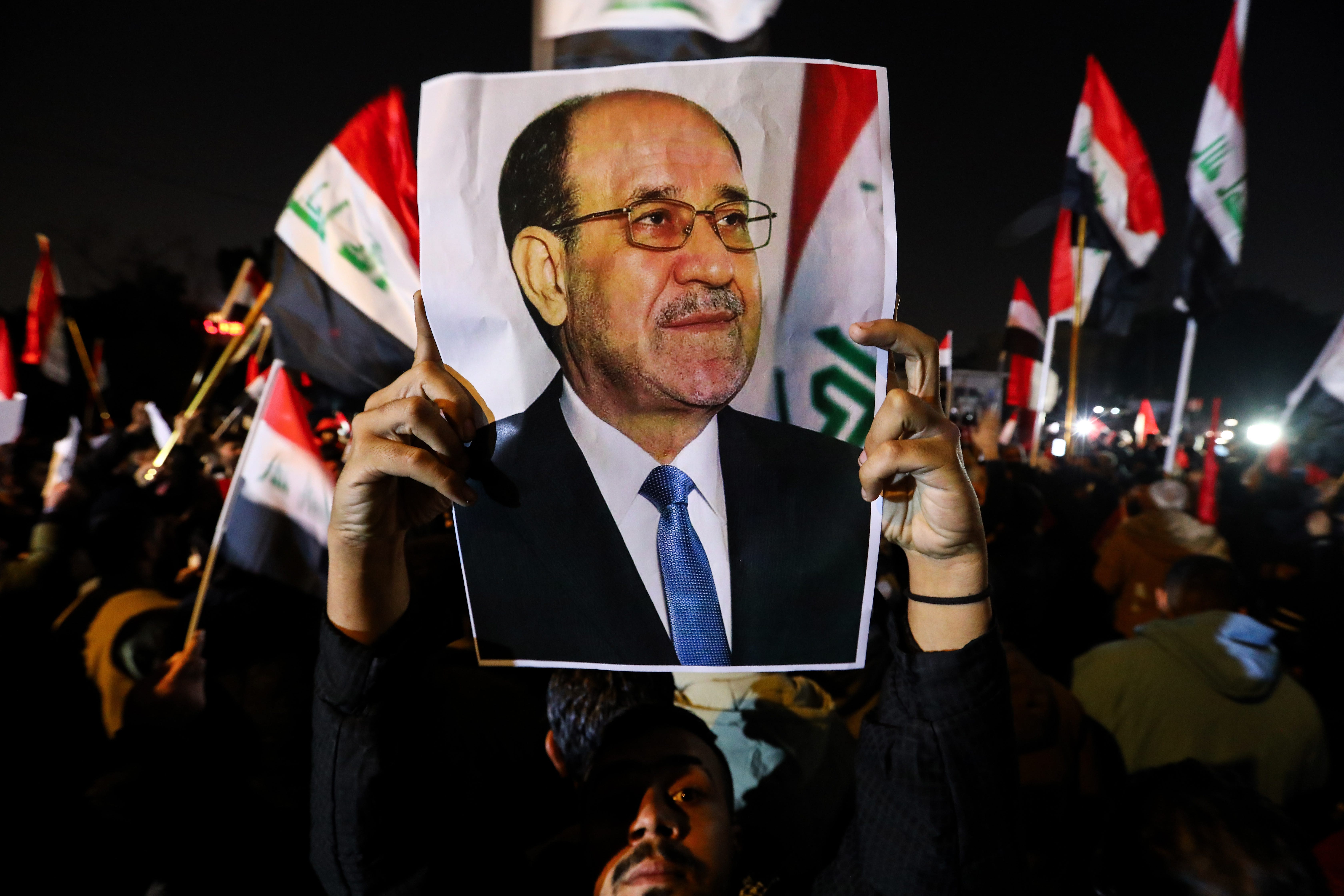
A protester holds a portrait of former Iraqi prime minister Nouri al-Maliki during a protest against President Donald Trump near the U.S. embassy in Baghdad, on January 29, 2026. Photo by Ameer Al-Mohammedawi/picture alliance via Getty Images.
The Coordination Framework’s intent to sponsor Al-Maliki’s political rehabilitation has shocked Iraqis. Nida Alahmad, a University of Edinburgh professor whose forthcoming book concerns the Iraqi state and its undoing, told me that “Al-Maliki is a figure that is closely associated with the forces that are understood to have fragmented the state and are benefiting from this fragmentation.” His image was irredeemably stained by lethal crackdowns on civil dissent and the failure to protect Iraq’s territory before the advance of the Islamic State, a time when an army of nonexistent “ghost soldiers” drained the state’s revenues but evaporated in time of need.
The consequences of Al-Maliki’s rule are enduring. Kali Rubaii, an anthropologist at Purdue University, told me in an email exchange that “the post-2003 regime joined the U.S. in its deployment of War on Terror rhetoric to justify shutting down popular demands and deploying coercive force as a modus operandi that ultimately dismantled safety, security, and wellbeing among the general population.”
By nominating Al-Maliki, the Coordination Framework reminded Iraqis of the disposability of their lives. But his successors didn’t fare much better, allowing the murder, displacement, and assassination of thousands, most recently the anti-imperialist women right’s defender Yanar Mohammed, the co-founder of Organization of Women’s Freedom in Iraq who was killed by two gunmen outside her Baghdad home this month.
“Regardless of the changing faces in power for the past quarter century,” Rubaii told me, “Iraqi people have been shouldering the immense imperial burden of the War on Terror, including the insulting rhetoric of salvation by subjugation.”
Before the unprovoked U.S.-Israeli aggression against the Islamic Republic, the U.S. envoy to Syria and Ambassador to Turkey Tom Barrack met with Al-Maliki in Baghdad to convey Trump’s diktats that it “should not be allowed to happen again.” Al-Maliki was adamant that he would not withdraw his nomination. He later made overtures to Washington, pronouncing on X his intention to reform the system and, of course, opening Iraq’s market to U.S. and European businesses.
But Al-Maliki has long been seen as a strong ally of Tehran. Salim, the former MP, told me that Iran still “has the long hand” in Baghdad’s politics. After the fall of Bashar al-Assad and the onslaught on Hezbollah’s leaders and Lebanese territories during the ongoing genocidal war against the Palestinians in Gaza, Iraq resembles Iran’s “last bastion of [defending its] national security.” Now a regional war is shuffling positions and forcing reconsiderations.
As Tehran and the region’s capitals erupt in flames, Shia elites and armed factions seemed to be initially at odds. Against the fiery statements of factional leaders, Al-Maliki retracted his condolences on X for Ali Khamenei. He called for restraint, insisting the next government should submit to no ‘axis’ and maintain its independence. Paramilitary leaders have opened fire on Shia politicians.
Earlier in March, I stood under an overpass where paramilitaries and their supporters protested, wanting to storm the Green Zone over the Tigris. Bitter chants rang through the night. Al-Sudani, who had been trying to curb their activities, was heckled as “a coward” and “an agent.” On March 12, Sadiqoun, the political front of Asaib Ahl al-Haq, said that “sovereignty” needs to translate into concrete actions rather than remain a vacuous term in official jargon. The previous weekend, parliamentarians were filmed chanting and making their allegiance to Khamenei heard, condemning the U.S. and Israel and hailing praises over the resistance. Abu Alaa’ al-Wala’i, the secretary-general of Kata’ib Sayid al-Shuhada’, describes the crisis as “an existential war against the Shia.” It requires rising to the challenge, he said, when many are hesitant to take a position on the side of the Islamic Republic and its allies. Akram al-Ka‘abi, the leader of Harakt al-Nujaba’, issued one scathing invective after another. Perhaps irked by Al-Sudani’s timidity and Al-Maliki’s overtures to Trump, he lashed out against those yet to condemn the U.S. actions and still “pandering to the Americans.” The cause is not negotiable, he declared, inviting fellow Arabs to form their own armed factions, to which he’d be open to bring his expertise, a statement that would only raise the concern of Iraq’s neighbors in the Arabian Peninsula.
By Friday, after a week of silence, Al-Maliki was abandoning his cautiousness for a caustic condemnation of “the American-backed Zionist forces.” The paramilitaries’ pressure had paid off, and Al-Sudani now seems to be on the back foot.
It was in the early years of occupation, Alahmad told me, that “militia-backed political groups with strong ethno-sectarian agendas moved into the space of state authority and have since then firmly consolidated their demarcated domains of authority over Iraq’s economy and politics.” Some had fought alongside Iran in the 1980s, others joined U.S. mercenary James Steele in his torture chambers. Al-Maliki had fought some of them in his early years in power, most notably Muqtada al-Sadr’s Jayish al-Mahdi. Al-Sadr, having won the 2021 elections, has withdrawn from politics and decided to be on the sidelines in the current upheaval. The popular cleric’s Shia foes have since closed their ranks and formed their own government, represented by the Coordination Framework’s current front man, Al-Sudani. Now both the paramilitary groups and the genocide enabler at 1600 Pennsylvania Avenue have their own visions of what the next government should be.
While it is tempting to overstate the intra-Shia rift, both the leading Shia figures in the porous apparatus that lends the paramilitaries their legitimacy and the very paramilitaries that undermine the state share an interest in the regime’s longevity. As Khalaf puts it, hinting at the repeated suppression of peaceful uprisings, “the Shia political actors that run the state and control its political and security affairs have long found a protector in these groups.” After the toppling of Al-Assad’s regime in Syria and the takeover by Ahmed al-Sharaa, what the U.S. wants is another vassal, one “beholden to a new imperial hegemony [and] sponsored by Washington.” It is a shoe that many Shia, including Al-Maliki, have comfortably filled before, their affiliation with Tehran notwithstanding.
Al-Sudani has so far been busy with masquerading this ruin. His infrastructure projects allowed real-estate investments and corruption to bloom, turning an ancient capital into a gentrified caricature no different than Doha and other “old towns” in the Gulf. In Sharm el-Sheikh, Al-Sudani posed with Trump before the cameras. Trump mumbled something about “plenty of oil.” The two gave cameramen the thumbs-up. Al-Sudani’s urban spectacle channels the illusion of progress, espousing the state’s interests with that of a budding class of nouveaux riches and elite investors. But the proscenium might be coming down before the play is over.
Nabil Salih is a writer and photographer from Baghdad. His writing has also appeared in the London Review of Books and the New York Review of Books, among other publications. He is an incoming PhD candidate at the Geneva Graduate Institute. Follow him @NabilAlMafrachi on X and @nabilsalih.bsky.social.
From Drop Site News via This RSS Feed.