


Amelia Schafer
ICT
RAPID CITY, S.D. – Standing in a showroom with a team of seamstresses and 10 seconds of an R&B hit from the late ’90s looping on her phone, Samantha Pourier, Oglala Lakota, plans the next comedic TikTok for her family’s small businesses, 3 Feathers.
Benjamin Leedom, Northern Cheyenne and Santee Dakota and founder of 3 Feathers, takes the lead, pretending to sing soulfully into a pair of fabric scissors as Pourier and four employees dance behind him.
“Coming up with the caption is the hardest part,” Pourier says afterward, trying to figure out what humorous text to put on top of the dance video. She settles on the caption “How customers expect us to handle all requests,” poking fun at the overwhelming amount of orders the business has received for graduation star quilts.
Just an hour after posting, the video already has 5,000 views on Facebook.
For small business owners Leedom and Pourier, social media became a saving grace after the COVID-19 pandemic and since then has maintained a unique way for the business to stand out during its 16 years in operation.
Back in 2010, having just finished his time in the navy, Leedom was living in Albuquerque and looking for a way to become an entrepreneur. As a kid, he’d used his talent for sewing to save money and buy sneakers, something he’s also always been passionate about. So at 26 he launched 3 feathers, the name being a nod to his favorite basketball player Allen Iverson and a classmate with a cool last name from grade school in Lame Deer, Montana.

Ben Leedom, Northern Cheyenne, demonstrates his circle technique on a long arm quilting machine at his storefront in Rapid City, South Dakota. (Photo by Amelia Schafer, ICT)
The business has since become a way to provide for his family and community. And 16 years later, he said it’s taken him further than he could have imagined with a brand new storefront in Rapid City, South Dakota.
But business hasn’t always been easy, he said. 3 Feathers, which specializes in high quality star quilts but also includes a clothing line, primarily sold its products at large events like powwows and conferences prior to March 2020. Once the pandemic hit and everything shut down, the business needed to find another way to sell.

Ben Leedom poses for a photo in front of three star quilts made by his business, 3 Feathers. 3 Feathers is preparing for the grand opening of its store front in Rapid City, South Dakota. (Photo by Amelia Schafer, ICT)
Leedom said the business had already been using its Facebook for free quilt giveaways and had amassed a large following from the online event. So the couple decided to use that following to promote in a new way, through Facebook live streams.
Facebook itself is highly popular among Indigenous people in the United States and Canada. It’s a way for Indigenous communities and people of all ages to stay in touch, provide information about cultural events like powwows or plan ways to organize politically.
During the Standing Rock Dakota Access Pipeline protests, Facebook was a primary tool for spreading information across Indigenous communities. Since then, it’s been paramount to raising awareness for Missing and Murdered Indigenous people and sharing information about causes.

The 3 feathers crew poses for a photo at the business’s storefront in Rapid City, South Dakota. (Photo by Amelia Schafer, ICT)
For many, particularly elders, it’s the most accessible social media platform, having remained one of the largest social media sites for over a decade.
So Leedom, someone who’d been using Facebook almost since its inception, decided he would start streaming himself sewing on Facebook live while simultaneously working to engage his audience. He’d dress up like Uncle Rico from Napoleon Dynamite and find ways to make his streams dynamic.
Six years later, their business has continued to harness social media not just when it comes to advertising but as a chance to make others laugh and a way to continue the brand and quilt’s tradition of giving.
As Tiktok and other short video platforms exploded onto the scene, the business continued to adapt. Leedom said staff members encouraged them to use trending audios and dances to promote the products and eventually staff members got comfortable enough that they’d join in and even star in some of the videos.
In one video, seamstress Tricia Withorne, Sisseton Wahpeton Dakota, and another employee reenact a scene from hit movie “Stepbrothers” in which one of the brothers touches the other brother’s drumset. Instead, “the drum set” is replaced by a pair of fabric scissors, something every sewist knows never to mess with or cut anything other than fabric with.
“It’s definitely a huge tool in our marketing,” Leedom said. “For some people, I think more than ever, with where this world is today, I feel like we’re a breath of fresh air. It’s almost needed to just brighten their day even if it’s just for a few seconds.”

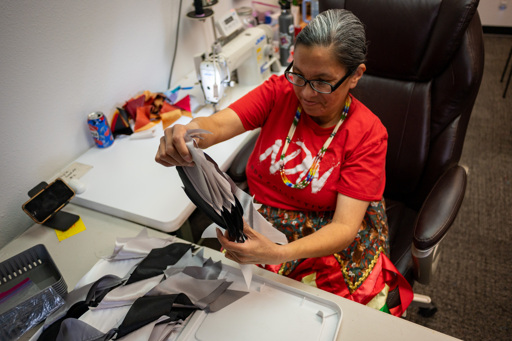
Allison Bear Nose, Oglala Lakota, sets up her industrial sewing machine at 3 Feathers in Rapid City, South Dakota. (Photo by Amelia Schafer, ICT)
Leedom said the business doesn’t profit from the individual views garnered by each video; instead, the focus is on spreading awareness for the brand and products. When they go live, whether it’s to chat while sewing or otherwise, Leedom said they often notice an uptick in quilt sales on the shop’s website.
But it isn’t all about profit or sales, a huge part of the brand is rooted in community and giving back, the very tradition the star quilt itself was born from.
Star quilts, quilts made with a lone star pattern, have been used for generations as a sacred form of gift giving. The quilts are given to newborn babies, high school and college graduates, newly weds, featured prominently at funerals and also just to show respect. To give a star quilt is to show the utmost form of respect for someone else.
The quilts are rooted in Indigenous plains culture, replacing a previous tradition of giving buffalo hides out to honor individuals. As buffalo became scarce and settlers moved into the great plains, Indigenous people began learning how to quilt from European settlers, missionaries and neighbors.

3Feathers employees are preparing for the grand opening of the business’s store front in Rapid City. (Photo by Amelia Schafer, ICT)
The star, something already extremely present in Plains cultural artwork, was quickly and easily adopted, sparking a new tradition spanning centuries.
For some, like Leedom’s ancestors, learning to make these quilts was also a light in the darkness. Leedom said his great-grandmother, Santee Dakota, shared with him that many of her people had been taught to quilt in boarding schools.
“They were able to turn a negative into a positive,” Leedom said.
For Leedom, looking for freedom and to carve his own path after serving in the military, making star quilts is almost therapeutic.
Leedom said the company’s social media first took off from their quilt giveaways, where the business will post on social media asking for users to follow the page, comment, like and share the post for a chance to win a free quilt. For every quilt given away during the live steam, Leedom said they’ll choose someone in need to fundraise for.
“That’s my favorite part,” Leedom said. “Being able to help people that need it more than ever.”
Most recently, Leedom picked a local woman with a family of six who was recently diagnosed with cancer to fundraise for.
For an hour, Leedom shared the woman’s donation information on the 3 Feathers livestream. Whoever donated would be put in as an entry for a free star quilt.
The company’s queen sized quilts retail for $400 each. Despite tariffs and inflation affecting the price of materials like satin, Leedom said he refuses to raise quilt prices.
Being a small business owner is hard, it’s something Leedom can attest to. Since starting 3 Feathers roughly 16 years ago, the business has come with many ups and downs and different struggles. On multiple occasions he’s felt like giving up, but they never do, he said.
“I know the potential, I know what it could be,” Leedom said. “We try to give back as much as we can, the bigger we get, the more we’ll return.”
The quilts are in high demand, especially in the spring during graduation season. Each star quilt is handmade, there are no mass production facilities, at least not any used by communities. Because of this, Leedom saw the opportunity to create a business centered around making the quilts.

3 Feathers specializes in creating star quilts, which are given away at events like graduations, weddings and other honorings. (Photo by Amelia Schafer, ICT).
Six months ago, Leedom and Pourier began renting a store front on the northern most side of Rapid City. There, the business houses roughly four sewing machines and one quilting machine, with more quilters on the way. With less than 10 employees, it’s a microbusiness, but one that can produce roughly seven quilts per day.
The business primarily creates satin star quilts, but is also known for regular cotton quilts and crushed velvet designs. 3 feathers also produces its own clothing line, making apparel, shoe wear and other items.
Currently, the company primarily sources its satin from manufacturers on the east coast in states like New Jersey, which host the majority of the United States’s textile facilities. But in the future, Leedom aspires to have his own facility where the business can make and dye fabric and help keep production local.
The demand is hard to keep up with, Leedom said. Right now the company has 300 more quilts commissioned to make for graduations and has one tribe negotiating a contract for over 4,000 quilts.
Fortunately, 3 Feathers was able to obtain funding from the Shakopee Mdewakanton Sioux Community to purchase additional long arm quilting machines and the businesses very own embroidery machine. The tribe also helped obtain the building 3 Feathers is using, something Leedom said made him extremely hopeful for the company’s future.
From the storefront, 3 feathers also hosts weekly events for local youth and proudly displays the trophy the youth group won from a recent handgames tournament. Across from the trophy is a wall full of photos of people 3 feathers has gifted quilts to including notable figures like Bernie Sanders, Snoop Dogg and Ice Cube.
While the storefront is currently in operation when it comes to making quilts, it’s not open to the public quite yet. Leedom said he plans to have the business’s grand opening in April and begin offering a space for local artisans to sell their products and showcase their talents.
“We want to showcase artists, not just their products,” Leedom said. “We want to take you directly to the source, give you a story about them, because it’s so hard to be an artist, especially today.”
The post How one Native-owned business is combining Native humor and social media trends to market their products appeared first on ICT.
From ICT via This RSS Feed.
How one Native-owned business is combining Native humor and social media trends to market their products highlights how 3 Feathers uses creativity, community, and humor to connect with audiences while promoting their quilts. Their approach shows how social media can be a powerful tool for building both engagement and meaningful impact. You can read more about how structure and habits support motivation and growth in this article: https://betterme.world/articles/workplace-wellness-challenges/. It’s a good example of how combining consistency with creativity can lead to long-term success.
