

A version of this article originally appeared in The Deep Dish, our members-only newsletter.Become a member todayand get the next issue directly in your inbox.
Big tech’s influence on the current federal administration is undeniable. During his first term, President Donald Trump issued an executive order to promote AI research and development. Shortly after taking office last January, he issued another order to investigate and remove any barriers to AI adoption. The One Big Beautiful Bill Act (OBBBA), which Trump signed into law in July 2025, authorizes more than $1 billion in federal funding for AI projects.
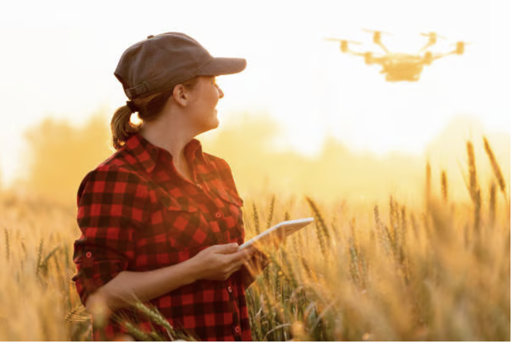
The intrusion of AI has spread to our food systems. In agriculture, an AI revolution is being widely promoted by those who stand to benefit: transnational corporations, banks, big NGOs, and governing bodies. Even though there are only 20 autonomous tractors in the U.S. as of 2025, John Deere has plans to go fully driverless by 2030. In seafood, Big Tech is also helping drive the push to expand offshore fish farming. This Blue Revolution—fashioned after the Green Revolution that industrialized agriculture in the 1950s and 1960s—describes the dramatic growth of farmed seafood since the 2000s.
Proponents claim this shift will make production more efficient and help feed the world. But as with previous food “revolutions,” we must investigate these claims.
Farmers today are being told that AI will future-proof their operations, boosting yields and streamlining their work. But in practice, many are signing away their data rights via complex “click-to-agree” contracts, feeding data into platforms they do not control. The tech firms behind these tools then sell the data to seed suppliers, animal and fish feed conglomerates, and pharmaceutical companies, which in turn sell their products right back to the farmers.
“Farmers today are being told that AI will future-proof their operations, but in practice, many are signing away their rights.”
TidalX AI, launched by Google’s parent company, Alphabet, is among the main groups lobbying the U.S. government to, for the first time, open federal waters to large-scale fish farming. The use of underwater cameras and AI underpins efforts to move operations farther offshore, even though doing so can increase risks and reduce the chances of spotting problems early. Last year, researchers reported more frequent and larger mass die-offs on salmon farms, partly due to reliance on technologies that attempt to “optimize” production in riskier environments.
While industrial aquaculture is often promoted as a source of new jobs, both aquaculture and agriculture face the likelihood that AI will replace workers with drones, automated feeders, and ground sensors to determine how much pesticide to apply, when, and where. The “fully autonomous farm” is coming into focus. This foreshadowing, along with continuing mass arrests of farm workers, begs the question: Will robots feed us when workers are deported?
To investigate whether AI will help feed people, we can look to previous tech shifts. It’s true that some tools have increased yields. Feed-measuring and herd-monitoring tools have boosted output per cow on dairy farms. New pesticides and precision methods have raised yields gradually and persistently for decades for soy and corn.
But higher yields have not guaranteed better access to nutritious food. The Green Revolution, for instance, made many farmers in the Global South dependent on synthetic chemicals that produce food of declining nutritional quality while contaminating ecosystems and posing dangers to human health. Moreover, traditional small-scale producers operating without AI have, by some estimates, managed to feed as much as 70 percent of our global population—even though they operate on as little as 25 percent of the world’s land.
“To investigate whether AI will help feed people, we can look to previous tech shifts. It’s true that some tools have increased yields, but higher yields have not guaranteed better access to nutritious food.”
The HEAL Food Alliance, a multi-sector, multi-racial coalition working to transform food systems, recently released a report on “precision” tech and AI tools in food systems. The report identifies a clear pattern: Corporations market these technologies as serving the public good, including as a climate solution. In reality, they consolidate corporate power and shift environmental costs onto communities and ecosystems. This diverts resources away from the farmer- and fisher-led solutions that keep ecosystems intact, support local economies, and strengthen food sovereignty. Food systems dominated by a handful of corporations are inherently vulnerable and unsustainable. Moreover, the data centers that power AI gobble up farmland and water, making it even harder for younger people to get into the profession.
We know that, as countries grow wealthier, the demand for meat and seafood rises. So the question remains: Will ramping up production in both agriculture and aquaculture improve food security—or simply expand the supply for premium markets and exports?
Here at home, as high-tech food production has increased, our food system has become more, not less, dependent on global trade. The U.S. imports about half of our fruit and one third of our vegetables. Seafood shows this dynamic even more clearly: American fishermen land more than enough wild seafood to meet domestic demand, but much of it is exported, while lower-quality imports are brought back.
This system does not feed people here or support the livelihoods of our food producers. It feeds global commodity markets, allowing corporations to move food wherever it fetches the highest return. The vulnerabilities of our globalized food system have surfaced repeatedly, including during the early stages of COVID-19, when farmers plowed their crops under and fishermen had no market for their catch. Just this year, retaliatory tariffs in Trump’s trade wars have further exposed our dependence on unstable global markets.
We know there are better solutions for feeding people, namely investing in local fisheries, small farms, and food systems at home that provide high-quality food while honoring ecological responsibility, fair pricing, and equitable access.
In this spirit, and challenging the various ag provisions in the OBBBA, more than 500 farmer and consumer groups have called for the “skinny farm bill” to include initiatives to restore SNAP funding, improve credit and land access, and make markets more competitive. As Congress revisits the farm bill, lawmakers should renew funding for Farm to School and Local Agriculture Market Programs, which directly support the food producers in our communities.
Similarly, Congress should reintroduce the Domestic Seafood Production Act (DSPA), which would improve working waterfront infrastructure, local processing, and training initiatives for seafood workers. Last year, a subset of DSPA, known as the Keep Finfish Free Act (KFFA), was introduced. Passing KFFA would bar federal agencies from authorizing large-scale finfish farms offshore without an act of Congress.
We need to keep a vigilant eye on each wave of tech change, asking whether it will actually feed people who grow and catch our food. Technology isn’t the enemy—until it’s monopolized and weaponized by corporations. Without guardrails, AI risks accelerating the extraction and exploitation already decimating our food systems.
The post Op-ed: The AI ‘Revolution’ Is a False Promise for Food Systems appeared first on Civil Eats.
From Civil Eats via This RSS Feed.