


20,000 people joined a demonstration in Rome to oppose reforms to the judiciary planned by Giorgia Meloni’s government, to be voted on in a referendum on March 22-23. The demonstrators – including grassroots trade unions, student associations, and women’s anti-militarist networks – warned the reform risks eroding existing safeguards securing the judiciary’s independence from the government, exacerbating the authoritarian turn promoted by the right-wing administration.
On March 14, protesters also assembled to denounce the government’s militarization drive and their endorsement of illegal US-Israeli attacks on Iran and the genocide in Gaza. The mobilization thus sent a resounding no to Meloni’s overall agenda, the left party Potere al Popolo emphasized. “‘NO’ to institutional rollbacks, starting with the referendum on March 22–23, through which the Meloni government is quietly tightening its authoritarian grip on democracy,” they said shortly after the event. “‘NO’ to the social war that the government wages every day against working people, against the homeless, and against those who can’t make ends meet.”
“The third ‘NO’ is aimed at the war economy and militarism, and the government’s complicity with the United States and Israel, a complicity they continue pursuing even as more war fronts open up,” the party added. “It’s no coincidence that the government is pushing for rearmament while simultaneously cutting public services: war is also a tool to divert attention, to mask inequalities with the rhetoric of an external enemy.
Read more: Militarization in Italy: from the war economy to the battle of ideas
The student organizations Cambiare Rotta and OSA highlighted the diversity of Saturday’s demonstration, seeing in it the best response to right-wing trends in Italy. “So many causes are driving this march,” they wrote on the day, “from supporting socialist Cuba … to campaigning for the more than 160 Iranian girls killed by imperialism, to efforts led by young people from working-class neighborhoods and squatter communities.”
Part of a broader authoritarian agenda
The government is proposing amendments to constitutional provisions regulating the judiciary system, including career paths of judges and prosecutors and the structure of magistrates’ governance and disciplinary bodies. Among other things, the reform foresees replacing the election of representatives to such bodies with lottery selection and selection from lists cleared by parliament. While Meloni’s ministers argue the reform is being pursued to improve the efficiency of the courts, progressive groups insist the changes have nothing to do with this, locating the reform in the same set of policies introduced by the far right to strengthen their grip over society.
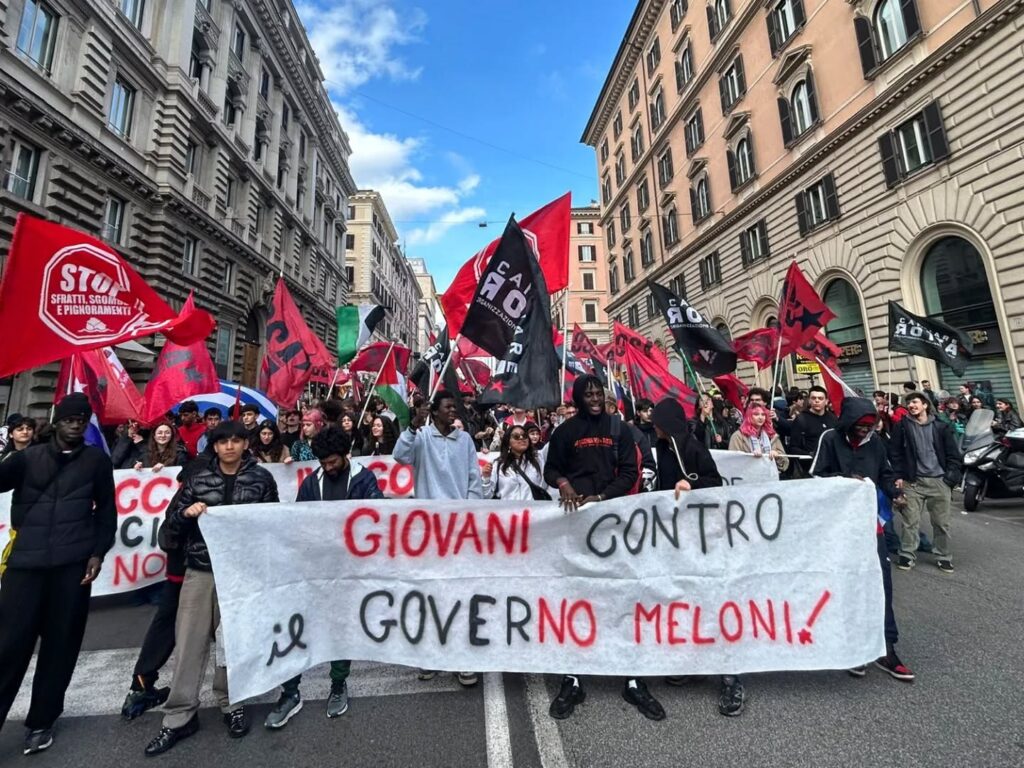
Student bloc at the demonstration, with banner reading: “Youth against the Meloni government”. Source: Cambiare rotta & OSA/Facebook
“Nothing in this reform serves the interest of the people,” Potere al Popolo warned ahead of the demonstration. “The real issue at stake and the reason we must mobilize, vote, and encourage others to vote ‘no’ is a significant shift toward a post-democratic system – what we might call a ‘democrature’ – where the judiciary’s self-governance, intended by the Constituent Assembly to balance executive power, disappears.”
At the same time as it promotes this reform, the Meloni government fails to address real issues burdening Italy’s judiciary, Potere al Popolo added, including chronic personnel shortages and precarious working conditions inside the system – giving even more reason to believe that the intent behind the reform is not benign.
Read more: Mediterranean dockworkers launch historic international strike
The co-organizers of Saturday’s demonstration insist that plans to reshape the judiciary cannot be viewed separately from other recent reforms, which overwhelmingly reduce space for democratic participation and criminalize dissent amid growing public opposition to the government’s policies. “This government has made it clear on multiple occasions that it represents the neo-corporatist and class interests of entrepreneurs, businesspeople, schemers, and wealthy elites,” Potere al Popolo warned earlier. It is in this context that the Meloni administration is seeking reforms to reshape election law and strengthen the institution of the Prime Minister, they point out.
Additionally, the notorious “Security” Decree foresees a number of restrictive measures to discourage or block people from taking part in protests, including hefty financial fines for organizers of specific types of demonstrations.
“This measure has two purposes: on the one hand, to increasingly undermine the organizational, associative, and union structures that effectively enable dissent and opposition to take shape in this country,” Potere al Popolo said of this reform. “On the other hand, to shift the public debate toward the issue of ‘security,’ diverting attention from more pressing issues like increased military spending, a reflection of the Meloni government’s subservience to the Trump administration, while the majority of the population sees their material living conditions deteriorate.”
Combined, all these reforms aim to place most control in the government’s hands ahead of the 2027 general election. “More power for the government, less power for parliament, and a judiciary redefined by political interests,” Potere al Popolo said of the agenda. “Together, these factors would create a level of centralization unprecedented in the Republic’s recent history.”
The post Mass demonstration in Rome against Giorgia Meloni’s “authoritarian” reforms and war appeared first on Peoples Dispatch.
From Peoples Dispatch via This RSS Feed.