

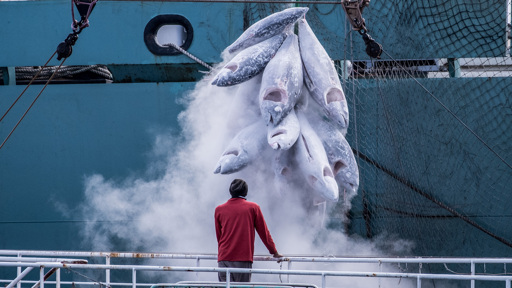
In public finance, some costs are politely kept off the books. The ocean has long been one of them. Governments often speak of “blue growth” and “sustainable use,” yet many policies still treat marine ecosystems as a kind of free input: available, resilient, and cheap to replace. The result is ecological decline. It is also a fiscal problem. States end up assuming risks they would not tolerate on land. Fishing provides a clear example. For decades, a large share of industrial effort has been propped up by public money. One influential analysis of high-seas fishing found that governments subsidized high-seas fleets by about $4.2 billion in 2014—more than the estimated net economic benefit of that fishing—and that without subsidies, as much as 54% of the high-seas fishing grounds currently exploited would have been unprofitable at the prices and costs prevailing at the time. The high-seas fishing fleet. High-seas vessels by flag state and gear type, as detected by GFW in 2016. Figure from Sala et al (2018) That framing is useful: some “profitable” activity may depend as much on government support and permissive accounting as on market demand. The subsidy patterns are not subtle. A summary of research on “harmful” subsidies lists the top ten providers in 2018, led by China at $5.9 billion and followed by Japan, Korea, Russia, and the United States. It also notes that these subsidizers spent more than $5.3 billion on fishing activity in the waters of 116 other nations, effectively shifting fishing pressure into…This article was originally published on Mongabay
From Conservation news via This RSS Feed.