

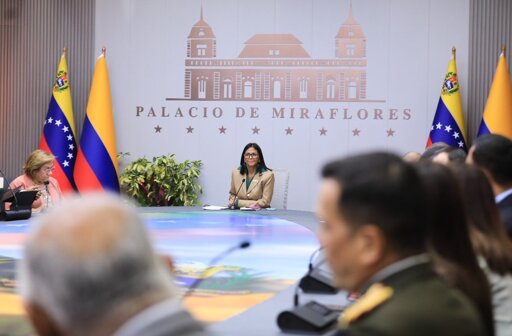
Mérida, March 16, 2026 (venezuelanalysis.com) – Venezuelan and Colombian high-level delegations met at the Miraflores Palace in Caracas on Friday, March 13, to advance a strategic roadmap for binational integration.
The summit, which focused on bilateral trade, energy, and security, culminated in the announcement of Venezuela’s first-ever export of liquefied petroleum gas (LPG) to its western neighbor.
Acting President Delcy Rodríguez led the Venezuelan delegation in the talks, overseeing a satellite broadcast of the first trucks from state oil company PDVSA carrying butane gas across the Simón Bolívar International Bridge from Táchira to Norte de Santander.
“This is the first step… the first LPG export from Venezuela to Colombia,” Rodríguez stated to reporters, characterizing the shipment as a symbol of the “Bolivarian spirit” of integration.
Beyond the immediate truck shipments, officials announced plans to revitalize the Antonio Ricaurte transnational gas pipeline. The project aims to facilitate the direct export of Venezuelan natural gas to Colombian markets, a move described by both governments as essential for regional energy security.
However, Colombian President Gustavo Petro noted via social media that full interconnection remains contingent on the lifting of US sanctions given the need for infrastructure repair works. For her part, Rodríguez reiterated calls for the Trump administration to remove unilateral coercive measures against the Caribbean nation.
“Unilateral coercive measures against the Venezuelan people affect the peoples of Latin America,” she said.
The 225-kilometer Ricaurte pipeline was completed in 2007 and was initially used for Colombian gas shipments to Venezuela. Plans to reverse the flow beginning in 2016 were hampered by US sanctions.
The Caracas summit also saw delegations review the recovery of commercial ties since the reopening of the border in 2022. According to figures shared during the meeting, binational trade has grown from US $220 million in 2020 to over $1.135 billion at the close of 2024.
To sustain this momentum, officials announced that the Administrative Commission of the Trade Agreement will be formally installed on March 18. The agency’s agenda will focus on achieving “zero tariffs” for specific goods and promoting binational tourism.
The Colombian delegation also emphasized the importance of the Monómeros petrochemical company, noting that its operation at full capacity is vital for Colombia’s food security. The agrochemical producer was placed under the control of the US-backed Venezuelan opposition by former Colombian President Iván Duque. The company was plagued by corruption scandals before being returned to the Venezuelan government’s control in 2022.
Monómeros, a major supplier of fertilizer for Colombian potato, coffee and palm oil producers, remains restricted by US sanctions, with Venezuelan plans to sell the company to the Colombian state contingent on US Treasury approval.
The two countries’ delegations likewise addressed joint security concerns during the Friday talks, activating an immediate coordination mechanism for sharing military and police intelligence.
The stated objective is to dismantle drug trafficking networks and counter irregular armed groups operating along the 2,200-kilometer border region. Petro described the goal as a the creation of a “Binational Zone of Peace,” emphasizing the importance of integrated military efforts to protect the territory.
The Caracas summit took place following the suspension of a planned meeting between Rodríguez and Petro at the Atanasio Girardot Bridge on Friday due to “force majeure.” Colombian outlets reported security concerns but offered no specifics.
Despite the setback, the Venezuelan government reaffirmed that the presidential invitation remains open and that the working groups at Miraflores had secured the “roadmap” for the coming months.
Colombian Foreign Minister Rosa Villavicencio, who led the Petro government’s delegation, praised the Caracas summit as a “great success” and vowed that “no one can split the Colombian and Venezuelan peoples” due to their shared history.
In the wake of the meeting with Colombian counterparts, Rodríguez announced the appointment of Admiral Orlando Maniglia as the new Venezuelan Ambassador to Colombia. Maniglia, who previously served as Minister of Defense and Ambassador to Germany, will replace Carlos Eduardo Martínez.
The two countries’ integration agenda will continue with the meeting of a bilateral commission on April 23 and 24 in Maracaibo, Zulia state. The upcoming summit will focus on migration, citizen rights, and the facilitation of free circulation across the border.
Edited by Ricardo Vaz in Caracas.
The post Venezuela and Colombia Advance Bilateral Agenda on Trade, Energy, and Security appeared first on Venezuelanalysis.
From Venezuelanalysis via This RSS Feed.