

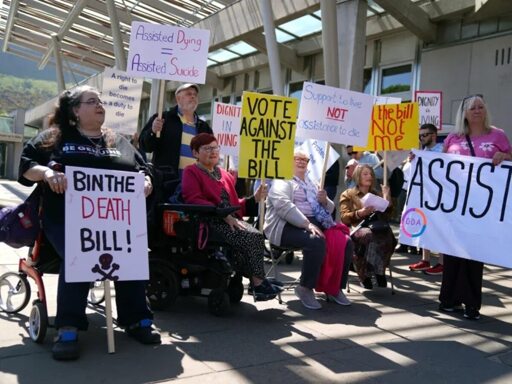

The final Holyrood vote on Liam McArthur’s Assisted Dying Bill takes place on Tuesday 17 March. Ahead of the vote, research shows significant concern in Scotland about its potential impact on disabled people.
Campaign group Not Dead Yet UK commissioned the poll. It also indicates that concern is stronger still among disabled people.
Public concern over assisted dying
The polling shows nearly 7 in 10 (69%) of Scots agree that the Scottish Parliament should prioritise improving access to care for disabled people before considering whether to introduce assisted dying.
Over 6 in 10 (62%) Scots agree that disabled people who struggle to access the health, social care and other support they need, given the current state of the NHS and social care funding, may be more likely to seek assisted dying.
Disability groups have made it clear that Holyrood should not introduce assisted dying to Scotland. But MSPs, who appear to be intent on changing the law, are ignoring them. Almost 9 in 10 (86%) of Scots agree that the views of disabled people and the groups representing their interests should be properly taken into account in the debate surrounding whether to introduce assisted suicide.
In fact, a polling comparison between results in 2025 and 2026 shows that public concerns are growing, not reducing, when it comes to protecting the rights and dignity of disabled people in the context of ‘assisted dying’. And this is despite a year of debate in parliament for the issue.
Key findings
- 69% of Scots agree that the Scottish parliament should prioritise improving access to care for disabled people before introducing assisted dying. This compares to only 18% who disagree.
This rises to three-quarters (72%) for people polled who had a disability.
It has increased since May 2025 when 66% agreed.
- Almost two-thirds (66%) of Scots agree that disabled people who feel they are a burden on family, friends or society may feel a sense of responsibility to access an assisted death if assisted dying becomes legal. Only 18% disagree.
This rises to over seven in ten (72%) for people polled who have a disability.
It has increased significantly since May 2025 when 59% agreed.
- Almost 9 in 10 (86%) of Scots agree that the views of disabled people and the groups representing their interests should be properly taken into account in the debate surrounding whether to introduce assisted dying. Only 5% disagreed.
It has increased significantly since May 2025 when 75% agreed.
-
Almost two-thirds (66%) of Scots agree that some disabled people may be coerced into assisted suicide by others who do not have their best interests at heart. Only 17% disagreed.
-
Over 6 in 10 (62%) Scots agree that disabled people who struggle to access the health, social care and other support they need, given the current state of the NHS and social care funding, may be more likely to seek assisted suicide. Only 19% disagreed.
This rises to nearly two-thirds (65%) for people polled who have a disability.
- 60% of Scots agree that if disabled people are living in poverty, and facing cuts to benefits, they may be likely to seek assisted dying instead of struggling financially. Only one in five (21%) disagrees.
This rises to 70% for people polled who have a disability.
Community leaders comment
Tanni Grey-Thompson, Paralympian and crossbench peer in the House of Lords said:
The lives of disabled people are under threat from McArthur’s assisted suicide Bill and this polling shows the majority of the public know that.
Making assisted suicide legal in Scotland will have a psychological and practical effect on the lives of disabled people, posing a very real risk to the quality of life of Scotland’s disabled population.
The difference between people who are thought to be terminally ill and people with different disabilities is often blurred, especially if those disabilities require regular management or treatment.
In some cases, failing to manage a disability could make some ‘terminally ill’ in the relevant sense and eligible for assisted suicide under the proposed Scottish Bill.
It is possible that, in the face of difficult circumstances, there will be some disabled people who deliberately stop treatment so that they become eligible for assisted suicide.
The state should be offering support for such people and those who feel they cannot cope with their circumstances, not offering them assistance in ending their lives.
Tressa Burke, CEO of Glasgow Disability Alliance, said:
This research evidences that the public in Scotland recognises the acute threat of the Assisted Dying Bill to disabled people. Whilst respecting the strongly held beliefs of MSPs who support the Bill, Glasgow Disability Alliance wants to make all those who will vote aware of the depth and levels of fear and concern which currently exist about coercion – either directly or indirectly.
Disabled women are 3 times as likely to experience violence and abuse as non-disabled women and disabled people generally are more reliant on services such as our NHS and social care systems which are under unprecedented pressures at this time.
Social care, in particular, has been cut to the bone, leaving people reliant on family and friends and feeling dehumanised and under targeted attacks from finance directors.
Consequently, many disabled people feel like a burden, internalising the problems we face. Some are at the very real risk of believing Assisted Dying to be their only option.
Heather Fisken, CEO of Inclusion Scotland, said:
Inclusion Scotland implores MSPs to carefully consider all the evidence on this issue. We know ourselves that whilst some disabled people support a change in the law to make assisted dying easier, Inclusion Scotland like many other disabled people and our organisations, takes the view that until all disabled people’s rights are met and we have equality in health, education, employment, housing, social care support as well as in end of life care, we cannot support a bill that would make coercion to choose assisted dying easier.
Mike Smith is a spokesperson for Not Dead Yet UK. He’s a former commissioner at the Equality and Human Rights Commission, and chair of its Disability Committee. He commented:
It’s clear from this polling that a significant majority of Scots agree that disabled people’s lives will be threatened if this legislation is passed.
Coercion comes in many forms, whether it’s intentional or more subtle. Most Scots agree some disabled people could feel encouraged to end their lives even if they don’t want to.
The very existence of McArthur’s wide-reaching legislation risks sending a message from the state that it would be better for disabled people to opt for assisted suicide.
In an environment where people struggle to access the health and social care they need to live a life with dignity, this is not the right time to be risking people’s lives.
The mantra of the disability rights movement is ‘nothing about us without us’. Nearly 9 in 10 Scots agree, yet many organisations representing disabled people report feeling their voices have been ignored in this debate.
Disabled people know the reality of their lives and how hard they can be. Their voices must be heard and their fears not ignored.
Given almost 70% of Scots agree that improved access to care has to come before assisted suicide is considered, we urge all MSPs to vote against this bill at Stage 3. It is dangerous and will imperil people’s lives. MSPs should be protecting the right to life for the many whose voices are not as loud as the well-funded campaign to change the law.
Featured image via the Canary
By The Canary
From Canary via This RSS Feed.