

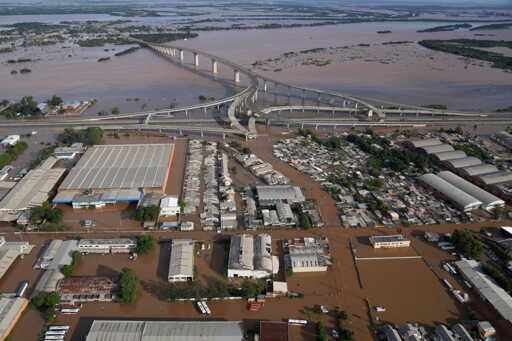
In May 2024, floodwaters submerged much of Porto Alegre. Brazil’s fourth-largest city lost bridges, hospitals, and months of economic output. Hundreds died. The images briefly commanded global attention. Then the news cycle moved on. What it left behind was something more consequential than headlines: a preview of what Brazil’s climate future looks like, playing out in real time. Porto Alegre was not a freak event. It was a signal, and the signal is getting louder. Few large economies are more directly exposed to climate and nature breakdown than Brazil. It is not merely a country at risk from a changing climate. It is a country whose entire economic model, social contract, and physical geography depend on the stability of natural systems that are now destabilizing faster than its institutions can adapt. The Central Market is flooded after heavy rain in Porto Alegre, Rio Grande do Sul state, Brazil, Thursday, May 9, 2024. Credit: AP Photo/Andre Penner A nation uniquely exposed Brazil has already warmed by roughly 1 to 1.5 degrees Celsius above pre-industrial levels. On higher trajectories, parts of the Amazon and the Cerrado savanna could exceed 3 degrees by the 2040s, a threshold at which compounding effects on water, agriculture, and human health become extremely difficult to manage. A systematic review of more than 20,000 Brazilian climate projections found severe risks across all six biomes – Amazônia, the Cerrado, the Caatinga, Mata Atlântica, the Pampas, and the Pantanal. The paradox is that Brazil is simultaneously one of the world’s…This article was originally published on Mongabay
From Conservation news via This RSS Feed.