

The U.S.-Israeli war of aggression against Iran has now entered its second week. Along with the intensity of the bombings and the volatility of oil prices and markets, speculation is growing about whether the end is near or if we are witnessing a new escalation.
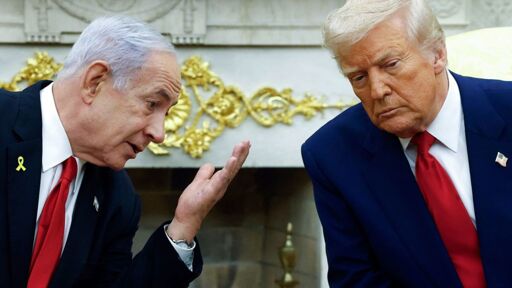
On the side of the attackers, Netanyahu holds firm to the objective of wiping the Islamic Republic off the map and, if possible, plunging Iran into a civil war that would lead to political, religious, ethnic, and territorial fragmentation, following the model of Syria or Libya. Guided by his regional aspirations to consolidate the dominance of “Greater Israel,” the genocidal prime minister reopened the war front in Lebanon. But his partner, Donald Trump, offers no certainty. Trump says one thing and then another: in just a single day, Trump claims the war could last four or six weeks (even longer than anticipated) before then suggesting that its objectives (what are they?) have been practically achieved and therefore the war is about to end. He doesn’t specify when or how it will end. This confusion on the battlefield shows that Trump entered this new “war of choice” in the Middle East without an exit strategy, and that the interests of American imperialism are not necessarily the same as those of the State of Israel.
True to his boastful style, Trump told Republican congressmen gathered at Mar-a-Lago that the United States had organized a “short-term excursion” to the Middle East to “eradicate evil” and that it would soon have a happy ending. But the president’s words ring hollow. Behind this bravado lie serious suspicions that Trump, aka TACO (“Trump always chickens out”), is closer to declaring “mission accomplished” and claiming victory with whatever resources are at hand.
The Middle East “excursion” is proving quite expensive (costing the United States at least $1 billion a day) and doesn’t seem to be much fun for major investors, nor for U.S. allies in the Persian Gulf, who are at the center of Iran’s attacks. And it’s becoming less so for the Trump administration and the Republican candidates hoping to renew or gain seats in Congress.
The global economic impact of this new war in the Middle East is already being felt. According to the Wall Street Journal, the virtual closure of the Strait of Hormuz, through which 20 percent of international oil trade passes, has triggered the worst energy crisis since the 1973 oil embargo. It is no longer just a matter of security issues, but also of concrete military attacks on oil tankers, and so far the United States has not found a way to open this strategic “choke point” or meet the demand for oil and energy. Gas supplies for Europe are at risk. In one week, crude oil reached the $100 per barrel mark (it was at $73 before the war), although it fell again following Trump’s vague promise that the war would be much shorter than anticipated, and the G7 economies’ commitment to release some of their reserves into the market to stabilize prices. With oil (and prices) rising and markets falling, the threat of stagflation looms on the horizon once again.
Perhaps Trump’s hour-long conversation with Vladimir Putin was related to seeking some form of mediation with the Iranian regime to find a way out. The one who fears this scenario most is Netanyahu, who already senses that his ally will once again leave him with the task unfinished, as happened with the “12-Day War” of June 2025. This concern is shared by the more hawkish and “neocon” wing of American financial capital, expressed in a Wall Street Journal editorial under the suggestive title “Iran Is Not Winning This War.”
Defense Secretary (renamed “Secretary of War”) Pete Hegseth announced even more devastating attacks, hoping to bring the Iranian regime to its knees. But so far, while the destruction and civilian deaths have certainly increased, the attacks have not achieved their intended effect.
Defiantly, the Islamic Revolutionary Guard Corps (IRGC) continued the war on the propaganda front as well. Its spokesman declared that Iran could withstand “at least six months of intense warfare” and that it reserves the right to “determine when the war will end,” implying that it is not in the Islamic Republic’s interest to accept a ceasefire similar to the one on June 12, which only postponed a new attack on Iranian territory by Israel and the United States for eight months.
Despite the military superiority of the American-Israeli alliance, and having achieved important tactical victories, this alone was not enough to bring about the capitulation or disbandment of the Iranian regime, although there are signs of internal divisions that could deepen, especially between President Masoud Pezeshkian — who is considered a “reformist” — and the theocratic establishment.
In the first hours of the attack, in a sort of division of labor, the American forces targeted military objectives while the Israeli army concentrated on the “decapitation” operation, for which they had precise intelligence thanks to Mossad’s expertise. Thus, shortly after the start of “Operation Epic Fury” (or Roaring Lion, as Israel codenamed it), Iran’s Supreme Leader, Ayatollah Ali Khamenei, had already been assassinated, along with much of the regime’s top brass, including commanders of the IRGC. This decapitation strategy is the same one that the State of Israel applied against Hezbollah (in the famous operation with the pagers) and against Hamas in September 2014. In the case of Iran, however, it was taken to the extreme; for the first time, a head of state was assassinated.
However, as happpened in the cases of Hamas and Hezbollah, it is one thing to weaken an organization and quite another to magically make it disappear, much less state structures, which in the case of the Islamic Republic of Iran, are the product of the expropriation and reactionary transformation by the Shiite clergy of the profound workers’, popular, and anti-imperialist revolution of 1979.
Faced with the imminence of war, the theocracy closed ranks and sealed its internal unity with a bloodbath. It brutally repressed the protests that challenged the regime between December and January, a resounding display of popular discontent that Trump and Netanyahu unsuccessfully attempted to exploit for their “regime change” policy. Nor is it working in the midst of war. The population, bombed and subjected to acid rain from Israel’s attack on fuel depots, is not welcoming the aggressors as “liberators.” The umpteenth attempt to use the Kurds as imperialist infantry is also failing.
Under fire, the Assembly of Clerics elected the son of the assassinated ayatollah, Mukhta Khamenei, as its new leader. Besides bearing the same surname (which nominally suggests continuity), he is associated with the IRGC and the hardline faction of the theocratic regime. This choice, which Trump claimed to have power to influence, is itself a message. Israel had already indicated that Khamenei’s days were numbered.
From a military standpoint, Iran adopted a realistic strategy of “active defense.” Its objective is not victory — which is beyond its reach — but rather to increase the military, political, and economic costs for the attackers to the point where they eventually deem it better to stop and seek a negotiated solution. This strategy, which some analysts call “horizontal escalation” because the goal is to expand rather than target hard targets, consists of launching missiles and drones against Israeli cities; U.S. bases in the Persian Gulf countries; bases of European countries such as the British base in Cyprus; and against airports and energy facilities, banks, financial institutions, and hotels. Above all, Iran plays the economic card, closing the Strait of Hormuz either partially or completely. For this, it relies on the collaboration of its weakened but still combat-capable regional allies, such as Hezbollah and the Houthis in Yemen.
As a consequence of the “horizontal” logic, the theater of operations expanded to several thousand kilometers, from Cyprus, Turkey, and Azerbaijan, to the vicinity of Sri Lanka with the sinking of an Iranian frigate that was coming from a military exercise with India (under suspicion of having sold the information to the United States).
Iran’s asymmetrical move is not without risks. The most significant is that it could backfire. That is, instead of the Gulf Cooperation Council countries pressuring Trump to end the war, the anti-Iranian alliance between these monarchies, the United States, and Israel could strengthen, following the geopolitical logic of the Abraham Accords. However, this has not yet happened, and it is unclear whether it will, given that the Gulf monarchies’ interest lies in regional stability that allows their businesses to flourish and facilitates their transformation from oil suppliers to technology hubs and tourism centers.
No Clear Way Out
Just as Netanyahu failed to achieve a decisive victory in Gaza despite two long years of brutal genocide, the Trump-Netanyahu duo in Iran appears to be facing the same strategic problem. As Washington Post columnist F. Zakaria argues, paraphrasing Clausewitz, without clear political objectives, war devolves into pure violence, and the outcome is left to chance.
While common sense suggests that for the Islamic Republic, victory lies in survival, and for Netanyahu in achieving the ultimate goal — annihilating Iran and establishing Israel as the sole dominant regional power — no one can currently define what a victory for the United States would entail. Trump seems to have entered this new war with the simplistic hypothesis that a devastating military attack by the United States and Israel would reignite internal chaos and lead to the rapid collapse of the ayatollahs’ regime, and its replacement by a leadership willing to submit to the United States (as in Venezuela) without forcing American imperialism to deploy ground troops as in Iraq.
At this point, it’s clear that this hypothesis of a rapid “regime change” didn’t materialize. Nor, for now, has its “light” variant of a Venezuelan-style “leadership change” come to pass. As a Financial Times columnist wryly suggests, rather than “Epic Fury,” the operation should be called “Desperately Seeking Delcy.” Trump’s problem is that Iran has yet to produce an insider to play the role of Delcy Rodríguez, who quickly transformed into an agent of imperialism after Maduro’s kidnapping and manages the U.S. neo-protectorate in Venezuela. This complicates the scenario for Trump, who faces the possibility of a protracted war and exposes the White House’s lack of strategy.
European powers find themselves in an awkward position that reveals their subordinate role, and faced with a dilemma, they choose to be vassals of Trump to avoid becoming targets of the American despot’s wrath (with the tepid exception of Sánchez’s government in Spain). While claiming to oppose the war, they send frigates and ships to the region to join the attack against Iran for “defensive” purposes (Macron), allow the use of American bases (Starmer), or directly join the chorus of Trumpian warmongering, as Germany does.
The war in Iran, and before that the U.S. intervention in Venezuela, cannot be understood outside the context of the strategic dispute between the United States and China. In both cases, one of Trump’s objectives is to deprive China of its supply of cheap oil and undermine Beijing’s alliances. Neither China nor Russia (Putin remains focused on gaining as much as possible from the war in Ukraine) came out in support of their allies, beyond the expected declarations of defense of the “multipolar order,” condemnation of U.S. aggression, and support for the regimes under attack. This does not mean they are not providing covert assistance to Iran, especially in the case of Russia, primarily through military intelligence. But clearly, this is not the time for them to openly confront the United States. China took note and decided to increase its military budget by 7 percent and its investment in technology to reduce its dependence on Washington’s whims and trade wars. These preparatory moves are combined with negotiations and truces — like the one Trump negotiated with Xi Jinping, in which he backed down on the exorbitant tariffs imposed on “Liberation Day” in exchange for guaranteed access to rare earth elements where China has a comparative advantage. And they are signs that the rivalry has not yet escalated to extremes.
Challenges for Trump
The outcome of the war remains uncertain. While it’s unclear how long Iran can withstand the onslaught from the United States and Israel, time is working against Trump. The longer the war drags on, the closer it gets to the crucial November elections, which are already shaping up to be a difficult one for the Republicans. In just one year in the White House, Trump has squandered his political capital and seen his control of state powers and the Republican Party itself dwindle. He has suffered blows such as the Supreme Court ruling (with a conservative majority) that struck down most of the “reciprocal tariffs.” And above all, he suffered a crushing defeat in Minneapolis, where the mobilization of workers and the general public forced him to back down on the anti-immigrant offensive carried out by ICE. In short, Trump presides over a weak Bonapartist government, at risk of becoming a “lame duck” if it loses control of either house of Congress.
The start of a war typically generates an initial sense of “national unity” or support for the troops and the president, which then fades. For example, George H.W. Bush had a 64% approval rating, which rose to 82% within days of launching Operation Desert Storm, although, as we know, he won the war but lost the election. And George W. Bush saw his approval rating jump from 51% to 90% after launching the war in Afghanistan, although his “war on terror” was ultimately condemned several years later.
None of this is happening now. The war on Iran has faced majority opposition from Americans from the outset. According to an IPSOS poll, only 27 percent approve of the attacks. Other opinion polls, such as the one conducted by Quinnipiac University, place approval at 40 percent, and note that the president’s approval rating — around 38 percent — has not changed significantly since the start of the conflict, although concerns about the economy have increased (more than 7 out of 10 voters). According to this poll, the Iran conflict is entirely partisan: Republicans mostly support it, Democrats oppose it, but a majority of independents — 67 percent — are also against the conflict.
Even sectors within the Republican base and the MAGA movement oppose it because they see it more as a war for Israeli interests than for those of the United States; rather than “America First,” they say Trump is the president of “Israel First.” Secretary of State Marco Rubio’s unfortunate remarks, in which he acknowledged that Israel forced the war on the United States, were a gift to conspiracy theorists who, with or without evidence, see Israel’s shadow behind American decline, from wars to the Epstein scandal. This occurs within a broader context of declining legitimacy for Israel among the American population, including evangelical sectors. The main spokesperson for the (far) right-wing opposition to the war in Iran is former Fox News host Tucker Carlson, an early proponent of “America First” who has become a relentless critic of the unconditional alliance between the United States and Israel, with openly antisemitic undertones. He is followed by other celebrities of the MAGA universe, such as former Congresswoman Marjorie Taylor Green and Steve Bannon.
For now, Trump takes MAGA’s unconditional support for granted. But this still limited challenge could become widespread. A surge in oil prices would immediately impact gas stations in the Midwest, where the core of Trump’s base is concentrated. This is a sensitive factor that could jeopardize the strategy of lowering inflation, almost the only strong card Trump has to play to reverse his plummeting popularity and avoid a defeat in the midterm elections, which seems increasingly likely.
The only one who has benefited so far from these extreme scenarios is Netanyahu, who is using the war in Iran to recover from a virtually terminal crisis and is betting that perpetual wars will allow him to win, however narrowly, the next elections. So far, the war in Iran enjoys broad support among the Israeli population, which has further shifted to the right. But Netanyahu’s unpopularity could resurface, especially if, as all indications suggest, Israel fails to achieve its objectives.
Chaos Reigns
In January 2003, then-President George Bush Jr. stood before the U.S. Congress to deliver his traditional State of the Union address. Bush dedicated a large part of that speech to constructing the casus belli against Saddam Hussein’s Iraq, a former Washington client turned public enemy number one of the empire. The infamous “fake news” about weapons of mass destruction served as a pretext for the first large-scale experiment with the doctrine of “preventive war,” one of the pillars of the post-9/11 U.S. national security strategy, bearing the unmistakable stamp of the neoconservatives. The other two pillars were unilateralism and the “expansion of democracy,” the ideological complement to this intensified warmongering.
The “endless wars” in Iraq and Afghanistan deepened the crisis of U.S. hegemony. One need only recall the image of imperialist troops hastily withdrawing from Afghanistan, almost as if in Saigon. According to Robert D. Kaplan, a prominent neoconservative analyst, these “middle-sized wars” (not to be confused with limited wars) are a trap for great powers and a disgrace that ruins presidencies. However, the wars in Iraq and Afghanistan were not the cause of the crisis, but rather a failed attempt to halt, through military superiority, the accelerated decline of American leadership. In retrospect, they were the last gasp of the “unipolar moment,” which came to an end with the 2008 capitalist crisis, the emergence of China as a strategic competitor, and the rise of a number of “middle powers” capable of pursuing national interests at the regional level.
Similarly, Trumpism is not the cause but the product of American decline — both internal and external — which, due to the magnitude of its power, destabilizes the entire international system.
The U.S.-Israeli war against Iran is the latest empirical evidence that the “rules-based order” designed by American imperialism to lead the postwar world is dead and buried. Chaos reigns. Trump embodies an attempt at a “power struggle” to overcome the U.S. crisis and restore its dominance. In a world governed by power rivalry, militarism, and protectionist tendencies, with the dispute with China as a strategic framework, Trumpism seeks to establish the United States as a kind of “predatory hegemon,” as the neorealist political scientist Stephen Walt calls it. The “Donroe Doctrine” and the war in Iran fall within this policy of using military power and other coercive instruments to discipline allies and enemies. But unlike the Monroe Doctrine that Trump invokes, we are not witnessing the rise but rather the decline of American imperialism.
The genocide perpetrated by Israel in Gaza gave rise to a powerful international movement of solidarity with the Palestinian people and against the Zionist state’s accomplices in this war crime. This movement, with its anti-imperialist elements, reminiscent of the movement against the Vietnam War, must be strengthened to end the imperialist war in Iran. The enemies are the same. If they triumph in Iran, they will be stronger to intensify their offensive and their class war. As happened with Argentina’s defeat in the Falklands War, the dictatorship eventually fell, but the national defeat was profound, reinforcing the conclusion that imperialism could not be confronted. And Margaret Thatcher used the victory in the Falklands to strengthen herself domestically and crush the miners’ strike. Despite the deeply reactionary and oppressive nature of the Iranian regime, and without offering it any political support, a defeat of the United States, the Zionist state, and their allies would be great news for the exploited and oppressed of the world.
This article was originally published in Spanish on March 14, 2026 in La Izquierda Diario.
The post Trump at a Crossroads: No Regime Change, No Exit Strategy in Iran appeared first on Left Voice.
From Left Voice via This RSS Feed.