

 By COCO SMYTH
Joseph “Country Joe“ McDonald, a key figure of the psychedelic music scene in San Francisco and the 1960s counterculture, died of complications from Parkinson’s on March 7, 2026.
From the start to the end, Country Joe was man of the left. He was born on Jan. 1, 1942, the son of two active members of the Communist Party USA, who named him in honor of Joseph Stalin. He grew up in Los Angeles in the post-war years and was exposed both to various progressive causes as well as the pervasive repression of the left during the McCarthy period. His father was brought before the House UnAmerican Activities Committee and lost his job for his support of communist policies in the 1950s. His parents played a big role in his political development from childhood, but also left him alienated from his peers as a child due to the social stigma of these beliefs during the repressive McCarthyist Era.
Immediately after graduating high school, Joe enlisted in the Navy and served as an air traffic controller in Japan during the early 1960s. Upon his honorable discharge and return to the U.S., he got involved in the lively music and political scenes in California at that time. He published a small magazine as a student at Los Angeles State College called Et Tu, where his political beliefs quickly expressed themselves. He published the lyrics to one of his early compositions, “Epitaph for Three,” which memorialized three civil rights activists who were murdered in Mississippi during 1964.
McDonald then moved to Berkeley, Calif., where he got involved with the burgeoning folk music scene and intervened in numerous causes including civil rights, justice for migrant farmworkers, the free speech movement, and opposing the embargo against Cuba. McDonald formed another magazine there called Rag Baby, which combined political issues with music. The politics, magazines, and music were a joint endeavor for McDonald. He performed alongside other musicians at a variety of local protests and rallies, promoted the magazine and self-produced music at these rallies, and wrote songs that connected with the attitudes of the protesters.
Country Joe & the Fish
His most important musical endeavor came together in 1965 when he formed the band “Country Joe and the Fish.” The name for the band came from an obscure allusion to a quote by Mao Zedong that a revolutionary is a “fish who swims among the sea of the people.” Country Joe and the Fish, like so many other artists in the San Francisco Bay Area, made the transition from traditional folk music to electrified psychedelic rock music, and the band became one of the lynchpins of that scene, which shaped rock music across the world. The rise of both the counterculture and the New Left created a receptive audience for the new band.
CJ and the Fish made their greatest wave when they put out their track “I-Feel-Like-I’m-Fixing-To-Die Rag.” This song presented an absolutely scathing critique of the Vietnam War, paired with a psychedelic reinterpretation of a ragtime theme. The instrumental has an upbeat and nostalgic feel combined with abrasive distorted electric guitar that undermines its sentimental and patriotic tone—very similarly to Jimi Hendrix’s reinterpretation of the Star Spangled Banner.
The instrumental detournement matches perfectly with the lyrical content of the song, which presents itself as a military recruiting pitch but is really a dark satire of the brutality of imperialist war. But unlike so many of the other Vietnam antiwar anthems, it is not a mellow call to give peace a chance. It moves beyond liberal pacifism to offer a biting critique of how working-class lives are destroyed for the sake of profit and political power for the capitalist class. The song exposes how militarism, anti-communism, imperialism, and capitalism are interconnected.
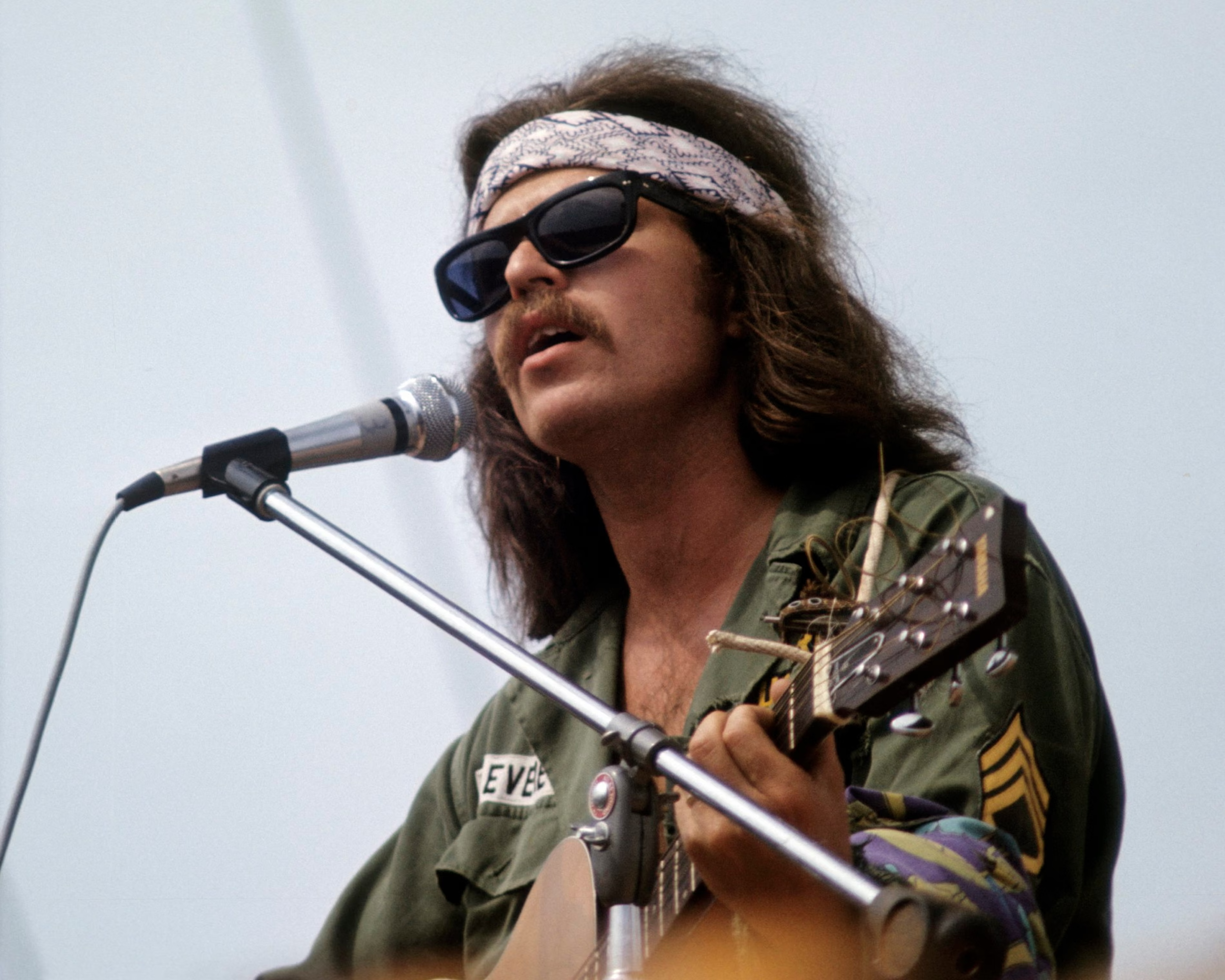
While the track didn’t top the charts, it became one of the most popular songs among anti Vietnam war activists. Beyond politicized circles, the legacy of the song has endured thanks to Joe’s acoustic performance of the piece at the singularly famous Woodstock Festival of 1969.
Both in CJ and the Fish and in his solo career in the following decades, Country Joe wrote and performed songs that critiqued systems of oppression from the left and sought to connect with the mass movements of his time.
The counterculture and the left
The 1960s counterculture is popularly remembered as a time of “sex, drugs, and rock and roll.” A minority—but a significant minority—of youth in the United States were searching for a different way of living, thinking, and doing that rejected the reactionary social and political mores that were common during the previous decade.
The consensus for this generation was progressive, though the counterculture, despite its affinity with leftist politics, sometimes found friction with it. Much of the organized left (often rightly) saw these youth subcultures such as the “hippies” as utopian, escapist, and eminently middle-class in outlook. A segment of the counterculture certainly focused on free living, fantastical spirituality, and hedonism while neglecting a confrontation with the stark political realities of the time.
But the counterculture had many faces, and Country Joe represented one of its most socially aware. McDonald and his band were paragons of the anti-establishment ethos of the counterculture, and their psychedelic music is one of its purest reflections. Yet, instead of escaping into pure fantasy, they used the counterculture as a conduit for radical politics. The 1960s were a time of both profound social changes and deep radicalization across the world. Country Joe was one of those figures best able to bring together these distinct, but intertwined, processes.
From the start to the end of his life, Country Joe was a fighter for equality and justice for all. He saw himself as “moral support” for good causes. Far beyond the upheavals of the 1960s, McDonald continued to use his music to support progressive causes. He continued to participate in antiwar, environmental, and other progressive movements into the 21st century.
The best way we can memorialize Country Joe is to continue his work and the work of so many others like him. Both as organizers and as artists, we need to swim like fish among the people, engage and confront the realities of our time, and develop the fight for a better world. These are solemn tasks, but as Country Joe showed us, they can be fun too.
Photo: Country Joe sings at the Woodstock festival in 1969. (Michael Fredericks / The Image Works)
The post Remembering Country Joe: A musician who sang for peace and justice first appeared on Workers’ Voice/La Voz de los Trabajadores.
From Workers’ Voice/La Voz de los Trabajadores via This RSS Feed.