

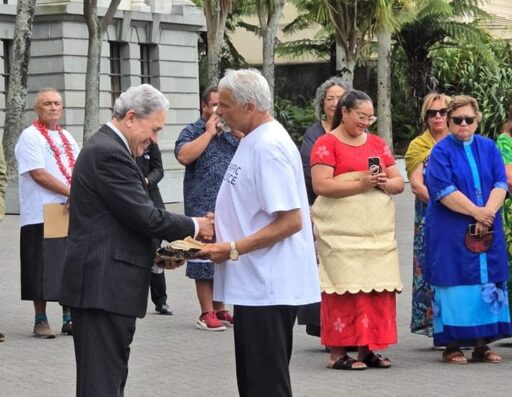

Winston Peters receiving a petition from former National MP Arthur Anae calling for visas on arrival for Pacific Islanders outside Parliament Buildings last month. (Photo: RNZ Pacific)
For all the talk of Pacific empowerment in Aotearoa, the conversation rarely extends to how Pacific political influence might be exercised within the current electoral system, writes law lecturer Sione Tekiteki.
When former National MP Arthur Anae handed Winston Peters a petition recently calling for visa-free entry for visitors from New Zealand’s Pacific neighbours, I couldn’t help feeling that we looked like supplicants appealing for sympathy, rather than partners asking for reciprocity*.*
When New Zealanders visit Pacific nations, they’re offered visitor visas on arrival — as they should, because, as politicians from here like to say, we’re all part of the “Pacific family”.
But while travellers from more than 60 countries can enter New Zealand through the relatively simple online travel authority system, visitors from many Pacific nations face far more complicated and expensive visa processes before they can even board a plane.
Pacific communities here have been raising the issue for years, but it always lands in the “too sensitive” basket of New Zealand politics. The main hurdle seems to be the fear that easier entry could increase overstaying or encourage greater migration from the Pacific Islands (although Winston Peters has signalled support).
For me, the more important question isn’t whether such a request will succeed but why Pacific political influence so often begins from a position of weakness.
For all the discussion of Pacific empowerment in New Zealand, the conversation rarely extends to how Pacific political influence might be exercised within the current electoral system.
New Zealand’s Mixed Member Proportional (MMP) electoral system distributes political influence in ways that often give smaller political actors more sway than in many other democracies. Under proportional systems, influence often rests with those who occupy the pivotal space between major parties, giving them the power to ultimately decide who can form a government.
The current government illustrates this dynamic clearly. Although the National Party secured the largest share of the vote in the 2023 election, it doesn’t exercise power in proportion to its electoral support. Instead, significant negotiating leverage sits with the smaller coalition partners, ACT and New Zealand First.
Their vote shares are considerably smaller than National’s, but their position within the coalition enables them to influence policy priorities and negotiate concessions that their larger coalition partner must accept.
This isn’t necessarily a flaw. In many ways, it’s the system working as intended — reflecting the diversity of New Zealand’s multicultural society.

Petitioners outside Parliament Buildings last month, carrying the Sāmoan flag. (Photo: Moera Tuilaepa-Taylor)
Pacific thinkers have long challenged the framing of the Pacific Islands as “small”. Their point was not only geographical — it was also political. In the context of visa-free entry for Pacific Island visitors, it’s the difference between appealing for sympathy and asserting agency.
Pacific peoples make up roughly 9 percent of New Zealand’s population. About 46 percent of the Pacific population is under the age of 25. This means that every election, tens of thousands of new Pacific voters join the electorate.
Yet the strength of that bloc has not always translated into decisive policy outcomes. As one Pacific commentator noted during the 2023 general election: “They talk about immigration policy and say they’re doing something about it. They’ve been looking at it for the last six years . . . they’ll probably still be looking at it for the next three.”
Pacific communities are concentrated in several electorates, especially in Auckland. They are sustained by dense networks of churches, families, cultural groups, and community organisations — the kind of social foundations that often drive political mobilisation.
At the same time, Pacific people are becoming more visible in public life and increasingly represented in parliament. Pacific MPs now sit across several parties, and Pacific issues periodically feature within party platforms.
These developments are evidence of the growing Pacific influence. However, that influence is rarely mobilised politically as a voting bloc.
Historically, Pacific voters have been twice as likely to vote for Labour compared to the general population. Across the political spectrum, their votes are mainly mobilised by the major parties and existing political structures, making them vulnerable to being absorbed into broader ideological agendas where they have limited independent bargaining power.
The irony is that Pacific communities already have many of the elements that generate significant political influence under proportional representation.
The Pacific diaspora makes up a highly influential voting bloc. With mobilisation, that bloc could either drive policy positions within existing political parties (most prominently through Labour) or through a standalone political party. Such a party wouldn’t need to dominate elections to influence outcomes. Often, it would simply need to exist.
To be clear, I’m not necessarily advocating for the creation of a Pacific political party, nor suggesting that Pacific voters should withdraw from the major parties where many have built longstanding relationships and leadership pathways. Identity-based parties come with their own challenges, and the Pacific diaspora is highly diverse. That said, many Pacific communities share common policy concerns shaped by migration experiences and socio-economic challenges that affect significant parts of the Pacific population.
My point is simply to highlight the underutilised leverage that Pacific communities already have under MMP.
Māori electorates notwithstanding, the experiences of the Māori Party offer an instructive example. In many elections, the Māori vote has shifted between Labour and the Māori Party, creating electoral leverage that compels both parties to compete more seriously for Māori policy priorities. A similar dynamic could emerge if a Pacific voting bloc were to consolidate — something Winston Peters may be more aware of than most.
It’s not inconceivable that a Pacific bloc could one day hold the balance of power in New Zealand politics. Even a small share of the vote, if strategically organised, would be enough to reach the 5 percent threshold needed for parliamentary representation. Alternatively, winning a single seat would also bring a party into parliament and allow additional MPs to enter through the party list — a pathway made more plausible by the geographic concentration of Pacific communities in several Auckland electorates.
Even the possibility of a Pacific political party or voting bloc could force existing parties to adopt clearer positions on issues like visa-free entry for Pacific countries.
Pacific politics in New Zealand is often framed through grievance. But MMP offers something different — a structural opportunity.
Real influence won’t come from appealing for sympathy. It will come when Pacific communities ensure our votes count where they matter most.

Sione Tekiteki, a senior law lecturer at Auckland University of Technology. (Photo: Francesca Brugnoli)
Sione Tekiteki is a senior lecturer in law at the Auckland University of Technology. He has worked in regional and political advisory roles across the Pacific, focusing on governance, democratic institutions, and international law.
The post Pacific possibilities under MMP appeared first on E-Tangata.
From E-Tangata via This RSS Feed.