

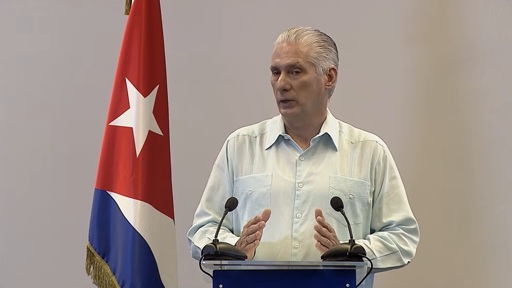
Cuban President Miguel Díaz-Canel reported at a press conference that talks are currently underway between his government and officials from the US government. According to the president, the talks have been facilitated by international actors, though he did not specify whom.
He also reported that the three basic objectives of the talks are to:
- Determine which bilateral issues require resolution.
- Establish possible avenues for resolving these issues.
- Determine whether there is a willingness to take concrete actions for the benefit of our peoples, which involves identifying areas of cooperation to address threats and ensure the security and peace of both countries.
In addition, during another appearance, Díaz-Canel said that a “possible visit” by the US Federal Bureau of Investigation is expected in the coming days to investigate the incident in which a boat carrying armed crew members entered Cuban waters and was repelled by the Caribbean nation’s armed forces.
The incursion, said the Cuban president, was an “armed infiltration for terrorist purposes, financed and organized from US territory.” However, he expressed openness to the FBI participating in the investigations. “Information regarding the events was promptly provided to our US counterpart, which has expressed, through diplomatic and consular channels, its interest in jointly participating in the clarification of the facts.”
Read more: Another terror attack on Cuba: The 66-year war that Washington refuses to end
Added to this is Havana’s announcement of the release of 51 detainees thanks to “the Vatican’s mediation.” According to Díaz-Canel, “all have served a significant portion of their sentences and have maintained good behavior in prison.”
Thus, it is evident that, in one way or another, certain channels of communication and negotiation have been reestablished between the Cuban and US governments, which could pave the way for alleviating the severe energy crisis currently plaguing the Caribbean nation.
US-made humanitarian crisis
Cuba is currently facing one of its worst energy crises due to the US blockade and the Trump administration’s recent measure threatening to increase tariffs by 10% on any country that sells oil to Cuba. Hydrocarbons power Cuba’s electrical, industrial, and commercial systems, meaning the measure has directly affected hospitals, schools, homes, stores, and more.
Some experts have called this situation a “man-made humanitarian crisis” caused by Washington’s desire to overthrow the revolutionary government in Havana. According to the UN, the Trump administration’s decision is causing problems in various sectors of the country. Essential services have been drastically reduced, there are patients with serious illnesses who cannot be treated, pregnant women are not receiving adequate care, nearly 10% of the population does not receive water regularly because its supply depends on tanker trucks, among other issues.
A few weeks ago, Trump announced that the US would begin selling oil to Cuba, provided it remained the only country exporting fuel to the island. However, President Díaz-Canel reported that not a single ship carrying fuel has arrived on the Caribbean island in the past three months. This continues to happen, the UN states, even though recently “a Supreme Court ruling declared it illegal for the United States to use an emergency economic law in this context.”
It is not yet known for certain what Washington’s demands will be and how much the revolutionary government of Cuba will concede.
The truth is that the Trump administration has made no secret of its desire to destroy the revolutionary process that began in 1959, which has been boycotted and confronted through direct actions by the United States via an aggressive and hostile foreign policy toward the Caribbean nation – whether through the longest-running economic and commercial blockade in modern history, through attacks and military operations financed by Washington, or the recent attempt to provoke an implosion in Cuba through an energy stranglehold.
The post Cuba announces the start of talks with the United States appeared first on Peoples Dispatch.
From Peoples Dispatch via This RSS Feed.