

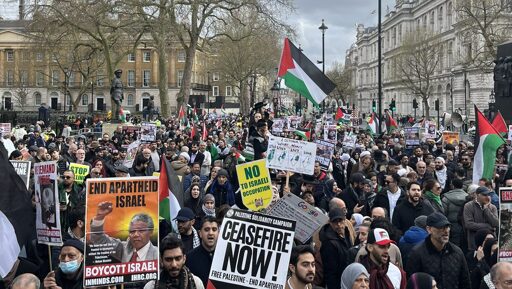
Activists in Britain remain alarmed over the government’s repression of basic civil liberties – notably the right to protest – as Home Secretary Shabana Mahmood decided to ban the yearly pro-Palestine Al-Quds Day march. “The government’s decision to ban the Al-Quds march in London marks a worrying escalation of its authoritarian crackdown on our civil liberties, that should concern everyone who believes in our fundamental rights to freedom of expression and assembly,” the Palestine Solidarity Campaign said.
Mahmood and the London Metropolitan Police announced the ban only days before the march was scheduled to take place, pushing organizers to move to a stationary form of protest. They claimed the ban was introduced to guarantee security, but many have pointed out that the decision was related to the pro-Palestine character of the mobilization and the profile of some of its organizers. “The Al-Quds march is uniquely contentious having originated in Iran, and in London is organized by the Islamic Human Rights Commission, an organization supportive of the Iranian regime,” the police themselves stated.
Activists and left politicians call out double standards
The arguments provided by the Home Office and the police have been criticized by several left politicians, who located the move in an escalating wave of oppression against citizens’ frustration over the Starmer government’s complicity in the Gaza genocide and, more recently, the illegal US-Israeli war on Iran. “This country would very quickly condemn any other country that started banning public protests, be it Iran or elsewhere,” Your Party’s Jeremy Corbyn commented.
As the Labour government moved to ban a protest it claims is supportive of the administration in Iran, British bases – not only those in Cyprus – continued to be used for aiding US attacks on the Asian country. “The British government is a participant in the war of aggression on Iran, against the will of the overwhelming majority of the British people,” Your Party stated. “The British government should be calling for an end to this reckless war, not helping load bombs onto US planes to wreak death and destruction in Iran.”
Read more: Britain’s role in attacks on Cyprus, Venezuela, and Iran
Activists facing legal action over their solidarity organizing with Palestine, including Chris Nineham from Stop the War Coalition, also warned the Al-Quds Day march ban is part of a worrying trend. “You don’t have to agree with all its politics to know this is an attack on the Palestine movement and freedom to protest,” Nineham wrote on social media.
Other reactions emphasized the decision showcases double standards being applied to mobilizations critical of specific aspects of current British policy compared to other events, including far-right marches. “We note that the Met allowed UKIP to march with banners calling for ‘mass deportations’ of Muslim ‘invaders’ and that last September, supporters of Tommy Robinson violently assaulted anti-racists and the police, but he is being allowed to organize another march in May,” Stop the War stated.
A general crackdown on dissent and activism
In the days surrounding the announcement of the Al-Quds march ban, other events caused concern about the government’s pressure on organized dissent and activism, including plans to expand police powers to ban repeat protests, pursuit of the proscription of direct action group Palestine Action – despite a February ruling judging it unlawful – and attempts to limit jury trials. In all of these cases, activist groups and experts have warned against devastating consequences if such measures pass or remain in place.
Notably, the Palestine Action ban has already severely impacted people’s lives. According to Defend Our Juries, over a dozen people who were arrested during peaceful sign-holding actions lost their jobs as a result, while many others faced different types of disciplinary action. “Over 2,700 people who were arrested for taking part in Lift the Ban actions are not only in legal limbo,” Defend Our Juries said, “but face prolonged uncertainty and consequences for their day-to-day lives.”
Read more: The war on Iran may be Washington’s most unpopular war in history among the US public
The number of people arrested during these actions has also skewed terrorism data, according to Morning Star. The newspaper warned that 3,034 terror arrests were made in 2025 – 92% of them related to the ban – compared to 250 in 2024. Additionally, last year’s data also suggests a significant shift in the demographics of the arrests, where those arrested were more likely to be women, and their average age approximately 28 years older than in terror arrests made unrelated to Palestine Action.
Campaigners have called for ongoing mobilization to resist government plans, including the appeal Mahmood is pursuing related to the recent ruling on the proscription of Palestine Action. “If we let this go, the unions, climate and racial justice movements, or any other worthy cause will be next,” Defend Our Juries said.
The post Repression of the Palestine movement continues with ban of Al-Quds Day march in London appeared first on Peoples Dispatch.
From Peoples Dispatch via This RSS Feed.
just after they illegally detained protesters for a year and a half. they’ll detail them all again and release them in another couple years when the courts decide it’s bullshit
