

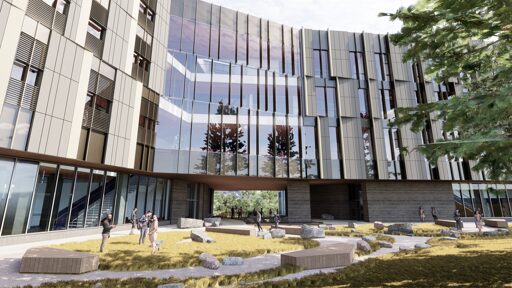

A rendering of the x̌əl sic snpax̌nwixʷtn building. Photo courtesy of the University of British Columbia-Okanagan
The University of British Columbia Okanagan (UBCO) is developing a new building to support Indigenous knowledge across academic disciplines.
The x̌əl sic snpax̌nwixʷtn building on the university’s campus in kiɁlawnaɁ (Kelowna) in syilx territory is set to open next spring.
It will be home to the university’s four Interior Salish language fluency programs and the new Interior Salishan Studies Centre (ISSC).
According to UBCO, the new centre will develop “Salishan-specific Indigenous knowledge” and “conduct Salishan-led research.”
The need for that work is essential, said lax̌lax̌tkʷ Jeannette Armstrong, syilx professor in Indigenous Studies and the program co-ordinator of the four Interior Salish language fluency programs.
“There’s so much knowledge packed into our languages about our land,” she told IndigiNews in an interview.
“If you’re Indigenous and you live in a place for 12,000 years like our people have, you know everything about the land, because it’s in your language.”
The syilx knowledge keeper and acclaimed author with a long-history in education leads UBC’s x̌əl sic snpax̌nwixʷtn’s cultural advisory working group.
She’s been heavily involved in the project’s development since its inception, with construction of the building commencing in 2023.
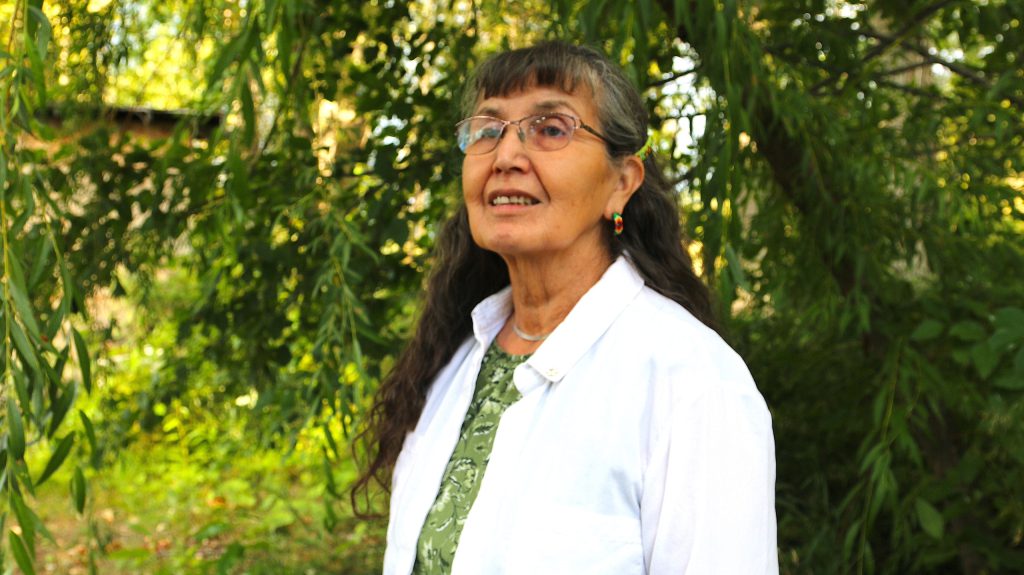
Jeannette Armstrong. Photo by Athena Bonneau
The UBC building will also bring together different research teams across various interdisciplinary fields under its roof — which the university says includes climate action, conservation, watershed research and more.
The spaces at x̌əl sic snpax̌nwixʷtn are organized into “neighbourhoods” — with the notion behind this layout to better facilitate collaboration between the research groups, as aspects of their research are anticipated to overlap.
“We can collaborate together. We can innovate together,” said Armstrong.
“We can cross-discipline so that more can be done by us. We become more knowledgeable in different ways through different avenues by doing that.”
Pioneering nsyilxcn language education and research
Previously, Armstrong helped UBC develop and implement the university’s bachelor of nsyilxcn language degree program, which is carried out in a partnership with the En’owkin Centre.
It made UBCO the first university in “Canada” to offer a bachelor’s degree in Indigenous language fluency.
Natalie Rodriguez, the director of interdisciplinarity and operations for x̌əl sic snpax̌nwixʷtn, described Armstrong as “the cornerstone” of x̌əl sic snpax̌nwixʷtn, as well as for the university’s relationship with the En’owkin Centre.
In addition to nsyilxcn — the language spoken by syilx people — the university also offers bachelor of language fluency degrees for the languages spoken by neighbouring Salish nations: NłeɁkepmx, St’át’imc and Secwépemc.
“We are the first institution in Canada to develop a degree program where people learn their language and learn the academic aspects of a bachelor’s degree in the language,” Armstrong said.
“We were the very first in Canada to make that happen within an academic institution that’s very colonized and very Western, in terms of what it offers.”
The x̌əl sic snpax̌nwixʷtn building will include two language labs for the Interior Salish language fluency programs.
“There was the intent to give space to our language program, because we don’t have a space anywhere, where our languages are,” she said.
“We need listening labs and recording labs, and Elders — all of the things that are required in order to not only learn the language, record the language, but also teach the language, and do research in the language.”
Previously, the university implemented street signage around its grounds that are written in both English and nsyilxcn. But a university building named in nsylxcn had never been done before.
When developing x̌əl sic snpax̌nwixʷtn, the university approached Armstrong about having the building named in nsyilxcn.
“I put a knowledgeable team together of language speakers, faculty members that helped — so it wasn’t just my work, but a team that worked with En’owkin Centre,” she said.
“They assisted with their fluent speakers to look at how that idea of interdisciplinary and collaboration and innovation might be worked into the name.”
The result was x̌əl sic snpax̌nwixʷtn. Armstrong said the name expresses what the building is intended for.
“The ‘x̌əl sic’ is for creating new things. ‘sic’ means in the future — the new things — so innovation. For innovating, ‘snpax̌nwixʷtn’ means collaborating academically with each other,” she explained.
“‘pax̌’ means academic learning. ‘pax̌nwixʷtn’ is a place where that happens among each other.”

A rendering of the x̌əl sic snpax̌nwixʷtn building. Photo courtesy of the University of British Columbia-Okanagan
Grounded in syilx values and teachings
The university also worked with the En’owkin Centre to include syilx values and teachings in both the layout and design of the x̌əl sic snpax̌nwixʷtn building, Armstrong said.
“They worked with us — the building, the architect group, and groundspeople worked with us,” she said.
One of those features is a circular gathering space on the building’s second floor, which can host up to 100 people to “support a space for dialogue and conversation.”
“Part of that idea for the syilx is that the more natural spaces we can create where people can move around together, be together… to be able to use curved spaces rather than linear spaces,” she said.
The interior of the gathering circular space, she said, also reflects the directions of the syilx Nation’s Four Food Chiefs.
“That idea of how that circular gathering space is a message as well, about a circle of people. A continuation — that’s what a circle represents,” she said.

A rendering of the x̌əl sic snpax̌nwixʷtn building’s interior circle gathering space. Photo courtesy of the University of British Columbia-Okanagan
Indigenous professors, including Armstrong, will also finally have their own office spaces within the building.
Currently, her office is a rented space off-campus.
Armstrong hopes to see Indigenous knowledge and language revitalization support the building’s interdisciplinary research efforts, which includes climate change and conservation, she said.
In addition to helping to deliver the language fluency programs, Armstrong is also a member of x̌əl sic snpax̌nwixʷtn’s watershed ecosystems research team.
That research will look at assessing the links and interactions between critical processes and Indigenous values — from timber to biodiversity and water functions — “using an interdisciplinary approach.”
The language fluency programs aren’t just about learning how to speak the language and translate it into English and vice versa, she said.
Rather, there is emphasis on developing “the knowledge that needs to be understood so that we can manage better; we can mediate better; and we can recover better,” she said.
“A lot of the language contains ecological knowledge; sustainability knowledge,” she said.
“If you start teaching what the values are, and what value the information has for today in the modern context … how does it enhance not only our lives, but everybody else’s lives to have better knowledge about the environment?”
She noted that many of the language fluency students are being hired in the fields of natural resources, health sciences, and as school teachers.
“There’s a lot of Indigenous work in the sciences that is needed, and is being called for,” she said.
“They’re in demand, so we know it’s making an impact. We know it’s a vital thing.”
The graduates who pursue masters’ degrees or PhDs who take on “research that will make differences” are the ones who are “going to change the world,” she said.
“I really mean that. Because you can’t fix anything by doing the same old, same old, teaching the same old,” she said.
“You really need new input. You really need new ideas.”
The post Renowned syilx educator hopes new UBCO building will be a hub for Indigenous innovation appeared first on Indiginews.
From Indiginews via This RSS Feed.