

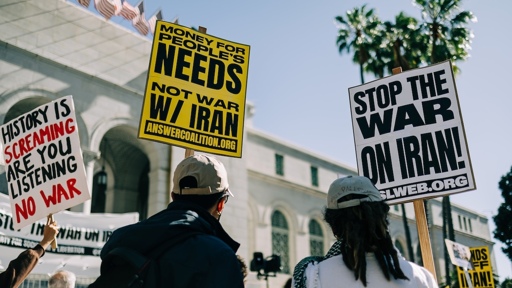
Over 1,300 people have been killed and 17,000 injured in Iran since the start of the US-Israeli war against the country on February 28. Major civilian casualties have been reported, including the 160 school girls killed in the attack on their elementary school. As the conflict reaches its third week, the vast majority of people in the US are flatly rejecting another war launched in their name.
According to a recent Ipsos poll, only 27% of the US public supports the attacks on Iran. Unlike previous conflicts, this aggression is unfolding amid what appears to be the deepest and most immediate opposition to a US war in modern history. The US war on Iran is reportedly even less popular than the Vietnam War was in its final years.
It may also be one of the most expensive wars in modern history. In the first six days, US taxpayers had already spent an estimated 11.3 billion USD. This number doesn’t factor in major costs like troop deployments, aircraft operations and maintenance, equipment losses, long-term care for wounded troops, rebuilding munitions stockpiles, and more. The real cost is inevitably much higher. The Pentagon reportedly burned through 5.6 billion USD worth of munitions in just the first 48 hours.
“We could spend this money on universal healthcare, affordable housing, schools…” said Layla, an Iranian-American protestor in the Bay Area, during a mass march against the war.
Gas prices in the North American country have also soared about 60 cents a gallon so far after the Islamic Republic shut down the world’s most critical maritime energy chokepoint, the Strait of Hormuz. Oil supply has been jammed in the region, lowering its availability and raising its price. A barrel of oil sold for about 60 USD before Washington launched the war on Iran. Today the price is around 100 USD. A spokesperson for Iran’s military command, Ebrahim Zolfaqari, warned, however: “Get ready for oil to be $200 a barrel, because the oil price depends on regional security, which you have destabilized.”
As the effects of the US-Israeli aggression accelerate, polls, protests, strikes, and even pushback in US Congress are reflecting a population that is increasingly opposed to funding this war.
Trump officials: “Death and destruction from the sky”
Despite the opposition across the country, the White House has resolved to continue the war “until the mission is complete”. The question circulating within the US government, however, remains: what exactly is the mission?
US officials have offered a range of different answers, including: preventing Iran from acquiring nuclear weapons, destroying Iran’s missile capabilities, weakening the Iranian government, and even regime change.
In a Pentagon update on March 4, Secretary of Defense Pete Hegseth described the strategy this way: “Every minute of every day until we decide it’s over … Death and destruction from the sky all day long.”
“No one is putting us in danger. We’re putting the other guys in danger. The only people who need to be worried right now are Iranians who think they are going to live,” he said, a few days later in a 60 Minutes interview.
On Fox News on March 8, Senator Lindsey Graham said: “We’re gonna blow the hell out of these people. This regime is in a death row now. It is gonna be on its knees. It’s going to fall.”
When asked why Washington is waging war on Iran, White House Press Secretary Karoline Leavitt said, “Well look, Iran chants ‘death to America,’ so you tell me if that’s a threat”.
In a press conference about the war, Hegseth said that this was not a “regime-change war” – the mission was to “destroy Iran’s missiles, navy and deny Tehran nuclear weapons”.
From threats of total destruction to casual boasts about civilian casualties, the administration’s rhetoric has been as extreme as it is inconsistent.
Despite the brazenness of Trump officials, there are signs that confidence may be shakier behind closed doors. The Guardian recently reported that Iranian officials have rejected multiple ceasefire requests. Instead, Iranian leaders “believe there can be no end to the conflict until it believes Trump has been shown the economic, political and military cost is so high that it is not worth repeating.”
The contrast between public bravado and private negotiation highlights the administration’s lack of a clear strategy.
Congressional pushback: No endgame, no strategy
With objectives unclear and costs reaching the tens of billions, opposition within Congress surfaced quickly. Senate Democrats and lawmakers expressed genuine frustration with the administration’s war justifications and oversight in general.
Key lawmakers emerged from a series of classified briefings earlier this week about the war visibly alarmed and dismayed at what they had just been told about the strategy, and goals of the conflict.
Senator Chris Murphy was among the most outspoken. He described the administration’s war plans as “totally incoherent” and lacking any clear endgame. He claimed that neither destroying Iran’s nuclear program nor regime change were listed as goals, raising serious questions about what possible objectives this military aggression was meant to achieve. The senator also noted that congressional authorization for the war would almost certainly fail because “the American people would demand their members of Congress vote no”.
The classified briefings left Senator Richard Blumenthal “dissatisfied and angry”. He said it was one of the most frustrating security briefings of his career, highlighting that there appears to be no endgame. “We seem to be on a path toward deploying American troops on the ground in Iran to accomplish any of the potential objectives here”, a prospect the senator says Congress and the public deserve much clearer explanations for.
A bloc of Senate Democrats, including Elizabeth Warren, and Chris Van Hollen, has pressed for more public accountability, demanding not just better strategic information but accountability for strikes that have caused severe harm, such as the confirmed US strike on a girls elementary school in Minab, Iran.
Meanwhile, congressional efforts to pass war-powers resolutions to force the president to seek formal authorization have so far failed.
The people of the US, on the other hand, have continued to mobilize since the first bombs fell on Tehran.
Anti-war movement builds in the streets
In the days immediately after the initial US-Israeli airstrikes on Iran, emergency protests broke out across the country. Following this first wave of demonstrations, protests have continued and are gaining momentum as the war escalates.
A coalition of organizations, including ANSWER, The Peoples Forum NYC, the Palestinian Youth Movement, and the Party for Socialism and Liberation, held a national day of action on March 7 against the war on Iran. Protests and rallies were seen in cities both large and small chanting “Stop bombing Iran now!” and “Money for jobs and education!”
Anti-war veterans were particularly outspoken at these actions, especially after veteran and anti-war activist Brian McGinnis was assaulted by Capital police in Washington DC for protesting the war on Iran. They broke his arm as he yelled “No one wants to fight for Israel!” during a US Senate Subcommittee meeting.
At an anti-war protest in Chicago, veteran Daniel Lakemacher had a message for US soldiers:
“To all those who are not yet deployed: Now is the time to resist!”
The very next day, International Women’s Day, various cities held yet another wave of protests against the war on Iran. The demonstrations highlighted how women and children are increasingly the direct victims of wars and among the first to suffer from displacement and economic devastation. Iranian-American women in particular spoke out at many of these rallies, highlighting the cost to US taxpayers.
“This war is costing us about one billion dollars a day. That is insane,” said Hanieyh, a protestor in the Bay Area.
Protestors have vowed to continue mobilizing on US streets until the human and economic cost of the war abroad becomes impossible to ignore.
Civilian casualties, black rain, and disaster: the toll of a war without limits
War crimes and violations of international law have been alleged since the opening days of the war. In one instance, a US submarine torpedoed and sank a defenseless Iranian frigate, “IRIS Dena”, in the Indian Ocean as it was returning from participating as a guest in the multinational naval exercise MILAN, hosted by India. The vast majority of the crew (160 sailors) were killed in the strike. In another horrific attack, US-Israeli airstrikes targeted fuel depots near Tehran, triggering massive oil fires that raged for days. Eyewitnesses reported giant black clouds covering the capital and “oily rain” falling on a city of 10 million civilians. Scientists say burning oil at this scale releases massive amounts of hydrocarbons, sulfur dioxide, nitrogen oxides, heavy metals, and soot into the atmosphere. When rain forms in such a polluted environment, it falls as toxic and oily “black rain”.
When one of the opening strikes killed Supreme Leader Ayatollah Seyed Ali Khamenei, Iran responded in the way it had long warned the United States and the region it would if attacked. The Islamic Republic targeted Israel, US bases across West Asia, and allied military installations in Qatar, Bahrain, Kuwait, Iraq, Jordan, Saudi Arabia, and others. Iran is currently launching its 40th wave of retaliatory strikes under “Operation True Promise 4”, according to the Iranian Revolutionary Guard Corps (IRGC).
Read more: As US wages war for regime change, Iran affirms continuity
After Reuters reported 150 US soldiers had been wounded, the Pentagon revised its initial report of fewer than a dozen wounded US servicemembers, now acknowledging about 140 injuries.
Western media has claimed 7 US soldiers have been killed so far in Iran’s retaliatory attacks. Although, some critics and analysts question the reported total, suggesting casualties are likely higher based on the scale of the war. Trump himself famously said about the first dead soldiers, “Sadly, there will likely be more before it ends. That’s the way it is.”
Escalation abroad, opposition at home
As the war enters its third week, the gap between the White House’s policy and public opinion continues to widen. While the Trump administration insists the bombing will continue “until the mission is complete,” it remains unclear what that mission actually is and how many lives, billions of dollars, and devastated cities it will take to achieve it.
For millions of people in the United States, the answer is increasingly simple: there is no justification for the war at all.
Between the staggering financial cost, the mounting civilian casualties (many of them children), and the absence of a coherent strategy, opposition to the war has spread far beyond traditional anti-war circles. Polls show overwhelming public skepticism, members of Congress are openly questioning the administration’s objectives, and a growing movement in the streets is demanding an immediate end to the bombing.
Whether Washington chooses to search for an exit to the war it started, one fact is clear: most of the US public is increasingly unwilling to accept another endless war fought in their name.
The post The war on Iran may be Washington’s most unpopular war in history among the US public appeared first on Peoples Dispatch.
From Peoples Dispatch via This RSS Feed.