

The war between the United States and Iran has entered a phase where military, political, and economic dynamics converge: time is working against Washington. For President Donald Trump, the problem is no longer just how to win the war, but how to end it. And each passing day seems to diminish the margin for an easy way out.
Two factors structure this dilemma: the growing pressure from the American political system — especially within the Republican Party itself — and the strategic resilience of the Iranian regime, which has managed to avoid the collapse that some in Washington and Israel considered inevitable.
Domestic Politics: the Invisible Enemy of War
In Trump’s war with Iran, the president’s most immediate problems are not only in Tehran. They are also in the energy markets and on the US election calendar.
The volatility of oil prices — with Brent Crude and West Texas Intermediate reacting sharply to every contradictory statement from the White House — has become a central political variable. Republicans are watching with growing concern the impact of the war on gasoline prices and, by extension, on inflation and voter sentiment. With midterm elections on the horizon, a prolonged energy price escalation could become a significant political liability for Trump.
The contradictory signals sent by Trump in recent days reflect this pressure. In a matter of hours, the president went from claiming the war was “virtually over” to warning that Iran would face “death, fire, and fury” if it blocked the flow of oil in the Strait of Hormuz. This rhetorical oscillation suggests less a coherent strategy than an attempt to balance incompatible objectives: maintaining military pressure while calming the markets.
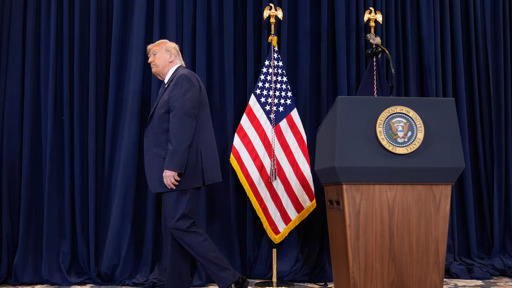
The episode of the president’s “disorganized” press conference on Monday, March 9, appears to have had precisely that dual purpose: to project the image of an imminent military victory and, at the same time, prepare the ground for a possible unilateral declaration of the end of the conflict.
But US domestic politics is not the only factor that complicates the equation.
Iranian Resistance and the Limits of Military Power
From a strategic point of view, the initial premise of the Israeli-American air war on Iran — that the Iranian regime would collapse under military and economic pressure — has not materialized.
The Iranian political system has demonstrated greater resilience than many in Washington and Tel Aviv anticipated. The opposition, weakened by months of repression, assassinations, and arrests, has failed to transform itself into a force capable of using the war to trigger the regime change that Washington and Tel Aviv hoped for.
Iran is not Afghanistan in 2001, where the Northern Alliance allowed the United States to combine air support with local ground forces to quickly defeat the Taliban regime. Nor is it Iraq in 2003, where a ground invasion was able to topple Saddam Hussein’s regime in a matter of weeks.
Because of its size, population, military apparatus, and complex geography, Iran presents a strategic challenge of a different magnitude. A large-scale ground campaign is politically unfeasible for the United States, while an air war, although capable of inflicting significant damage, does not appear sufficient to bring about the collapse of the regime.
The experience of Afghanistan and Iraq, moreover, offers a clear warning: even when a quick military victory is achieved, subsequent political success is far from guaranteed.
Tehran’s Asymmetric Warfare
Adding to this structural difficulty is the strategy adopted by Iran. Instead of responding with a direct conventional confrontation, Tehran has opted for a carefully calibrated asymmetric war.
Iran’s strategy involves absorbing attacks, preserving its key capabilities — especially missiles and drones — and maintaining pressure on vulnerable points in the global energy system, particularly the Strait of Hormuz. Meanwhile, the regime is attempting to erode international support for the U.S. military campaign and increase the economic cost of the conflict.
In this arena, Iran holds a significant strategic advantage: time. While immediate political and economic pressures weigh heavily on an American society largely unconvinced by the war, the Iranian leadership can pursue a protracted strategy of attrition. The perception in Tehran is that, if the conflict lasts long enough, internal pressures in the United States and the Gulf states will eventually push them toward negotiations.
A Strategic Dilemma With No Simple Solution
Given this scenario, Washington faces two main options, both problematic.
The first option is to escalate the war, expanding attacks in the hope of forcing an Iranian capitulation or an internal collapse of the regime, or, even more seriously, gambling on a balkanization of Iran. However, unlike Israel, which considers neutralizing Iran’s capacity to threaten it the central objective, even at the risk of provoking internal chaos in Iran, the U.S. administration and, even more so, the Gulf States attach significant importance to the “day after” in Iran. For these actors, the key issue is not only weakening the regime but also ensuring that whoever governs Iran is capable of maintaining internal stability. This concern stems in part from fears of large refugee flows, regional instability, and potential lasting disruptions to the flow of oil and gas from the Gulf to global markets.
The second option is to seek a negotiated solution or unilaterally declare an end to the war. But this path is also not easy. Tehran is unlikely to accept a ceasefire without substantial concessions, such as the lifting of sanctions or the release of frozen funds. The temptation of a spectacular military maneuver to break this impasse is growing. But, as Edward Luce points out in the Financial Times, Trump faces two extremely risky bets. The first would be a commando operation to seize the enriched uranium stockpile in Isfahan. The second, occupying Kharg Island to block Iranian oil exports. Both options could offer a dramatic exit, but they involve considerable military and political risks. The specter of Jimmy Carter and his failed hostage rescue mission in Iran in 1980 — which contributed to the downfall of his presidency — looms over the first option, while the second carries the risk of significant casualties. But after barely a week, public support for Trump’s war against Iran is at the same level as it was for the Vietnam War in late 1967, after more than 11,000 American deaths. Today, American public opinion would hardly tolerate even a few dozen casualties.
The Strategic Hourglass
The fundamental problem for the White House is that the clock of the conflict seems to have turned. At the start of the war, time appeared to be on Washington’s side, which expected a rapid collapse of the Iranian regime. Today, the opposite is true.
If Iran manages to maintain its ability to exert pressure — especially on the global energy market — and the conflict continues to erode international economic stability, the political pressure on Trump could become intolerable.
The paradox is that even if the United States succeeds in inflicting significant damage on Iran’s military capabilities, the strategic outcome will remain uncertain. Iran could rebuild some of those capabilities over time, even as critical issues, such as the future of its nuclear program remain unresolved.
Moreover, if the regime remains intact when Washington declares a ceasefire, Tehran will proclaim its own victory. That is precisely what Saddam Hussein did after the end of Operation Desert Storm in 1991: the mere fact of having resisted the United States and its allies was enough to transform a military defeat into a political triumph. That is the real risk for Washington and for the credibility of its power beyond the Persian Gulf.
The post Time is Running Out for Trump in Iran appeared first on Left Voice.
From Left Voice via This RSS Feed.