

Since 2023, there has been an unprecedented wave of U.S. and Israeli attacks across the Middle East. The two countries have invaded, bombed, and occupied several nations, including Lebanon, Syria, Yemen, Iraq, and Iran, while also prosecuting a genocide in Gaza and annexing the West Bank. Concurrently, the U.S. has ramped up its aggression against its neighbors throughout the Americas. But this activity has come at a high cost.
Israel has spent billions of shekels, expended countless munitions, and deployed reserves month after month to continue its aggressive campaign. Its politicians have yearned for a decisive war with Iran to crush Israel’s primary military rival and establish unipolar dominance in the region. But as this war unfolds, Israel finds it has underestimated Iran’s ability to evade and degrade its missile-defense system while enduring a hellish bombing campaign.
In the U.S., Trump’s attack on Iran has introduced new political and economic challenges for his coalition. After campaigning against new military interventions in 2024, his cabinet has struggled to formulate a coherent justification for yet another military quagmire in the Middle East. Voters in Trump’s base worry that he is compromising his campaign promises to abet Israel in a war that will cost American lives and tax dollars, further undermining an already-weak economy. With the midterms just months away, Trump has a limited window to resolve this crisis before the fallout threatens his control over Congress, potentially cornering him into a lame-duck presidency.
U.S. and Israeli Missile-Defense Systems
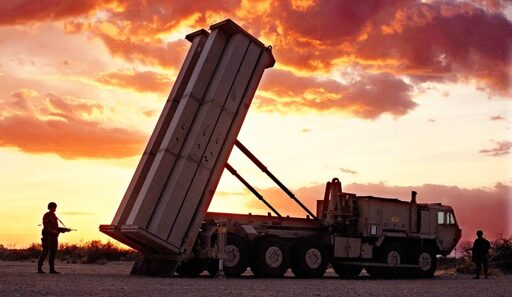
The missile-defense infrastructure developed by Israel and the United States in the Middle East consists of multiple layers of systems designed to detect and intercept projectiles launched by adversaries. These include Israel’s Iron Dome, Arrow, and David’s Sling systems, alongside U.S. counterparts like Aegis, Patriot, and THAAD. Each system has distinct strengths, and their overlapping capabilities mean that every missile fired must successfully evade all nearby systems before striking an American or Israeli target. During the current conflict with Iran, the THAAD system has played a crucial role in intercepting ballistic missiles, making it a primary target for Iranian attempts to weaken the system.
The THAAD system was developed in response to the shortcomings of the Patriot system during the First Gulf War, when Saddam Hussein successfully launched ballistic missiles at Israel, Kuwait, and Saudi Arabia. It is now produced in collaboration with several defense contractors, including Lockheed Martin, RTX (formerly Raytheon), Boeing, and others, costing over a billion dollars to produce a single battery. Fewer than a dozen active THAAD batteries exist globally; several are deployed across the Middle East in Israel, Jordan, Saudi Arabia, and the UAE. Despite their rarity, the powerful AN/TPY-2 radar acts as the “eyes” of the system, detecting projectiles up to 1,800 miles away. This positioning allows THAAD radars across the Gulf states to monitor Iran’s roughly 1,000-mile-wide geography. The THAAD system had notable success in intercepting Iranian missile volleys during the 12-day war in June 2025, but advancements in Iranian military strategy and technology are beginning to strain its effectiveness.
Iran has launched substantial barrages of ballistic missiles and drones to overwhelm the system and exhaust its costly, slowly produced interceptors. Reports indicate that in the first 36 hours of the war, the United States and its allies fired nearly 800 interceptors from air, land, and sea, including 70 THAAD interceptors, each costing $12.7 million. For the U.S., the cost is less concerning than its inability to mass-produce this essential defense munition. Lockheed Martin produces the interceptor missiles in the United States but managed to produce only 96 of them in 2025. Trump previously marshalled executives of Lockheed Martin and other defense contractors at the White House, after which Lockheed Martin agreed to increase yearly interceptor production to 400. But it remains uncertain whether this ramp-up will occur in time to replenish the United States’ rapidly dwindling arsenal.
Iran has sought to degrade the effectiveness of missile-defense systems by targeting the network of radar components spread throughout the Middle East. Satellite imagery has confirmed the destruction of the THAAD AN/TPY-2 radar stationed at the Muwaffaq Salti Air Base in Jordan, while other images suggest that two additional AN/TPY-2 radars, one in the UAE and another in Saudi Arabia, have been damaged or destroyed by Iranian attacks. Each of these radars is estimated to cost $500 million, and it is unclear how long it will take to repair or replace them. Similarly, satellite images show damage to a $1.1 billion AN/FPS-132 early-warning radar system at Al Udeid Air Base in Qatar. While the damage does not render the THAAD system useless, it means that the system may increasingly rely on secondary detection equipment or place greater reliance on the Aegis and Patriot missile-defense systems, whose interceptors are also in short supply.
Tel Aviv on Fire
The U.S. and its allies refuse to acknowledge the impact that attacks on radar devices will have on their missile-defense capabilities, but weaknesses are already surfacing in the Israeli missile-alert system. Part of this system includes apps that provide Israelis with warnings 30 to 90 minutes before an incoming missile strike. During the 12-day war in June 2025, the IDF announced that they could provide only a 10-minute warning before an incoming missile. Now, facing further degradation and increasingly sophisticated Iranian ballistic missiles, the IDF has warned that alerts may come as little as two or three minutes before a missile arrives, or perhaps not at all. This would mean that Israelis would rely solely on sirens for alerts, with as little as 90 seconds to reach a shelter.
Israelis have long lived comfortable lives while their government undertakes a brutal campaign of colonization and genocide against the Palestinian people. Their comfort is afforded by the Israeli state’s apartheid regime and the technology developed alongside its U.S. partners. Their missile-defense systems represent the pinnacle of their achievement, making Israel nearly untouchable as it carries out crimes throughout the region. Now, as missiles land in their neighborhoods — resembling the destruction routinely inflicted on Gaza and Lebanon, albeit on a much smaller scale — it is uncertain how the Israeli population will respond.
The Forever War on Terror
“Iran aggressively pursues these weapons and exports terror, while an unelected few repress the Iranian people’s hope for freedom.” These were President Bush’s words when he designated Iran as part of the “Axis of Evil” in January 2002. Twenty-four years later, using the same accusations of terrorism and promising the same freedom, Trump has launched another chapter in the now decades-long history of America’s “Global War on Terror.” But unlike Iraq, Afghanistan, Syria, Libya, and Somalia, Iran has achieved a level of military preparation and technological advancement that challenges U.S. dominance.
Even though Trump has deployed a ruthless, Rumsfeld-style shock-and-awe campaign of total destruction, he has failed to collapse the Iranian government. In the past week, he has used or discussed every tool in America’s imperial toolkit, from floating the idea of proxy army invasions to planning a Special Forces mission into Iran’s nuclear sites to attempting to leverage protests in Iran for regime change. But none represent a viable path forward. Trump now finds himself in a difficult spot: the clock is ticking as both Tel Aviv and U.S. bases endure daily bombardments from Iranian missiles while interceptor supplies dwindle further. Simultaneously, regional disruptions to the global oil supply have sent prices soaring. Yet, if Trump exits the war without achieving regime change or flattening a nuclear site, Trump risks being attacked by his more hawkish rivals for having “TACO’d” out.
Under these circumstances, Trump’s only way out might be through launching bigger attacks with bigger bombs on denser targets. Perhaps the U.S. can then finally get its point across to Iran, though that seems unlikely. Netanyahu promises that the “moment of truth is near” in Iran, but such language offers little to look forward to and much to fear as the two nuclear powers grow more desperate to demonstrate both the strength of their weapons and the flexibility of their morals.
As the war enters its second week, America and Israel have already killed over 1,000 people in Iran and hundreds more in Lebanon, throwing the region into turmoil. With each passing day, more workers across the globe lose their lives and livelihoods while titans of the weapons industry drain public coffers. But unlike past U.S. interventions in the Middle East, this war is already opposed by most Americans.
To combat Trump’s imperialist aggression, it is essential to build on this passive opposition, transforming it into an active anti-war movement that unites all sectors in the United States resisting Trump. The Left of the anti-war movement must cultivate anti-imperialist consciousness by advocating the military defeat of the United States and Israel while refraining from offering political support to Iran’s anti-worker regime. The crisis of U.S. military capacity, now further strained by a war on Iran with no clear end, presents an opportunity to build the anti-war movement we need. We must mobilize the working class to use their power to end this aggression.
The post With Dwindling Interceptors and Degraded Radar, Israel and the U.S. Enter Uncharted Territory appeared first on Left Voice.
From Left Voice via This RSS Feed.