

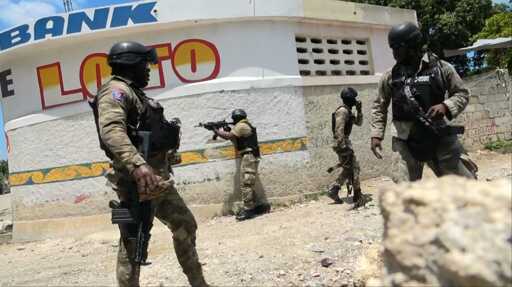
Dozens of children have been killed in drone strikes in Haiti over the past year, according to a report released by Human Rights Watch (HRW) on March 10. The report has exposed the controversial operations carried out by the Haitian security forces, along with private contractors, in their fight against criminal groups.
The report notes that between March 2025 and January 2026, at least 1,243 people were killed in drone strikes, what they have deemed “deliberate extrajudicial killings”, and 738 were injured. At least 17 children were killed in the strikes.
Juanita Goebertus, the Americas director at Human Rights Watch, said, “Ordinary people, including many children, have been killed and injured in these lethal drone operations,” she added, “Haitian authorities should urgently rein in the security forces and private contractors working for them before more children die.” Many of the 141 operations which were registered in the report were carried out “with quadcopter drones armed with explosives in densely populated urban areas.”
According to the United Nations Integrated Office in Haiti, drones have been widely deployed during operations of Haitian forces and a private military company called Vectus Global, which has links to mercenary Erik Prince. According to the US ambassador to Haiti, the US State Department granted a license to this private company to export its services to Haiti. On the Haitian side, Haiti’s latest prime minister, Alix Didier Fils-Aimé, permitted Vectus Global to operate in the Caribbean nation.
Among the various testimonies collected by HRW is one of an attack in which several children were allegedly killed: “In the September 20 attack, a drone armed with an explosive device detonated near the ‘Nan Pak’ sports and cultural complex in the Simon Pelé neighborhood of Port-au-Prince, the capital, where children had gathered for a gift distribution by the Simon Pelé criminal group. Human Rights Watch found that 10 people who were not members of criminal groups, including 9 children ages 3 to 12, were killed.”
Despite the concerning number of civilian casualties, drone strikes appear to be on the rise. Between November 2025 and January 2026 alone, there were 57 drone strikes, nearly double the number carried out between August and October 2025. Thus, nearly 40% of the killings occurred between December 2025 and January 2026.
“The videos show the repeated use of drones equipped with explosives to attack vehicles and people, some of them armed, but none who appear to be engaged in violent acts or pose any imminent threat to life. These videos bolster the impression that many of the drone attacks are attempts to target and extrajudicially kill people, rather than a law enforcement response that might justify the deliberate, lethal use of force”, said the report.
In addition, the report demands: “The authorities should also ensure transparency and accountability for any unlawful deaths resulting from security operations, and conduct prompt, thorough, and independent investigations to reveal, to the greatest extent possible, the number and identity of victims, and provide adequate redress where violations have occurred.”
Volker Turk, the UN’s human rights chief, added to these criticisms, stating that the use of force against gangs in Haiti has been “unnecessary, disproportionate, and likely a violation of international law.”
The failure of international occupations
The news of the drone strikes is the latest chapter in the US-backed attempts to use violence to resolve the deep crises facing Haiti. In 2021, the security crisis in Haiti dramatically worsened when the president, Jovenel Moïse, was assassinated by foreign mercenaries. Haiti has not managed to organize elections since then and none of the interim leaders have been able to control the escalating crisis which has seen considerable growth of gangs and criminal groups using violent means to assert control over more and more territory. According to a report from the International Organization for Migration (IOM), over 1.4 million people were displaced from their homes in 2025.
In response to the deepening crisis in Haiti, several UN member states proposed a tried and failed option: build a multinational security force to “reestablish order” in Haiti. While the previous UN-mandated missions like MINUSTAH and MINUJUSTH have been subject to scrutiny and criticism due to the documented human rights violations and accusations that the UN mission was responsible for introducing cholera into Haiti, this method was tested again.
The Multinational Security Support Mission was authorized by the UN Security Council in October 2023 and was largely composed of Kenyan police officers, despite strong opposition from Kenyan society. This mission once again failed to “stabilize” the country through foreign military occupation, and now, the MSS is winding down to be replaced by yet another force, allegedly with more powers and capabilities, the Gang Suppression Force (GSF) backed by Panama and the United States.
The post Over 1,200 killed in drone strikes in Haiti in less than a year appeared first on Peoples Dispatch.
From Peoples Dispatch via This RSS Feed.