

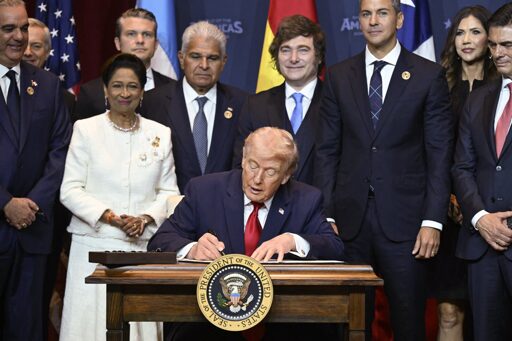
At least 17 countries in Latin America and the Caribbean are on board with Trump’s new military alliance. They are calling it the America’s Counter Cartel Coalition. Latin America’s top right-wing leaders are involved, including El Salvador’s Nayib Bukele and Argentina’s Javier Milei. They met in Florida for the event, on March 7.
The United States has promised to use lethal force to destroy cartels and narco-traffickers in those nations. Kristi Noem, the former head of Homeland Security, is the new special envoy for the coalition.
This is a new phase of Trump’s plan for Latin America. Trump’s Donroe Doctrine—Monroe 2.0. The first was the offensive against his enemies in the region. Now Trump is shoring up his allies, and building a coalition where the US military can continue to take action, now in collaboration with countries allied with Trump. We’ve already begun to see this unfold in Ecuador.
This is Episode 8 of Under the Shadow, Season 2.
Under the Shadow is an investigative narrative podcast series that walks back in time, telling the story of the past by visiting momentous places in the present. Season 2 responds in real time to the Trump administration’s onslaught on Latin America.
Hosted by Latin America-based journalist Michael Fox.
Many thanks to Belly of the Beast for the interview with Liz Oliva Fernandez and the use of the sound from several of their videos.
This podcast is produced in partnership between The Real News Network and NACLA.
Theme music by Michael Fox’s band, Monte Perdido. Monte Perdido’s 2024 album Ofrenda is available on Spotify, Deezer, Apple Music, YouTube or wherever you listen to music.
Other music from Blue Dot Sessions.
Script editing by Heather Gies. Hosted, written, produced, mixed, and edited by Michael Fox.
Guests
- Alexander Main from the Center for Economic and Policy Research
- Alexis Ponce
Resources
You can read Alex’s excellent analysis of the Shield of the Americas summit here.
Please also check out CEPR’s Americas Live Update Blog, with all of the latest from the region.
- The Beginning: Monroe and migration | Under the Shadow, Episode 1
- Panama. US Invasion. | Under the Shadow, Episode 13
- The legacy of Monroe | Under the Shadow, Bonus Episode 4
Support Under the Shadow
Please consider supporting this podcast and Michael Fox’s reporting on his Patreon account: patreon.com/mfox. There you can also see exclusive pictures, video, and interviews.
Transcript
MICHAEL FOX [NARRATION]: Here’s the scene: Donald Trump sits at a wooden desk with the presidential seal on it. He’s wearing a dark blue suit. White shirt. Red tie. He has a big black marker in one hand as he talks to someone off screen. Eleven men and one woman walk onto the stage behind him and get into place. They’re soon joined by Trump’s Cuban American Secretary of State Marco Rubio and Secretary of War Pete Hegseth. They are all smiling.
These 12 men and woman behind Trump are his dream team of allies in Latin America and the Caribbean. His Avengers… The conservative and right-wing presidents who have been invited into Trump’s new exclusive club in the Americas.
In return they are promising to do his bidding in the region and open their borders to the US military.
This is their coming out party. Their debutant ball.
The summit was called the Shield of the Americas. It was held on Saturday, March 7, in Miami, Florida, at Trump’s National Doral Golf Club.
Flanked by allies like Argentina’s Javier Milei, Trinidad and Tobago Prime Minister Kamla Persad-Bissessar, and El Salvador’s Nayib Bukele, Trump looks down and signs a document committing to fight drug cartels in these countries and to “train and mobilize partner nation militaries to achieve the most effective fighting force necessary.”
PRESIDENT DONALD TRUMP [CLIP]: But on this historic day, we come together to announce a brand-new military coalition to eradicate the criminal cartels plaguing our region … We’re calling this military partnership the Americas Counter-Cartel Coalition.
MICHAEL FOX [NARRATION]: Trump spoke before the signing.
PRESIDENT DONALD TRUMP [CLIP]: For decades, leaders in this region have allowed large swaths of territory of the Western Hemisphere to come under the direct control. And transnational gangs have taken over, and they’ve run areas of your country. We’re not going to let that happen.
We’ll help you. And bloodthirsty cartels that impose their will through murder, torture, extortion, drug trafficking, bribery, and terror. And some of you are in danger. I mean, you’re actually in danger. It’s hard to believe. But we’re working with you to do whatever we have to do. We’ll use missiles. If you want us to use a missile, they’re extremely accurate. Right into the living room. And that’s the end of that cartel person. But we’ll do whatever you need, if you want.
MICHAEL FOX [NARRATION]: This is a new phase of Trump’s plan for Latin America. Trump’s Donroe Doctrine — Monroe 2.0. The first was the offensive against his enemies in the region: threaten and attack his political adversaries. Unleash boat strikes in the Caribbean and Pacific. Invade Venezuela. Kidnap the president. Strangle Cuba. Threaten Mexico and Colombia. Tariff war on Brazil. And now it’s all happening in the shadows of war as the US bombs Iran.
Now Trump is shoring up his allies in the region and building a coalition where the US military can continue to take action, now in collaboration with countries allied with Trump. We’ve already begun to see this unfold in Ecuador.
US Southern Command posted this video on X on March 3. It shows a chopper taking flight, and then gray footage shot from a helicopter or drones with a bullseye on the screen under the words “unclassified.”
The text reads, “On March 3, Ecuadorian and US military forces launched operations against Designated Terrorist Organizations in Ecuador. The operations are a powerful example of the commitment of partners in Latin America and the Caribbean to combat the scourge of narcoterrorism.”
On Friday, March 6, the US and Ecuadorian military announced that they had carried out joint strikes on a drug traffickers’ training camp in northeastern Ecuador.
“We are advancing alongside our partners in the fight against narcoterrorism,” Southcom posted on X.
PRESIDENT DONALD TRUMP [CLIP]: Just as we formed a coalition to eradicate ISIS in the Middle East, we must now do the same thing to eradicate the cartels at home.
ALEXANDER MAIN: I think basically they’re trying to find any excuse to get militarily involved in as many countries as possible in the region using the pretext of the threat of the cartels and drug trafficking.
MICHAEL FOX [NARRATION]: Alexander Main is the director of international policy at the Center for Economic and Policy Research based in Washington, DC. We will hear from him throughout this episode.
ALEXANDER MAIN: And of course, they’ve been inventing cartels, including the Cártel de los Soles, which was the whole pretext for Venezuela and abducting President Nicolás Maduro of Venezuela. So when they say cartels, I think they use that term very loosely.
In the case of the Cártel de los Soles, there’s no evidence that it is any kind of an organized drug trafficking cartel.
MICHAEL FOX [NARRATION]: This is a new game plan in the region, one which we have not seen in a very, very long time.
ALEXANDER MAIN: To my knowledge, we haven’t seen this in recent times, this kind of level of collaboration in carrying out military attacks within a country, at least publicly.
MICHAEL FOX [NARRATION]: And this is just the beginning.
At least 17 countries in Latin America and the Caribbean are on board with Trump’s campaign. The United States has promised to use lethal force to destroy cartels and narcotraffickers in those nations. Kristi Noem, the former head of Homeland Security, is the new special envoy for the coalition.
US Secretary of War Pete Hegseth spoke to the audience just before Trump’s signing ceremony.
PETE HEGSETH [CLIP]: And at the War Department, we look forward to working with all of your countries and more that are not here to say, with our shared assets and our intelligence and our capabilities with American leadership, we will go on offense against the cartels.
They will know that we’re just around the corner. Whether it’s drug boats or on land, we look the Americas Counter Cartel Coalition, the ACCC, will be a force for good, for peace through strength in this hemisphere.
MICHAEL FOX [NARRATION]: All of that in a minute…
[THEME MUSIC]
This is Under the Shadow — an investigative narrative podcast series that looks at the role of the United States abroad, in the past and the very present.
This podcast is a co-production in partnership with The Real News and NACLA.
I’m your host, Michael Fox — Longtime radio reporter, editor, journalist. The producer and host of the podcasts Brazil on Fire and Stories of Resistance. I’ve spent the better part of the last 20 years in Latin America.
I’ve seen firsthand the role of the US government abroad. And most often, sadly, it is not for the better: invasions, coups, sanctions. Support for authoritarian regimes. Politically and economically, the United States has cast a long shadow over Latin America for the past 200 years. It still does.
This is Season 2 of Under the Shadow: “Trump’s Attack.”
“The Donroe Coalition: Trump’s New Right-Wing Military Alliance for the Americas.”
So… If you have been following this podcast, you know that most of this season I’ve been looking at Trump’s onslaught on the region, in particular against his political adversaries. I’ve looked at the boat strikes, the invasion of Venezuela, the US oil blockade against Cuba and resistance against these and other threats across Latin America
Today, I’m diving into Trump’s Shield of the Americas summit. I’ll dig into his increasing ties with right-wing governments across Latin America and the US military plans to use force inside those countries under the pretext of the so-called drug war. But it’s not just about drugs.
As guests on previous episodes have underscored, Trump’s doctrine is spinning together the war on drugs and the war on terror into a frightening new militarized agenda in the name of combating narcoterrorists or cartels in Latin America, even when those cartels are a fabrication.
ALEXANDER MAIN: So they’re talking about fighting cartels, and we can expect them to pull cartels out of thin air right and left so everything is a cartel, and then anything that’s a cartel is a terrorist organization too. And that’s something we’ve been seeing since the beginning of this administration, this Trump administration. They’ve been referring to cartels and gangs as terrorist organizations. And as terrorist organizations, that makes them military targets.
MICHAEL FOX [NARRATION]: I’m going to be joined most of today by Alex Main. He followed this Shield of the Americas summit closely and wrote about it for the Center for Economic and Policy Research, where he’s the director of international policy. Alex says even just a few weeks ago, the summit wasn’t really on people’s radar.
ALEXANDER MAIN: Well, it’s something that no one really knew about until fairly recently. And until it actually happened, we still didn’t know much about it because the White House, contrary to other big events, multilateral events that happened that the US administration organizes, there are no fact sheets, there were no press releases, there was nothing to really explain what this was. And in fact, we first found out about it, essentially through leaks, some leaks to the media, and mostly from heads of state themselves that were proudly sharing the invitations they got to this summit.
Of course, dealing with foreign interference has always been the big pretext for US intervention of all kinds in the region. That’s what the Monroe Doctrine is based on, initially to keep out European powers and to help Latin American and Caribbean independent nations keep those European powers out, but in practice, of course, becoming fairly quickly a pretext for trying to exert direct control over those countries and eventually invading and occupying those countries in a lot of cases.
And so you know we’re now dealing with um a Monroe Doctrine that’s on steroids, and it’s being called the Donroe Doctrine. It sounds like a joke, Don for Donald Trump. But it’s actually a term that’s being used seriously by people, cabinet officials, Marco Rubio and Defense Secretary Hegseth and others.
PETE HEGSETH [CLIP]: President Trump has reestablished the Monroe Doctrine, the Trump Corollary of the Monroe Doctrine, or if you’d like, for short, you can just call it the Donroe Doctrine.
ALEXANDER MAIN: So it’s the Donroe Doctrine. And, we’ve had an indication of what that is over the last year or so, particularly since the US began to really militarize the Caribbean and Eastern Pacific and carry out military actions that have gone far beyond anything that a recent US administration has done in the region. So it’s elicited a lot of concern.
But the countries that were invited to this summit were actually those countries, and it’s a minority of countries in the region, that have basically been cheerleaders for the Trump approach, the Donroe Doctrine, and particularly this militarized approach that we’re seeing. They’ve not only gone along with it, they are doing the same thing in their own countries in a lot of cases. They’re labeling gangs and cartels and so on as terrorist organizations, just as the administration started doing at the beginning of last year.
And, of course, by calling these crime organizations, by referring to them as terrorist organizations, they then make those organizations military targets. And it gives them a pretext to mobilize the military and to involve the US in a lot of cases, like we’ve just seen in Ecuador.
MICHAEL FOX [NARRATION]: Like we have seen in recent weeks in Ecuador. We’ll get to that in a second. But first I want to go to Miami.
This is where Trump held his Shield of the Americas meeting. It’s not an accident that it was in Florida, rather than in Washington, the US capital. Alex explains why this was a no-brainer for Trump.
ALEXANDER MAIN: It is his own territory. It’s his golf resort. He has two big resorts down there. One is Mar-a-Lago, and then the other in Miami is the Trump National Doral Miami Golf Resort. And we can expect, just as Mar-a-Lago has gotten a lot of revenue from a lot of visitors that want to see President Trump, that want to hobnob with him since he’s there all the time, similarly with the location of this summit, we can clearly see that there’s also a profit motive behind the choice of the place.
But beyond the fact that it’s at the resort, there I think it’s also significant that it’s in Miami, in South Florida, because this is where you have the most enthusiastic audience for Trump’s approach to the region, to this Donroe Doctrine, and particularly his and Secretary of State Marco Rubio’s attacks against the left. And this came up a lot during the summit. I mean, attacks against Cuba in particular.
This is what the administration has been focused on quite a bit since the intervention in Venezuela. They’ve set their sights on Cuba with a veritable oil blockade that’s been really asphyxiating the country economically. Of course, the country has been suffering economically for a long time as a result of US sanctions, the US embargo that’s been in place since 1960, but this has reached a whole new level, and it really appears that they’re pushing hard for regime change.
And yeah, this has an enthusiastic audience among Cuban American exiles in South Florida, sort of the old guard that still exerts a lot of influence over politics and the media and the economy of South Florida. And so I think this was the perfect stage for this kind of a gathering.
MICHAEL FOX [NARRATION]: The Latin American leaders at Trump’s summit were a who’s who of the right and far-right leadership in the region. Among them were the heads of Argentina, Bolivia, Chile, Costa Rica, the Dominican Republic, Ecuador, El Salvador, Guyana, Honduras, Panama, Paraguay, and Trinidad and Tobago.
ALEXANDER MAIN: We’ve seen a lot of political change in the region over the last few years, and that change has generally been towards the right, and more and more towards the far right. A lot of these leaders that were present from 12 countries in the region at this summit, a lot of them can be really characterized as far-right and very aligned with President Trump.
MICHAEL FOX [NARRATION]: People like Nayib Bukele.
PRESIDENT DONALD TRUMP [CLIP]: Nayib Bukele, he is a man who we’ve gotten very close to. I saw him as a young man my first time. You were young and handsome. Now you’re older and handsome. You’re older and handsome. But he runs a good operation. That’s all I care about, right?
MICHAEL FOX [NARRATION]: Bukele is El Salvador’s 44-year-old president, who’s been in power since 2019. His name has become synonymous with power grabs and an iron fist crackdown on gangs in Latin America. He literally has called himself the “world’s coolest dictator.” He has opened the country for real estate, tourism, and tech business while imposing an ongoing state of exception that has locked up more than 90,000 alleged gang members since 2022. But thousands of people are innocent. And they’re languishing in El Salvador’s high-security prisons without habeas corpus or the rule of law.
Argentina’s chainsaw-wielding free-market economist president Javier Milei was also present. He’s become famous for shouting “Long live freedom, damn it!” at his rallies.
“Viva la libertad, carajo!”
ALEXANDER MAIN: He characterizes himself as an anarcho-libertarian. And I think that sounds more benign than it really is because he is also a big admirer of the military dictatorship in Argentina. And he’s engaged in a war on the left, on social movements. And of course, he’s trying to reduce the welfare programs that exist in Argentina. And he’s really been engaged in an onslaught against some of the achievements, the social and economic achievements of Argentina, over the past few decades.
And he’s gotten a lot of support for Trump, and Trump has intervened heavily in his favor, in particular with a $20 billion bailout last year that occurred shortly before the elections. The Trump administration also supported a major loan from the International Monetary Fund, one that a lot of the membership of the International Monetary Fund objected to because it was so enormous and because the levels of debt in Argentina are so high. These moves helped stabilize the currency and stabilize the economy before the congressional elections last year and allowed Milei to have a real victory there. And he’s now able to ram through some of his more radical reforms through Congress.
And then you have Daniel Noboa from Ecuador, who has also aligned himself very strongly with Trump and who’s also attacking the left, not only at home where he’s basically outlawed the major opposition party. That was his latest move. It just happened a couple of days ago, actually. But he has also been involved in really really heavy repression of the left in Ecuador. And he’s also helping serve as a proxy to try to weaken the left-wing government that’s next door, which is that of Gustavo Petro of Colombia, where he has been imposing very, very high tariffs.
MICHAEL FOX [NARRATION]: Chile’s then-President-elect José Antonio Kast also attended Trump’s summit. He was inaugurated this week.
Kast is perhaps the most radically far right president in the region today. And he is extreme even by Trump standards.
ALEXANDER MAIN: His father himself was a Nazi. There’s evidence for that. And it’s not something that Kast has tried to distance himself from. Kast is a big defender of the Pinochet dictatorship which involved so many victims, so many forced disappearances, so much torture and killings and so on.
So, you have a lot of individuals of that nature in the region now. And I think more and more that are going further than they would otherwise.
MICHAEL FOX [NARRATION]: Alex says one example is Kamla Persad-Bissessar…
ALEXANDER MAIN: The prime minister of Trinidad and Tobago, who used to be considered somewhat progressive when she was leader of the opposition in Trinidad. Today she is joining the Trump administration in attacking Cuba, and she’s very supportive of the blockade against Cuba that’s occurring at this moment.
She was very supportive of the attacks on boats in the Caribbean and the Pacific last fall. Even though a lot of these attacks probably involved Trinidadians, we know that there were Trinidadian victims.
And she supported the invasion of Venezuela. She went against basically all the other countries in the Caribbean to do this. And it’s become quite clear that she believes that the winning ticket is to go along with Trump and his policies. She was one of those who was very proudly telling the world that she’d been invited to this summit, even though it only happened recently. She was only invited at the last minute, really, in the last two weeks.
When Caracom held a summit, she took some positions against the rest of the Caribbean community, including on Cuba and Marco Rubio, who rewarded her with an invitation to this summit. So basically, if you want to be part of the club, you have to go along with the extreme agenda of President Trump and Secretary of State Marco Rubio in the region.
MICHAEL FOX [NARRATION]: Marco Rubio spoke to the leaders assembled at the summit.
MARCO RUBIO [CLIP]: These are countries that have been there for us, and these are leaders that are not just allies. They are friends, and they are always willing to work and cooperate with the United States. And we’re grateful for that.
We want to be a partner with you in that. We want the world to see that when you are a friend and an ally of the United States, it is a good thing.
MICHAEL FOX [NARRATION]: It’s reciprocated. It comes back the other way as well. And so the fact the president is here today and making this a priority is so critical.
Clearly, Trump’s allies represent a growing proportion of leaders across the region. And he’s thrown his weight around to help make it so.
On the eve of the presidential election in Honduras in November 2025, Trump threatened to cut off aid to the country if voters did not choose his preferred candidate, the right-wing former mayor of Tegucigalpa, Nasry “Tito” Asfura. Trump’s allegiances are clear: before Honduras had finished a long, drawn out vote count, Trump pardoned Juan Orlando Hernández, convicted drug trafficker and Honduran former president, who also happened to be an important ally of Asfura, who ultimately won.
Elsewhere in the region, Trump expressed support for Bukele’s 2024 reelection bid in El Salvador. Noboa in Ecuador in 2025. And he’s already endorsed Argentina’s Milei for another term ahead of presidential elections in 2027. And Trump embraced Chile’s Kast before he had even entered office. The list goes on.
But the region’s three most populous countries — Brazil, Mexico, and Colombia — are clearly not on board. And Alex says the majority of the region isn’t going along with Trump’s agenda.
ALEXANDER MAIN: One litmus test is right after the attack on Venezuela and the abduction of Maduro you had a meeting, an emergency meeting of the Community of Latin American and Caribbean states, CELAC. And there was agreement apparently between two-thirds of those countries on a statement denouncing the intervention and saying that it violated international law, which of course it did.
But you had this group of countries, and I think it was eight or nine at the time, that blocked it. And again, the numbers are growing. But at the moment, you still have the majority of the region. I wouldn’t call them necessarily progressive, all these countries, but at least wanting to defend sovereignty. They see what happened in Venezuela and think, this could happen in my country, what’s going to prevent the US doing the very same thing?
And so, they have pushed back, but I would say they don’t offer a very united front. And so that’s, I think, one of the dangers of this summit is that they’re really trying to consolidate a bloc of countries that are closely coordinated.
MICHAEL FOX [NARRATION]: Trump has appointed the former Homeland Security Secretary Kristi Noem to lead the coalition. Remember, she’s been largely responsible for the crackdown across the United States over the last year, and in particular the chaos of Operation Metro Surge in Minneapolis.
She spoke to the leaders assembled at the Shield of the Americas summit.
KRISTI NOEM [CLIP]: This Shield of Americas will be a powerful example to the rest of the world about what’s possible. There’s nothing like this happening today anywhere else in the world, and the way that we cooperate on our shared ideals of freedom and of democracy and safety and security will be a shining light to all of those who wish to be more like all of us.
Our objectives are going to be to destroy the cartels, to go after these narcoterrorists that are destroying our people, killing our children and our grandchildren. We’re also going to keep our adversaries at bay. Those adversaries that wish to change our way of life and our values that are outside of our hemisphere, we want to ensure that we’re continuing to keep them out of our hemisphere and focus on building alliances amongst ourselves and our strengths.
MICHAEL FOX [NARRATION]: Kristi’s choice of words here is striking. It’s reminiscent of George W. Bush’s language in the wake of 9/11, as the US launched its war on terror.
GEORGE W. BUSH [CLIP]: Every nation, in every region, now has a decision to make. You’re either with us or you’re with the terrorists.
Today our way of life. Our very freedom came under attack.
MICHAEL FOX [NARRATION]: Bush said those words often. In one press conference the month after September 11, 2001, he told press: “The object of terrorism is to try to force us to change our way of life, is to force us to retreat, is to force us to be what we’re not. And they’re going to fail.”
Today again the language of the war on terror is being combined with the war on drugs to create a new justification for intervention in the region: the cartels, or so-called narcoterrorists.
I spoke with Alex Aviña about this a few weeks ago. He’s an associate professor of Latin American history at Arizona State University.
ALEX AVIÑA: We have an affirmation of power, and we can do things because we can. And if you’re not with us, we are going to destroy you. And I think that’s the logic. That connects Gaza to the US-Mexico borderlands, to Cuba, to Venezuela, to anybody who’s in the crosshairs right now, to Iran. And it’s a powerful sovereign who gets to decide who must live and who must die, who deserves to die. I think the “deserves” part is really important.
And that’s what also connects someone like Alex Pretti’s extrajudicial assassination with the more than a hundred of Latin Americans, Colombians, Ecuadorians, Venezuelans that have been extrajudicially executed in the Caribbean and the Eastern Pacific. It’s not just that they must die, it’s that they deserve to die.
And there’s no legal process. There’s just an execution because these people were marked as deserving to die because they are narcoterrorists in the case of these individuals in the Caribbean. Or in the case of Alex Pretti and Renee Good, they’re domestic terrorists. So of course they have to die.
MICHAEL FOX [NARRATION]: And now more than a dozen countries in Latin America are opening their doors to lethal action inside their borders by the United States…
A dozen leaders attended the Shield of the Americas Summit, but the defense ministers of 17 Latin American countries participated in the Americas Counter Cartel Conference two days before. It was held at the headquarters of the US Southern Command in Doral, Florida, near Trump’s golf course and the Miami airport.
The five additional countries included the Bahamas, Belize, Guatemala, Jamaica, and Peru.
STEPHEN MILLER [CLIP]: Good morning, welcome to the America’s Counter Cartel Conference hosted by the Secretary of War the Honorable Pete Hegseth and the Commander of the United States Southern Command General Francis Donovan.
MICHAEL FOX [NARRATION]: Homeland Security Advisor Stephen Miller spoke to the countries present. He did not mince words when it came to conflating the war on terror with the war on drugs.
STEPHEN MILLER [CLIP]: The cartels that operate in this hemisphere are the ISIS and the Al Qaeda of the Western Hemisphere and should be treated just as brutally and just as ruthlessly as we treat those organizations.
Just as we fought Al Qaeda and fought ISIS with the tip of a very lethal spear, the reason why this is a conference with military leadership and not a conference of lawyers is because these organizations can only be defeated with military power.
MICHAEL FOX [NARRATION]: Military power.
PETE HEGSETH [CLIP]: Ladies and gentlemen, it is now my distinct pleasure to introduce our Secretary of War the Honorable Pete Hegseth. Well, good morning, everybody.
MICHAEL FOX [NARRATION]: At the event, Hegseth took strides to find common ground and history with the participating nations.
PETE HEGSETH [CLIP]: All the nations represented in this room are offsprings of Western civilization. Our nations are and always will be united by our heritage, our history, and geography in this New World. We share the same interests. And because of this, we face an essential test, whether our nations will be and remain Western nations with distinct characteristics, Christian nations under God, proud of our shared heritage, with strong borders and prosperous people ruled not by violence and chaos but by law, order, and common sense. Or whether we are permanently torn apart by something else, led astray by competing forces, radical narcocommunism and anarchotyranny which threaten our people, borders, and sovereign lands in the name of a false sovereignty or a false peace.
MICHAEL FOX [NARRATION]: Alex Main….
ALEXANDER MAIN: So I think just as the summit at the Trump resort in Miami was a Trump show, other leaders didn’t get much of a chance to speak. In fact, what most of them managed to do was just get a selfie with Trump. And this is just a show that involved mostly a speech by Trump.
Well, similarly, we saw this with Pete Hegseth, who put on a big macho, militaristic show as well to these defense ministers from 17 countries in the region, basically saying we need to get tougher on these cartels, and basically is encouraging these governments to both give their militaries a blank check in going after organized crime, or maybe not even organized crime, having their way in these countries in terms of law enforcement. And also encouraging them to seek the US’ aid. And if they don’t seek the US’ aid, it might be forced upon them.
PETE HEGSETH [CLIP]: President Trump understands that today’s threats to border security and key terrain in our hemisphere are existential questions for our nation and for all of yours. When adversaries conduct incursions in this hemisphere off the coast of a US state, Alaska, or off the coast of Greenland, or in the Gulf of America, or the Caribbean, that is a direct threat to the United States homeland and to peace in this hemisphere.
When adversaries control ports or infrastructure along strategic choke points for US and hemispheric trade such as the Panama Canal, or install military facilities just miles off our shore, that is a threat to the United States homeland and peace to this hemisphere. When terrorist killers and cartels capture strategic infrastructure, resources, and entire towns or cities close to US borders and US shores or profit from mass illegal migration, that is a threat to the United States homeland and a threat to all of you as well, to the Americas.
MICHAEL FOX [NARRATION]: Alex Main…
ALEXANDER MAIN: So, yes, I think it was a Hegseth show. Of course, we know he was a Fox News host, and he’s continued to play a similar role as defense secretary. And this whole idea that they are now going to focus on the cartels, I come with a lot of skepticism because, for one, they do make up cartels out of thin air, as we saw in the Venezuelan, the Cártel de los Soles. And two, it’s pretty clear that they are very selective in how they want to combat drug trafficking.
We saw President Trump pardon Juan Orlando Hernández of Honduras, who is apparently involved, and there’s evidence of this, in enabling an enormous amount of trafficking of cocaine to the US, more than 400 tons of cocaine, apparently. And so if you’re going to release somebody like that, that suggests that maybe you’re not all that serious about drug trafficking or that you see the drug trafficking problem very selectively.
And another indication of this is how deep they’re getting into cooperating with Daniel Noboa of Ecuador in fighting drug gangs there, or at least that’s what they say they’re doing. When there are reports that his family’s business, one that he’s been very involved in in the past, and has been shipping cocaine to Europe. At the very least, you would think that before going in deep with Daniel Noboa and fighting drug trafficking that they might want to look into this just a little bit, but there’s no indication the Department of Justice in the US is in the least bit interested in trying to find out more about how the Noboa family business could be involved themselves in major drug trafficking.
MICHAEL FOX [NARRATION]: That’s for a good reason…
Born in Miami, Florida, and raised in Guayaquil, Ecuador, Ecuador’s 38-year-old President Daniel Noboa is a friendly sidekick for the Trump administration. Noboa has been bucking public opinion in Ecuador to build increasing ties with the United States and the US military.
ALEXANDER MAIN: I think the US sees Ecuador as a model in this regard, and Ecuador signed a status of forces agreement which allows US military personnel to be mobilized in the country and gives them immunity from prosecution. Paraguay just signed a similar status of forces agreement, and I think we’re going to be seeing more of that and just more involvement in these countries.
And when the US gets very deeply involved in the military and intelligence apparatus of the state, it gives them enormous leverage, leverage including over the politics and the policy agenda of those countries. And so it is an instrument of control, and it’s one that I think the Trump administration is very interested in using more and more.
MICHAEL FOX [NARRATION]: Ecuador. This is a country I know pretty well. I lived there in the mid 2010s. I covered Daniel Noboa’s presidential reelection last year. And both before and after that reelection, Noboa has ordered the country’s armed forces to carry out military operations against so-called “terrorists” or gangs.
In January 2024, he declared an “internal armed conflict” in the country and classified 22 criminal gangs as “terrorist organizations.”
“We are in a state of war,” he said in a 2024 interview, “and we cannot give in to these terrorist groups.”
He used this narrative to get reelected last year.
In early March, this year, as I mentioned at the top, Ecuador became the first country in the region during Trump’s second term to invite in US forces to collaborate on a violent raid on a drug traffickers’ training camp.
This is significant for multiple reasons. For one thing, this move came less than four months after Ecuadorians voted down a national referendum proposed by Noboa to change the constitution to allow foreign military bases in Ecuador. Remember that, for 20 years, the United States controlled the Manta military base, northwest of Guayaquil along the Ecuadorian coast. But in 2009, former President Rafael Correa shut down the base and kicked US troops out of the country.
I spoke with Ecuadorian human rights defender Alexis Ponce about the impact of the Noboa-Trump joint military raid and Noboa’s increasing US military ties. He spoke over Zoom from his home in Quito.
Alexis says that when Ecuadorians voted against allowing foreign military bases and a number of other proposed constitutional changes, movements in other countries said, “Wow, the Ecuadorian people are on the forefront of the fight against military intervention in Latin America.” And this amidst a continent where the US was already bombing the Caribbean, threatening Greenland, Canada, Mexico, and Colombia.
Alexis says he hoped Ecuadorians and their Latin American neighbors could build on the victory. Stay united and gain inspiration. But Noboa disregarded the popular will and instead pushed ahead with his militarization agenda.
ALEXIS PONCE: The people feel that it is a shame. They voted against the US bases, and yet Noboa is advancing with the US military on top of us. But at the same time the people are afraid, as in 1930s Germany. Why? Because with fear you win the ideological, cultural battle of thought, because people are afraid that Noboa and his allies can do whatever they want. They can do anything, and they don’t have to tell anyone because it’s classified. No one has the right to know how many US soldiers are here and what they’re going to do. Though, we can guess what they’re planning from what they’ve already done.
MICHAEL FOX [NARRATION]: Alex Main…
ALEXANDER MAIN: To my knowledge, we haven’t seen this in recent times, this level of collaboration in carrying out military attacks within a country, at least publicly, because we know that privately the US has been involved in a lot of intelligence sharing. There could at times be special forces on the ground that we don’t know about.
For instance, during the presidency of Álvaro Uribe in Colombia, there was actually a military strike on a camp of a guerrilla insurgency group, the FARC, that was close to the Colombian border. And they went in and violated Ecuador’s sovereignty. And afterwards, it became clear that these attacks were carried out with a lot of help from US intelligence and so on.
So I think that sort of thing has probably been going on for a while, and and far more than what’s on the public record.
But doing this overtly, one, it hasn’t been seen, I think, in a very long time, but two, it also can have a chilling effect on other countries in the region.
Ecuador has Colombia on its border. It’s very close to Brazil as well. Two countries with progressive governments that the Trump administration doesn’t get along with. And there could easily be fears that if tensions grow between the Trump administration and some of these progressive governments, and they’ve been quite intense in recent months, that there is the possibility of military action. The US military is right there. They effectively have bases in a place like Ecuador, even though that’s unconstitutional.
And so if we see this in more countries, and particularly in these very far-right areas, these countries with very far-right governments, neighboring progressive governments, I think these progressive governments are going to be feeling more and more surrounded by a hostile US.
MICHAEL FOX [NARRATION]: One theme was sounded again and again by US officials at both the Shield of the Americas summit and the Counter Cartels Conference: The need to use lethal military force against their enemies… foreign and domestic.
Donald Trump.
PRESIDENT DONALD TRUMP [CLIP]: Every leader here today is united in the conviction that we cannot and will not tolerate the lawlessness in our hemisphere any longer. The only way to defeat these enemies is by unleashing the power of our militaries. We have to use our military.
You have to use your military. You can’t fight these people with — And you have great police. You have some great police, but they threaten your police. They scare your police. You’ve got to use your military.
In many cases, our forces have already been working closely with yours. And the United States looks forward to deepening and expanding that cooperation in the months ahead. And it’s so good that we got to know so many of you.
MICHAEL FOX [NARRATION]: I want to underscore something that is really important. What Trump is demanding here is really concerning, and a complete about-face for the direction Latin America has tried to head into since the end of the Cold War.
Remember that throughout the 1960s until the ’80s, South America was ruled by US-backed dictatorships and Central America was in the grips of US-backed authoritarian governments and bloody civil wars. Throughout the region, militaries were unleashing violence on their own civilian populations, as I looked at in depth in Season 1 of this podcast.
But the late ’80s and ’90s ushered in a redemocratization effort that attempted to separate out the role of the police and military forces. It wasn’t always successful. But the idea was to ensure that the countries of Latin America would not use lethal military force on their own citizens under the guise of national security… or in the name of protecting the nation against a so-called internal threat.
Trump is turning the clock back on this policy to a Cold War era in which governments once again deploy their militaries on citizens inside the country… in Latin America and even in the United States.
And his policies are pushing deadly force with no accountability.
Alex Main…
ALEXANDER MAIN: You are seeing more and more the police pushed to one side and the military taking over law enforcement. That’s become the big thing. And then in some cases, a militarization of law enforcement. We’ve seen this in Honduras over the years. It started under Juan Orlando Hernández, actually, where they created you know militarized units of the police. And so the lines are getting completely blurred between the police and the military and what is what. It’s all becoming extremely militarized.
And the military has no training in human rights or restraint. They’re trained for combat. That’s part of the issue with deploying the National Guard all over the US. Thankfully, to date in the US, the National Guard haven’t actually been involved in clashes with protesters and so on, but that’s happened with ICE, which is a similar militarized law enforcement unit here in the US.
But yeah, this is becoming the new paradigm. And as you mentioned, it’s kind of hearkening back to what we were seeing under the dictatorships.”
And you know basically, again, this idea that anybody can be labeled part of a cartel, if the government says, oh, you’re a drug trafficker, that’s it. But then they don’t necessarily provide any evidence. And suddenly, you’re a military target.
And I think that’s the real danger as well. We’re going to see, we are seeing, a growing backlash to these far-right governments in the region. And the best way to deal with a strong backlash, as we saw into the dictatorships, is to mobilize the troops and to violently repress dissent internally. And now there is a new paradigm that I think is gonna really enable that more and more.
So, t’s a real danger. And I think in the US, we have to think when we’re fighting the militarization of law enforcement in the US, think about how it needs to be fought elsewhere and how the US is backing this same model that we’ve been seeing in the US in other countries in the region.
MICHAEL FOX [NARRATION]: The meetings over the last week in Miami were just the beginning. The 17 members of the new Counter Cartel Coalition have their marching orders from Washington. And if Trump has his way, they will be following in the footsteps of Ecuador, actively collaborating with the US military. Think School of the Americas 2.0, but with US soldiers taking flight alongside foreign militaries and dishing out lethal action up and down the hemisphere, with the consent of local governments.
But with one country actually calling the shots — The United States.
This new coalition is also a symbol of how Trump is trying to circumvent multipolar institutions with parallel institutions that will do his bidding. Instead of working through the UN, Trump founded his so-called Board of Peace to allegedly manage the so-called reconstruction of Gaza.
Instead of working through the Organization of American States — Which the US already controls but where there would be clear dissent — Trump has launched his Counter Cartel Coalition with his closest allies clearly on board and zero resistance to his agenda.
PRESIDENT DONALD TRUMP [CLIP]: We will join and work together to end the pandemic of the cartels and all the criminal actions associated to them.
MICHAEL FOX [NARRATION]: Chile’s incoming minister of defense spoke at the Counter Cartels Conference.
FERNANDO BARROS [CLIP]: The great difference between them and us is that this alliance is against criminals and we will fight them, and we will be tough. We will fight. We will be in a war because the law is with us.
MICHAEL FOX [NARRATION]: Costa Rican Minister of Public Security Mario Zamora Cordero.
MARIO ZAMORA CORDERO [CLIP]: We are thankful that the doctrine of the United States of the year 2026 gives priority to this continent because, Mr. Hegseth, you come in the moment that the Americas really need the support of the United States. Today you’re commanding as in the past Colonel Custer commanded the 7th Cavalry, supporting the democracies in the continent at the moment in which we really need it.
MICHAEL FOX [NARRATION]: Those words are pretty shocking — Especially from a representative of Costa Rica, a country that abolished its army more than 70 years ago.
Colonel GeorgeCuster was a Civil War hero for the Union Army, but he is better known for leading the 7th Cavalry on a US genocidal campaign against Native Americans, pushing the Lakota from their land in the present-day Western US in the 1870s. He was killed at the Battle of Little Bighorn in an event that would be known as “Custer’s Last Stand.”
The Costa Rican representative’s comparison is both chilling and revealing. Historian and activist Nick Estes has described the Monroe Doctrine as the extension and expansion of manifest destiny across the continent. Manifest destiny, of course, was the 19th century idea that justified US western expansion and violence against Indigenous people.
The Monroe Doctrine, and more specifically the Roosevelt corollary that Trump’s actions harken back to, took up that campaign for ever-expanding annexation and control abroad. And it’s clear that Trump is also lifting this flag of manifest destiny again like no US president in recent history. From threatening to take Greenland, to transforming Canada into a 51st US state, renaming the Gulf of Mexico, and all of his threats across Latin America. He even referenced manifest destiny on the inauguration of this second term.
PRESIDENT DONALD TRUMP [CLIP]: The United States will once again consider itself a growing nation — One that increases our wealth, expands our territory, builds our cities, raises our expectations, and carries our flag into new and beautiful horizons. And we will pursue our manifest destiny into the stars, launching American astronauts to plant the Stars and Stripes on the planet Mars.
MICHAEL FOX [NARRATION]: Once again the justification for most of this intervention and expansion in Latin America is the Monroe Doctrine. It’s clearly the guiding light for the Trump administration, and apparently even for some of Trump’s allies.
Alex Main.
ALEXANDER MAIN: When Trump came back, it wasn’t only the Monroe Doctrine. It was like a new extreme version of the Monroe Doctrine that was going to be applied. They talked about it in the National Defense Strategy, they talked about having a Trump corollary to the Monroe Doctrine, which also brings back some very bad memo