


Bullets:
Cocoa prices hit all-time highs in 2024 and 2025. Producers in West Africa sold hundreds of thousands of tons to buyers in China, and poor growing conditions led to record prices for Western chocolate companies.
But over the past year, cocoa prices have plunged by 70%, as weather improved. Yet chocolate candy prices have increased, despite collapsing input costs.
“Shrinkflation” and “Skimpflation” were deployed by candy companies in Europe and the United States. Smaller packaging, and the substitution of cocoa butter with inferior oils, resulted in booming profits even while cocoa prices soared.
Now that input costs have fallen, chocolate companies have maintained those strategies, and are more profitable than ever.
Inside China / Business is a reader-supported publication. To receive new posts and support my work, consider becoming a free or paid subscriber.
Report:
Good morning.
Most of the world’s cocoa comes from West Africa, and Chinese firms now have first option to buy hundreds of thousands of tons of African cocoa, that previously were headed to Europe and North America. That region suffered from severe weather problems in 2024 and 2025, and so those hundreds of thousands of tons that went to China instead of to Western markets resulted in severe shortages and price shocks. Cocoa prices hit all-time records.
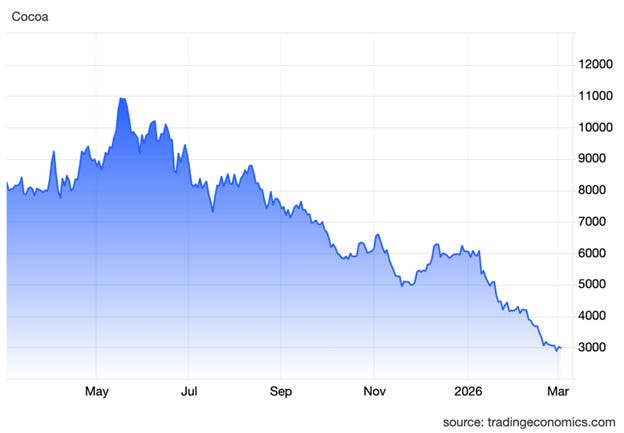
Now the supply situation is much improved, and cocoa prices have collapsed, over the course of a year, falling by 70%. But retail prices for chocolate haven’t moved in the United States or in Europe. That’s to say that the input costs are only a third of what they were two years ago, but the retail prices aren’t going down at all.

The first issue, is that some of the largest confectioners are working through their inventories that were produced before they saw big declines in the cocoa price. They first need to sell those stocks and recover those higher costs, before taking advantage of the new cocoa prices. And that’s not going to happen soon; most of those inventories won’t be cleared until next year—2027.
There are two other conditions in this industry, though, that are far less innocent. “Shrinkflation” and “skimpflation” – there are words we need to start getting used to, as supply chains shift to China and Asia, and Western manufacturers become ever more cunning at maintaining high profit margins. They are continually testing what consumers – the companies’ customers – are willing to tolerate. Shrinkflation means that the product sizes get smaller, while the prices stay the same.
Cadbury is in England, and they reduced their Twirl packs by 25%, but kept the same pricing. For other candies, the sizes dropped by 10%, while prices were either raised or held steady.
So the packages are getting smaller without corresponding decreases in retail price, and that’s the definition of shrinkflation. Skimpflation is a decrease in the quality of the product itself. And here we see some chocolate brands replacing the chocolate entirely.

This is Brad Reese, a superfan of the milk chocolate and peanut butter, and he is the grandson of the inventor. He recently bought a bag, hated it, and went to war against the company. Reese’s Peanut Butter Cups were a product that customers loved for a hundred years, but they replaced the milk chocolate with non-chocolate, and they also switched out the peanut butter. That’s skimpflation–when companies simply use inferior ingredients to cut costs, and hope their customers don’t notice or don’t care.
Brad Reese did notice and did care, but overall these companies have been right, so far. They are substituting milk chocolate with low-cost alternatives, then reducing the package sizes, and thus far chocolate consumers generally just keep buying. What’s strange here is that the legal definition of “milk chocolate” already seems like a pretty low bar. “At least 10% chocolate liquor”, from ground cocoa beans, doesn’t sound like a tough standard to meet.
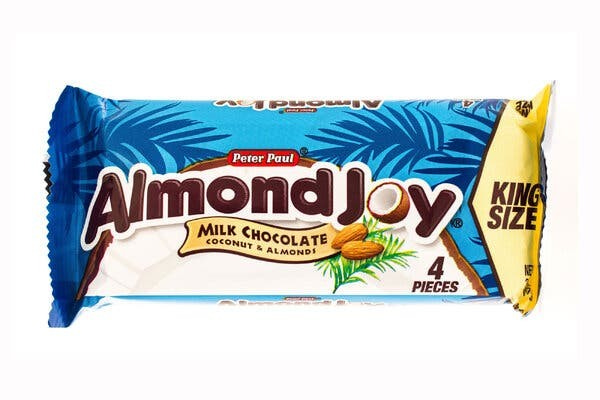
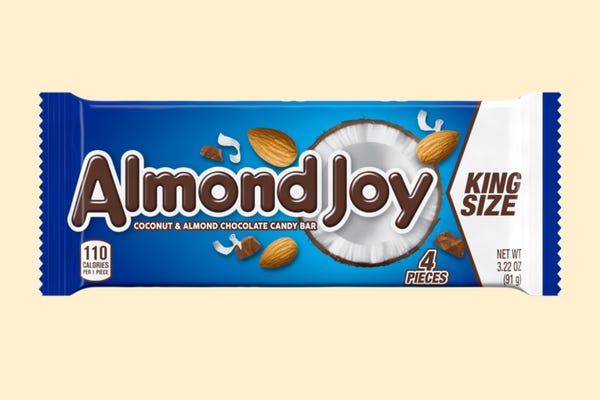
But Almond Joy, Mr. Goodbar and Rolo candies did the same thing Reese’s did—they changed their recipes, and so also had to change the packaging. Mr Goodbar replaced “milk chocolate” with the words “chocolate candy”. Almond Joy went from “Milk Chocolate, coconut & Almonds” to “coconut and almond chocolate candy bar”.
In the food industry, these are called “reformulations”, and an example is the replacement of cocoa butter with cheaper fats and oils.
Over at Nestle, they did the same thing, and Nestle was kind enough to tell us how profitable this practice is. This is Slide 11 of their earnings report from 2024:
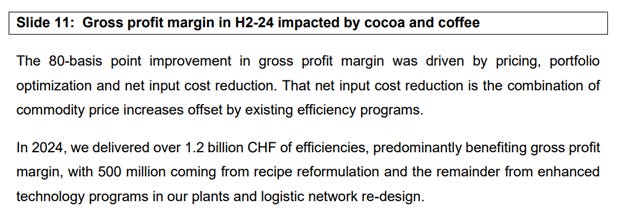
Gross profit margin rose, despite skyrocketing input prices, because of the “net input cost reduction”. 500 million Swiss Francs is over 600 million USD, which came from “Recipe reformulations”. Simply swapping out high-value chocolate with cheaper alternatives added over half a billion dollars in gross profits to Nestle in a single year…
Recently, cocoa prices are falling, sharply. So it shouldn’t be surprising that candy companies are making more money. But that’s not the reason. Chocolate companies in Europe and the United States replaced high-quality milk chocolate with substitute ingredients, and now make candy that tastes so bad that the grandkids of the company founders can’t eat it. They changed the recipes, and what’s more reduced the serving sizes of the products themselves. So now Western companies are making more money than ever, and China is the only place candy buyers can get real chocolate.
Be good.
Resources and links:
Nestle, 2024 FULL YEAR RESULTS TRANSCRIPT
https://www.nestle.com/sites/default/files/2025-02/full-year-results-2024-prepared-remarks.pdf
New York Times, What’s Missing From Your Favorite Chocolate Bar? It May Be Chocolate.
https://www.nytimes.com/2025/10/30/climate/candy-chocolate-cocoa-prices-climate-change.html
Falling Cocoa Prices Won’t Necessarily Mean Cheaper Valentine’s Day Chocolates
https://www.usnews.com/news/business/articles/2026-02-13/falling-cocoa-prices-wont-necessarily-mean-cheaper-valentines-day-chocolates
EXCLUSIVE: Cocoa’s Epic 70% Plunge Should Mean Cheaper Chocolate — So Why Are Americans Still Getting Hit At Checkout?
https://www.benzinga.com/markets/commodities/26/03/50992551/exclusive-cocoas-epic-70-plunge-should-mean-cheaper-chocolate-so-why-are-americans-still-getting-hit-at-checkout
The candy heir vs. chocolate skimpflation
https://www.npr.org/sections/planet-money/2026/03/03/g-s1-111940/the-candy-heir-vs-chocolate-skimpflation
Cadbury and Mars’ popular chocolate packets are SHRINKING - but their prices are not
https://www.dailymail.co.uk/news/article-14436517/cadbury-mars-popular-chocolate-packets-shrinking-prices.html
Inside China / Business is a reader-supported publication. To receive new posts and support my work, consider becoming a free or paid subscriber.
From Inside China / Business via This RSS Feed.