


Bullets:
Tesla is shifting focus in the US market from Electric Vehicles, to the production of humanoid robots.
The company is repurposing a plant in Fremont, California to the manufacture of Optimus humanoids, instead of EV’s.
Supply chains for humanoids run through China, and Tesla is meeting with hundreds of suppliers in China to build an “Optimus Chain” of components, which will be then exported to Fremont for final assembly, and sale to American factories.
Were Tesla to do the R&D and component manufacturing in-house, their total costs would soar, to over $130,000 per unit.
Chinese humanoid companies, such as Unitree, are already in mass production, and sell units at retail prices that are far below Tesla’s expected costs, after Fremont is online.
Inside China / Business is a reader-supported publication. To receive new posts and support my work, consider becoming a free or paid subscriber.
Report:
Good morning.
Humanoid robots will be a gigantic market in the next two decades, and the race is on to lock up supply chains and manufacturing centers for them. Morgan Stanley projects that there may be a billion of them by 2050, and this is a key caveat here: almost all of them will be for industrial applications. Chinese firms are way ahead, and enjoy support from the national and local governments to stay there.
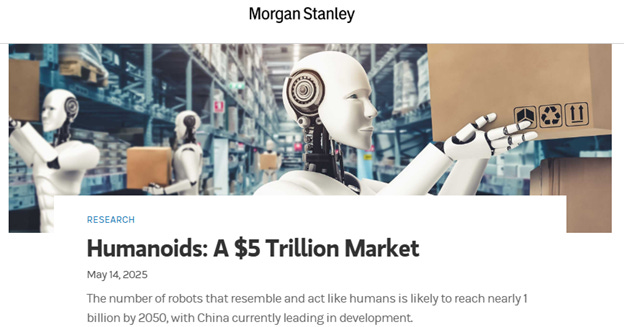
The biggest market for these machines, by far, will be here, in China, where demand will be four times that of the United States. Again, insiders don’t expect household demand to be anywhere close to what factories and industry are calling for.
All of these issues are problems that face Tesla’s plans in the United States. The company wants to pivot from producing electric vehicles in the US, to the manufacture of humanoid robots. The Tesla plant in Fremont is being overhauled to build Optimus robots, with plans to produce a million humanoids a year.
And given what we already know, it’s hard to understand what Tesla’s strategy is. China is where the market for humanoids will be, because China is where the factories are. China is where the production of robots gets government support, right now. Tesla’s plan is to build these “smart machines” that will be the “workforce at American factories”.
The problem is that the supply chains for humanoid robots all run through China, and the stated intention of Tesla is to build robots for American factories that will be in direct competition against factories here. This is the business model, for Tesla: buy parts and components from hundreds of Chinese suppliers, then ship them to Fremont for final assembly and branding, then market them to American factories that will compete against Chinese ones.
The objective for Tesla is to do for humanoid robots what Apple does in consumer electronics: work closely with Chinese R&D scientists and hardware engineers, and develop an “Optimus chain” which include suppliers for motors, bearings, vision and sensory systems, batteries, even the screws that hold everything together.
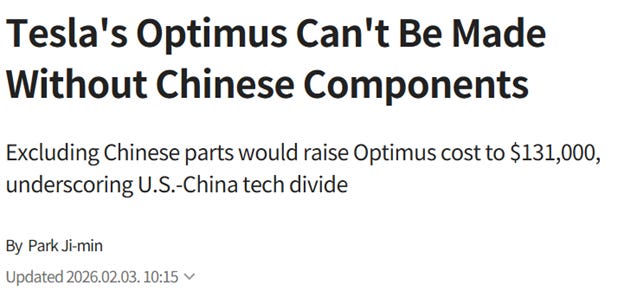
It’s a given that Tesla can’t build anything without Chinese components, at least in a way that would be price-competitive. China is about two thirds of the entire humanoid supply chain. And Tesla, going it alone–building these machines themselves–drives the production cost from $46,000 to over $130,000.
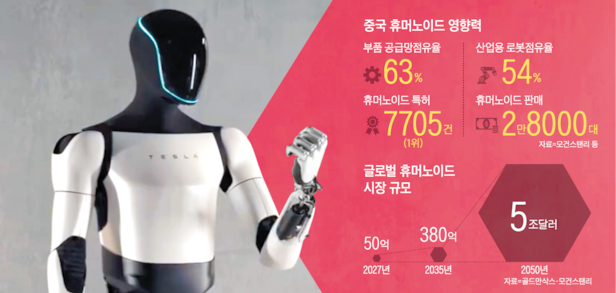
Here is another problem. Conventional wisdom in the United States assumes that the best humanoids will have a US Brain – AI and software coming from Silicon Valley, while the Chinese are producing the dumb parts, the body. China has already won that part of the race. The supply chain for the body is already here, and Unitree’s humanoid models are priced at $16,000 apiece—that is the today’s market price–which is already about one fourth of what Tesla’s costs are projected to be.
There’s a big issue too on the “US Brain” side. Elon Musk spends a lot of time in China, and he knows that Silicon Valley is fooling themselves if they think American AI will be powering these machines. China is ahead in Artificial Intelligence applications for industrial and machine use.
China’s supply chain for humanoids is already developed. The AI and software that run Chinese machines are also developed. The Chinese consumer and industrial markets, the buy-side—those are developing, fast. The costs for Chinese machines are already low, and will probably fall as competitors enter the market here.
Tesla likely believes that US regulators will ban Chinese-built humanoids from the US market, like they do with Huawei or Chinese cars brands, and they will have the whole US market to themselves when they finish renovating Fremont. But that assumes that Chinese regulators will even allow the export of those components, to be later used in US factories. And it further assumes that American factories using Tesla’s Optimus humanoids can be competitive against Chinese factories running China-built ones.
Be Good.
Resources and links:
China supply chain dominance clouds Elon Musk’s bid to build Optimus humanoid robots
https://interestingengineering.com/ai-robotics/chinese-parts-cloud-tesla-humanoid-robot-growth
Tesla’s Optimus Can’t Be Made Without Chinese Components
https://www.chosun.com/english/industry-en/2026/02/03/ANUC5SME6ZDXNDIPYCUFPN3YAU/
‘Optimus chain’: Chinese suppliers form the backbone of Tesla’s humanoid robot initiative
https://www.scmp.com/tech/tech-trends/article/3341953/optimus-chain-chinese-suppliers-form-backbone-teslas-humanoid-robot-initiative
Morgan Stanley, Humanoids: A $5 Trillion Market
https://www.morganstanley.com/insights/articles/humanoid-robot-market-5-trillion-by-2050
Unitree showcases 49 humanoid robots performing synchronized martial arts demo at Temple of Heaven after Spring Festival Gala show
https://www.globaltimes.cn/page/202602/1355607.shtml
Orders for robots surge after China’s Spring Festival Gala
https://asianews.network/orders-for-robots-surge-after-chinas-spring-festival-gala/
Inside China / Business is a reader-supported publication. To receive new posts and support my work, consider becoming a free or paid subscriber.
From Inside China / Business via This RSS Feed.