

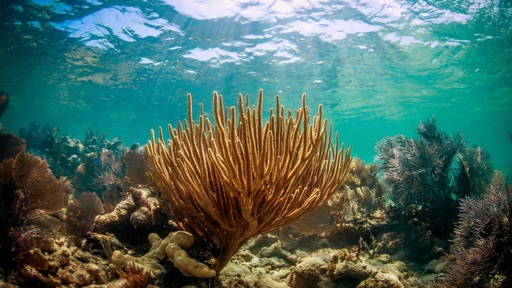
Healthy reefs aren’t just about colorful fish — they also shield shorelines from intense tropical storms. If Florida’s reefs keep degrading, flooding during tropical storms could get much worse, increasing risks to people and costing nearly a billion dollars a year in damage to buildings and economic disruption annually, a new Earth’s Future study finds. Coral reefs act as natural breakwaters, absorbing up to 97% percent of an incoming wave’s energy, with the top of the reef taking the bulk of the impact. Globally, around 200 million people benefit from this kind of natural flood protection, according to a 2014 Nature Communications study. But around the world, coral reefs are in trouble. The most recent bleaching event, driven by record temperatures, hit more than 80% of reefs. Reefs are also battling coral diseases, pollution, microplastics, physical damage and other threats. In the Florida Keys, live coral cover has declined by about 90%, over the last 40 years, according to the U.S. National Oceanic and Atmospheric Administration (NOAA). Degraded reefs aren’t as strong, and crumbling coral means they aren’t as able to cushion the impact of waves. As waves become more forceful, they erode sediment, deepening the seafloor closer to shore. “Waves break relative to their water depth. … Now, all of a sudden, you make that water deeper, that means a bigger wave can come in closer to shore,” says Curt Storlazzi, a researcher at the United States Geological Survey (USGS) and the study’s first author. In a previous study,…This article was originally published on Mongabay
From Conservation news via This RSS Feed.