

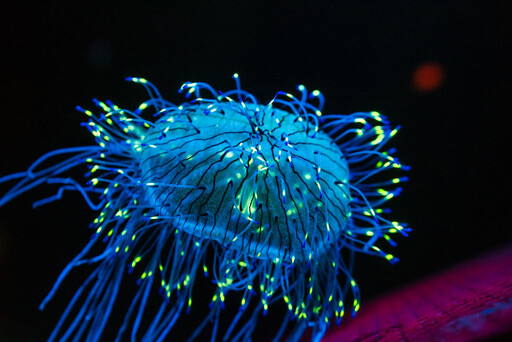
The documentary A Life Illuminated will make its Washington, D.C., premiere on March 19, the first night of the D.C. Environmental Film Festival, where Mongabay is a media partner. The film traces the career arc of U.S. marine biologist Edie Widder, an expert on bioluminescence who’s made headlines for decades, and documents her team’s attempt to capture a remarkable deep-water phenomenon called “flashback” on camera. The film, directed by U.S. documentary filmmaker Tasha Van Zandt, has been on the film festival circuit since September, when it made its world premiere at the Toronto International Film Festival. In the film, Widder meditates on the importance of the deep sea, which usually refers to waters below 200 meters (660 feet) in depth, a zone many experts call the world’s largest habitat. In the deep sea, most creatures can emit light, a trait few land-dwelling animals possess. (Fireflies are a notable exception.) The film’s plot toggles between previous Widder expeditions and a recent one to the waters off the Azores, a Portuguese-administered archipelago in the Atlantic Ocean, to document flashback. The term refers to the way a wide variety of organisms, from the macro to the micro, will simultaneously light up in response to a flash of light from, say, a submersible. Those who’ve witnessed the phenomenon speak about it with awe: Before the flashback, the sea is pitch-black to the human eye, a seeming void. The flashback then envelops the submersible in an ephemeral snowstorm. Edie Widder, a marine biologist and bioluminescence…This article was originally published on Mongabay
From Conservation news via This RSS Feed.