The larvae of the black soldier fly (Hermetia illucens) are considered a promising source of sustainable protein, as they contain high-quality protein comparable to soy protein. They can produce this protein from a wide variety of biomass sources, including by-products and residues from agriculture and food processing. However, while their potential is the subject of intense debate, little is known about the emission of greenhouse gases during their rearing.
From Biology News - Evolution, Cell theory, Gene theory, Microbiology, Biotechnology via This RSS Feed.
You must log in or register to comment.
Roughly 9kg of feed to make 1kg of animal protein (livestock).
Vs 1 kg of feed to make 9kg of insect protein.
IIRC.
So, uhh, genuine question, where does the extra 8kg of mass come from?
Reproduction i would assume
But even with reproduction, the elements for the mass need to come from somewhere. There’s a reason that pregnant women say they are eating for two.
An insect is not a magic mass producing machine, it cannot produce more than it takes in… however, the quality of the food needed for insects is much lower than what’s needed for something like a cow.
Im not an entomologist and im really just spitballing, but maybe it comes from the air like trees?
I jumped down the rabbit hole because I like the idea that insects could harvest carbon from the atmosphere… especially since carbon is required for amino acids. But it looks like that’s not the case (great hypothesis though!)
I did find a reliable source that puts insect food to protein conversion at 2:1, which is still impressive compared to a cow at around 8:1.
From https://www.fao.org/edible-insects/en?hl=en-US#%3A~%3Atext=%232%2Ckg+of+body+weight+gain.
Insects have a high feed conversion efficiency because they are cold-blooded. On average, insects can convert 2 kg of feed into 1 kg of insect mass, whereas cattle require 8 kg of feed to produce 1 kg of body weight gain.
Oh neat! Thanks for sharing
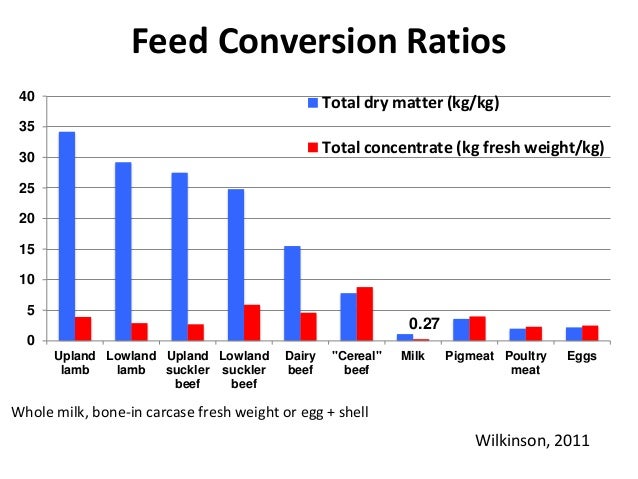
You’re right: nothing produces 9-kg of protein on 1-kg of feed.
Here are some feed-conversion-ratios: https://image.slidesharecdn.com/mikewilkinson-150219083856-conversion-gate01/95/redefining-efficiency-of-feed-use-by-livestock-mike-wilkinson-3-638.jpg?cb=1424335600
Those aren’t protein, those are total, from what I can see.
_ /\ _
Bacteria live on insects. They adhere to them on a substrate of mineralogist carbonate that they get from C02 in air, it’s a significant amount of carbon fixing.
It’s IRRELEVANT if you’re allergic to shellfish/insects/crustaceans.
_ /\ _