

Bullets:
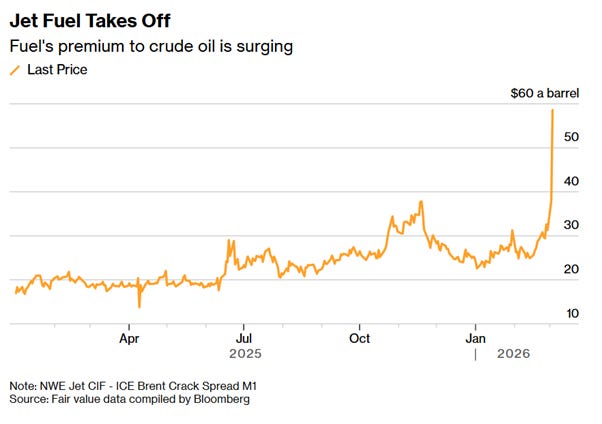
The cost of jet fuel is skyrocketing, and the prices paid to refineries to process crude into fuel is higher than the cost of oil itself.
Tens of thousands of flights across the Middle East have been canceled, and air traffic re-routed to avoid Persian Gulf airspace.
Air travel to the Middle East is highly profitable to airlines, because of the revenue mix from upper-income tourists and business travel.
Western airlines were already at a competitive disadvantage to carriers in East Asia, because of the Russia problem: Asian airlines overfly Russia, saving operations costs and time, while carriers in the US, Canada, and Europe take far longer routes around Russian airspace.
Inside China / Business is a reader-supported publication. To receive new posts and support my work, consider becoming a free or paid subscriber.
Report:
Good morning.
The newest war in the Middle East is only a week old, but it’s already blowing up industries. Global airlines are in big trouble, because of thousands of flight cancelations, a shift of priorities from tourism and business travel to evacuation flights, and skyrocketing costs for jet fuel.
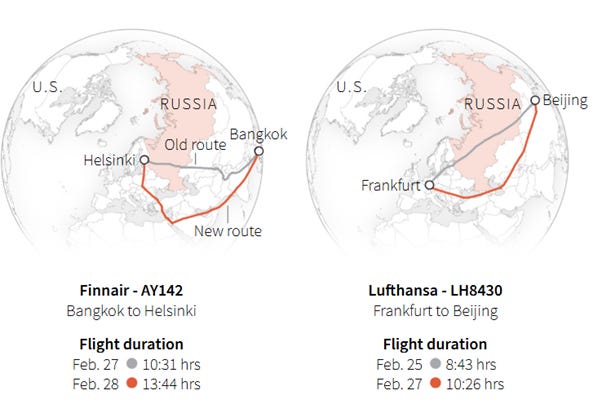
Even before the war, airlines based in Europe and North America were uncompetitive, compared to airlines here in Asia. Those problems came from overflight bans; American, Canadian, and European airlines suspended flights over Russia, which is just enormous, and so flight routes around Russia, over time, add millions of hours and billions in costs for flights that are flown direct by Asian carriers. This map explains that dynamic, with Russia closed, and now Iran:
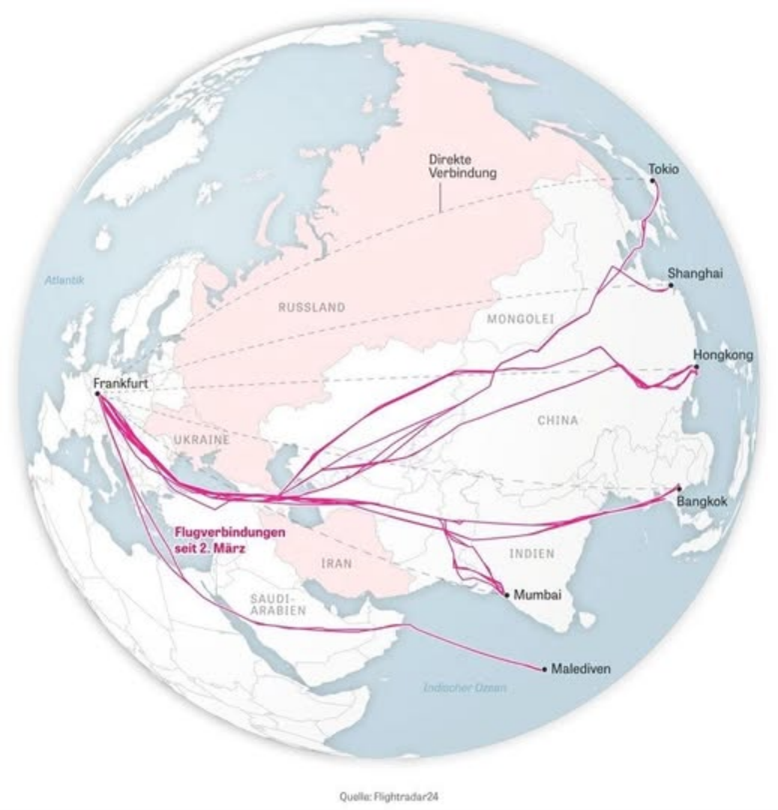
Air traffic to major Middle East hubs has been deeply impacted. In the first several days of the war, 14,000 flights were canceled in the Middle East. That is two thirds of scheduled flights, from the major airports in 10 countries in the region. As of yesterday, and across all airports, over 40,000 flights have canceled, so far. Some carriers have resumed limited operations, but the priority is getting out travelers already stranded, and expatriation flights of diplomats and their families.
Flights by tourists and business travelers into the Middle East has dropped to about zero, so airlines are sending empty planes to those hubs to pick up people with one-way tickets out, tickets which have been already paid for. That’s a huge hit to revenues, because these travelers tend to be high-end, and those travelers and revenues are gone.
Now the carriers have an existential issue on the cost side. Jet fuel accounts for 30% of costs industry-wide, and airlines aren’t making money on tickets previously booked, when prices were lower.
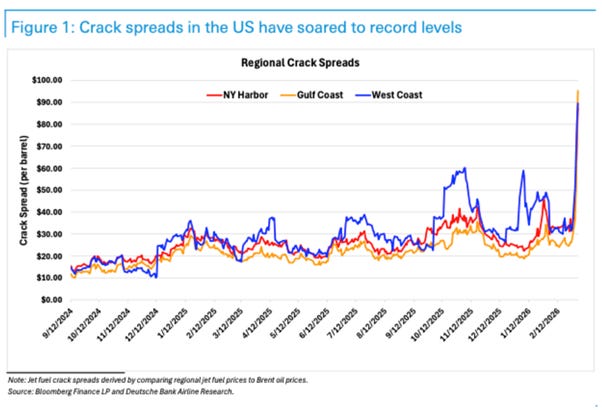
In the United States, the cost to refine crude oil to jet fuel is over $85 a barrel, which is almost as much as the oil itself. 17 February to 5 March is under three weeks, and the price of jet fuel went from $2.28 per gallon to $3.95. These are the regional crack spreads – crack spreads are the premiums to refineries, the difference between the crude oil come in and refined products going out, and the spreads are blowing out everywhere:
Last time something like that happened, was after Hurricanes Ivan and Katrina, which pushed Delta and Northwest Airlines into bankruptcy.
Airline stocks and fuel costs are negatively correlated. The S&P Airlines Index tracks only US airlines, and their shares have fallen 22% since last month.
Airlines do have some tools to reduce their exposure to big price swings in jet fuel. Options contracts and hedging strategies are common in the industry, but those are obviously much more expensive too, now, because it’s much more risky to take the other side of that trade. And American airlines don’t hedge anyway. That means that US airlines are more exposed to the volatility than carriers in Europe, the Middle East, and Africa.
This all puts Western policymakers in a tough spot. Without fast relief, airlines will have no choice but to park their planes. Weaker airlines will go out of business completely. So already there are calls in Europe and the United States to pull crude reserves, out of strategic stockpiles. Doing that, in theory, would free up less expensive oil for airlines that they can then refine into jet fuel.
But this war is just 10 days old, and 20% of the oil trade in the world is bottled up, not moving. Country by country, officials and politicians are deciding, right now, what is the best use of their Strategic crude reserves? And what happens if they draw them down this week to help the airlines, but next week they need to do it again? And next month if they don’t have enough to keep their school buses and fire trucks on the road, let alone what new demand might come from armed forces to keep the war going?
Be good.
Resources and links:
Airlines in Bear Market as Oil Poses ‘Existential’ Threat
https://www.bloomberg.com/news/articles/2026-03-06/airlines-face-existential-threat-from-war-deutsche-bank-says
Lufthansa:Wie kommt man jetzt noch nach Bangkok?
https://www.zeit.de/wirtschaft/2026-03/lufthansa-europa-asien-nahostkrieg-flugverkehr
Jet fuel refining margins are surging to 20-year highs amid Iran war, threatening airlines
https://sherwood.news/markets/jet-fuel-refining-margins-are-surging-to-20-year-highs-amid-iran-war/
Deutsche Bank Warns Energy Shock “Existential Threat” To Airlines, May Force Some To Ground Fleets
https://www.gulf-insider.com/energy-shock-existential-threat-to-airlines/
The hole in the sky: How Middle East airspace closures are reshaping global aviation
https://www.aol.com/articles/hole-sky-middle-east-airspace-170414483.html
Unfriendly skies
https://www.reuters.com/graphics/UKRAINE-CRISIS/AIRLINES/klpykbmropg/
Chinese airlines grab market share from US and European carriers who have to fly around Russia
Germany to release oil reserves in global push to tackle Iran war energy price surge
https://www.reuters.com/business/energy/germany-release-oil-reserves-after-iea-request-minister-says-2026-03-11/
Inside China / Business is a reader-supported publication. To receive new posts and support my work, consider becoming a free or paid subscriber.
From Inside China / Business via This RSS Feed.