

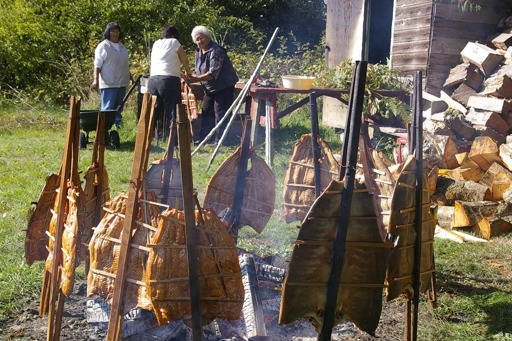

ɬaʔəmen (Tla’amin) Elders cook salmon by a fire. A new cookbook and harvest guide by their nation aims to gather the community’s recipes, stories and tips. Photo courtesy Tla’amin Nation
Denise Smith cherishes her childhood memories of her parents harvesting and preparing traditional ɬaʔəmen (Tla’amin) foods — from hunting deer in the forest, to fishing for perch on their territories, and for cod in the ocean.
Though her mother passed away when she was young, Smith remembers her “being that person that was always doing something with food.”
When her father would bring home deer he’d harvested, “there she would be in the kitchen, cutting this deer up and putting it away,” Smith recalled.
“Always traditional food. We were very fortunate that way.”
Thanks to her upbringing, food security has always been very important to her, both in her work and personal life.
Today, decades later, she is Tla’amin Nation’s director of lands and resources.
In an interview with IndigiNews, she said one of the ways her family preserved food was by canning deer meat, allowing them to store venison for winter months.
Smith’s family recipe involves cutting the deer into stew-sized cubes, and partially cooking it with broth, water, seasonings, and flour — forming a tasty gravy.
The hot venison and gravy mix is then poured into hot jars, covered with lids, and pressure-cooked for 90 minutes.
“It is meat, so it takes quite a bit of time,” she explained. “And it should stay good on your shelf for years.”

Denise Smith, director of lands and resources for Tla’amin Nation, speaks with community members. Photo courtesy Tla’amin Nation
‘Inspired to use a traditional food’
Smith’s canning method is one of the many recipes included in an upcoming Tla’amin community cookbook and harvest guide.
But until now, her jarred venison recipe isn’t something she had ever written down.
She simply remembers how it’s made from her mother, who herself learned it from previous generations.
“I believe she got the recipe from her mother … my grandmother Lily,” Smith said.
“Back then, we didn’t have freezer space, and she wanted a way to make sure that the food was going to last.”
The Tla’amin cookbook emerged from a series of workshops the nation held about traditional foods, starting two years ago, led by community experts.
Topics included shellfish harvesting, mushroom picking, and canning, said Emma Morgan-Thorp, a skills and training co-ordinator with Tla’min Nation.
As the session series came to an end, community members wanted to document all the skills and recipes they’d learned in one book, she said.

Multiple generations of Tla’amin members help prepare apples in a community kitchen. Photo courtesy Tla’amin Nation
Based on the nation’s 13-moon calendar, the cookbook and harvesting guide that resulted is something Morgan-Thorp said is “joyful and exciting” to share.
But it is much more than simply a record of what participants shared in the workshops, Morgan-Thorp emphasized, but rather the “vision and the feeling” of the events.
She hopes the project will “capture the way that folks are enjoying traditional foods with their families, then share that around — so that people have each other’s recipes or know each other’s harvest stories, or just are inspired to use a traditional food that they’re not already using.”
The initiative was a team effort, Morgan-Thorp said, which involved inviting community members to submit recipes and stories, interviewing experts, and planning out the book.
It also features a QR code that readers can scan with their smartphone to see video tutorials.
“Folks can see the people talking about their recipes or their harvest stories,” she said.

Tla’amin members work together to can and preserve fish in a community kitchen. Photo courtesy Tla’amin Nation
Food teachings ‘not yours to keep, you have to share’
As a čičyɛ (grandmother), Smith said she’s excited to be included in the cookbook — so her grandchildren can “pick up that cookbook in the future and see their čičyɛ in there.”
“It’s important that we keep these things happening,” she said.
“We share what we know; I remember my dad and my grandparents saying that ‘what we teach you is not yours to keep, you have to share that.’”
That ancestral lesson applies to everything from basket-weaving to fish-cutting and food preparation, she said.
“It’s just really important that we share what we know … in a fun way,” she said. “The cookbook is a fun thing, and it’ll be exciting to see and share those recipes.”
The cookbook is still in its draft phase, Morgan-Thorp said. Its contents are laid out in alignment with the 13 lunar months, grouped into four seasons.
For example, the section about springtime will include an explanation of what the spring moons are, and an overview of foods that can be harvested or cooked at that time of year.
The next step is to send the draft to expert harvesters in Tla’amin, to see if any changes need to be made — such as if the availability of traditional foods due to which may have been impacted by climate change or colonialism.

Harvested herring eggs cling to evergreen branches. Photo courtesy Tla’amin Nation
For example, Smith remembers harvesting herring eggs with her children. But today, the species doesn’t spawn in the community any more.
“I have a lot of fond memories of harvesting and gathering,” she said, “being able to go right down the beach here in Tišosem and get herring eggs.”
Back in the day, she said, herring would spawn in huge numbers right offshore from her oceanfront home on Tla’amin Nation, on the upper Sunshine Coast.
In fact, it is where Tišosem village got its name; in the ʔayʔaǰuθəm language it means “milky waters from herring spawn.”
Her family and others in the community would collect the herring roe.
There were once so many eggs that her mother would have to say, “OK, that’s enough, we can’t handle any more herring eggs now,” Smith recalled.
“It’s really sad because now, we can’t even get a herring spawn in front of our community anymore.”

Tla’amin members harvest clams on their territories. Photo courtesy Tla’amin Nation
Morgan-Thorp hopes to have the cookbook printed by May, when copies can be given to families who took part.
And Tla’amin Nation plans to offer a free digital version online to anyone wanting to learn about traditional foods.
“With the cookbook and harvest guide … there are so many different people who have amazing recipes or have tips about how to harvest different things,” she said.
“It’s just this community and all of these exciting, vibrant skills that everybody’s sharing that makes it all such an exciting project.”
For Smith, the project was a chance to celebrate the importance of Tla’amin foods — and a lifetime of memories from harvesting them
When her own kids were young, she and her father took them to harvest clams at low tide.
She’ll never forget her children’s enthusiasm for every clam — it was like an Easter egg hunt.
“‘I found one!’” she remembers them exclaiming.
“That’s how they were with these clams, and they’re just so excited.”
The post Food security and community memories are the key ingredients of a new Tla’amin cookbook appeared first on Indiginews.
From Indiginews via This RSS Feed.