


This story was originally published by The Imprint.
Nancy Marie Spears
The Imprint
Controversy surrounding a publicly financed report in Michigan on the brutal impact of Indian boarding schools continues to grow.
In a subcommittee hearing late last month, state lawmakers demanded clarity about why the state’s Department of Civil Rights failed to release the 300-page taxpayer-funded report. The report was recently made public by nonprofit media outlet Bridge Michigan, which first broke the story.
But that clarity remains elusive.
Similar to other boarding school investigations, the report uncovered rampant child abuse in Indian boarding schools in Michigan, ranging from beatings and starvation to rapes and death.
“The history of Native American boarding schools in Michigan is deeply enmeshed within the broader colonial policies of the United States,” the once-buried report by a prominent Native-led research firm states. “Despite the treaties that promised education, the boarding schools ultimately served as a mechanism of colonization, with the explicit goal of assimilating Native children into Euro-American society, often through coercion and force.”
A range of recommendations are proposed as remedies. One calls for a lifting of the statute of limitations for childhood sexual and physical assault. Other suggestions include a formal apology by the state of Michigan, and the return of children’s remains to tribal nations.
In what could be the first of several public hearings, the meeting revealed few answers. Rep. Thomas Kuhn, chair of the appropriations subcommittee, said representatives from the state Attorney General’s Office declined to attend. Michigan’s Department of Civil Rights also declined to attend as it weighs potential lawsuits to recoup the costs of the report.
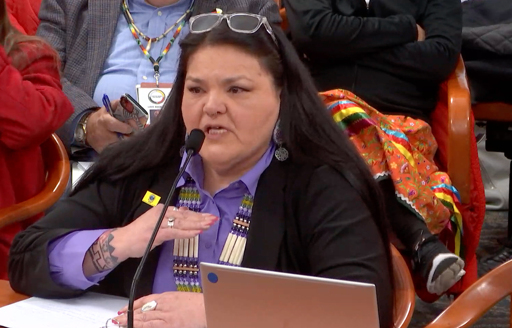
Instead, committee members heard from the Washington-based, Native American-led consulting firm Kauffman and Associates — which produced the $1.1 million report — as well as from boarding school survivors who described a range of concerns.
According to public testimony from the hearing and interviews with The Imprint, some critics say the report should not be released because it doesn’t reflect what the study set out to accomplish:toinvestigate Michigan boarding schools and local government involvement. Some also said it would only re-traumatize survivors.
Others said they believe the burying of the report represents an intentional attempt to erase this history.
“It’s beyond ridiculous,” said Marilyn Wakefield, who spent six years at Holy Childhood School of Jesus — the first federally run Indian boarding school in Michigan. She said she and other survivors she knows are outraged about what they consider a bitter truth some would rather forget. “It’s unfair to the survivors and descendants who were part of this report.”
Five Indian boarding schools in Michigan were operated by the federal government. The earliest opened in 1823. The last closed in 1983. According to the report obtained by local media, Michigan is “the only state where the federal government entered into an agreement that transferred full responsibility for Native education to the state without further federal cost.”
The state appropriated more than $1 million for the report in 2023. It was meant to examine Michigan’s boarding school history and “how the State of Michigan contributed to this system,” according to a letter from Department of Civil Rights Executive Director John Johnson Jr.
The report was set to be released in September, but the state asserted to lawmakers months later that the final product produced by Kauffman and Associates, Inc. (KAI) was not substantive enough to be released.
The consulting firm maintains it was asked to chop the initial report to 50 pages, and to remove references to local government involvement, according to Bridge Michigan reporting.
“Limiting our role in this way was consequential,” Jo Ann Kauffman, the firm’s president and founder and a Nez Perce tribal member testified at last month’s hearing, adding that the state gave no explanation for the restrictive requests. “This request undermined KAI’s ability to make the data meaningful, responsible and usable,” she said.
Kauffman founded her consulting firm in 1990, and she is described by Washington’s secretary of state as a champion of Indian health and justice. Her firm consults on issues from tribal affairs and education to behavioral and public health. Since 2002, it has held $136 million in federal contracts and grants, offering support to tribes and states working on environmental protection, suicide prevention and a response to the opioid epidemic.
The full report centers on survey responses from 30 living survivors and 165 descendants of survivors. Information was gathered through archival research, academic literature reviews and community forums. The latter included talking circles, formal interviews and questionnaires online and in print.
Participants in some cases received stipends for their involvement — a sticking point for one survivor, whose grandparents also attended out-of-state boarding schools.
“Having boarding school survivors and their descendants participate for $100 — that doesn’t even cover therapy if they choose to have it later,” said Meredith Migizi in a phone interview. She is the founder and executive director of Miigwech Inc., a nonprofit organization promoting “Mino-Bimaadiziwin” — which translates to “the good life” — for all Indigenous communities in Michigan. Migizi, a member of Little Traverse Bay Bands of Odawa Indians, went to Holy Childhood as a day student until it closed in 1983. “So here we have communities which, once again, are asked to relive these things, and it just reads as trauma porn in the worst way.”
In written testimony, Migizi urged the subcommittee to not release the report, because the “foundational research” that was promised wasn’t delivered.
Winnay Wemigwase, Little Traverse Bay Bands’ tribal chairperson, also attended Holy Childhood as a day student. She testified that she revoked her consent to participate in the study after a snippet of her two-hour-long video interview appeared in a trailer “like a major motion picture,” without her consent. Her part of the trailer was ultimately removed, and her results were omitted from the report.
“It felt very sensationalized,” Wemigwase said at the hearing.
For Wakefield, a member of Sault Ste. Marie Tribe of Chippewa Indians, the fight for healing is never over.
“It is unbelievable to me, the depths of evil this has caused children through their whole lives that are now adults,” Wakefield said. “They took a lot from us, but they didn’t take our voices. We’re not going to stop speaking out until we get justice.”
The post Michigan lawmakers and boarding school survivors speak out on shelved Indian boarding school report appeared first on ICT.
From ICT via This RSS Feed.